Axiom-4 human spaceflight mission and ISRO astronaut training
Source:The Hindu ↗
Why It Matters
India's participation in the commercial Axiom-4 mission serves as a critical stepping stone and training opportunity for ISRO astronauts ahead of the Gaganyaan mission, underscoring growing international and public-private partnerships in space exploration.
Summary
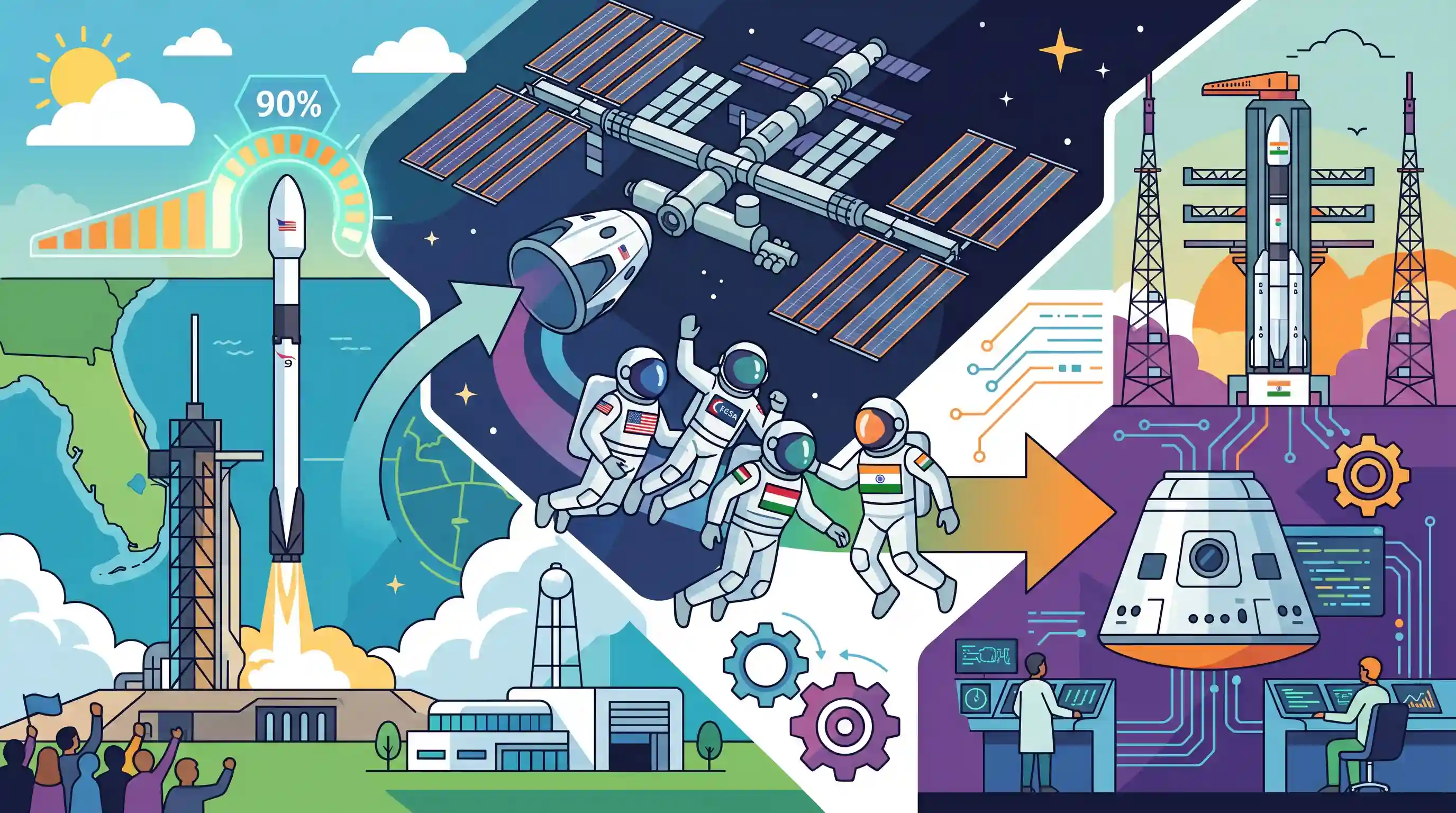
SpaceX has announced that the weather is 90% favorable for the launch of the private Axiom-4 (Ax-4) mission to the International Space Station (ISS). The mission will lift off from NASA's Kennedy Space Centre in Florida. The international four-member crew notably includes ISRO astronaut Shubhanshu Shukla, alongside astronauts from the United States, Poland (ESA), and Hungary. This mission marks a significant milestone in international space collaboration and provides crucial operational experience for India's indigenous human spaceflight program.
Key Points
- The Axiom-4 (Ax-4) mission is scheduled to launch to the International Space Station (ISS) utilizing a SpaceX transport vehicle.
- The crew features Indian astronaut Shubhanshu Shukla representing ISRO, which acts as valuable preparation for India's upcoming Gaganyaan human spaceflight mission.
- The multilateral crew also includes former NASA astronaut Peggy Whitson, ESA astronaut Slawosz Uznanski-Wisniewski, and Hungarian astronaut Tibor Kapu.
- The launch will take place from Launch Complex 39A at NASA\'s Kennedy Space Centre in Florida.
Important Terms
Axiom-4 mission (Ax-4)

A private astronaut mission to the ISS featuring ISRO's Shubhanshu Shukla; it provided India with critical operational experience in crewed missions and international space station docking.
UPSC context
GS III (Science & Tech); tests knowledge of international space collaborations and India's global human spaceflight participation.
Gaganyaan
India's first indigenous human spaceflight program aiming to send a 3-member crew to Low Earth Orbit (400 km) for 3 days and return them safely to Earth.
UPSC context
GS III (Science & Tech); core topic for indigenization of technology and major Indian scientific achievements.
ISRO (Indian Space Research Organisation)
India's national space agency responsible for the development of space technology, satellite communications, planetary exploration, and the indigenous human spaceflight program.
UPSC context
GS III (Science & Tech); central agency for all space-related policy and technological developments in India.
SpaceX
An American private aerospace manufacturer providing launch services (Falcon 9) and spacecraft (Dragon) for NASA and private missions like Axiom-4.
UPSC context
GS III (Science & Tech); highlights the transition toward commercial spaceflight and reusable rocket technology.
International Space Station (ISS)
A habitable artificial satellite in Low Earth Orbit where international crews conduct scientific research in microgravity; operated by NASA, Roscosmos, ESA, JAXA, and CSA.
UPSC context
GS III (Science & Tech); relevant for understanding international research facilities and global scientific cooperation.
Axiom Space
An American private company facilitating commercial space travel and building commercial modules for the ISS to expand human activity in space.
UPSC context
GS III (Science & Tech); represents the 'NewSpace' era and private sector's role in space infrastructure.
Low Earth Orbit (LEO)
An orbit around Earth at an altitude of 160 to 2,000 km; the primary location for most satellites, the ISS, and human spaceflight missions.
UPSC context
GS III (Science & Tech); fundamental orbital concept for satellite communication and human spaceflight operations.
Prelims Trap
"Axiom-4 is a joint NASA-ISRO government space mission."
Axiom-4 is a commercial, private mission operated by Axiom Space using SpaceX hardware. While it carries ISRO/ESA astronauts, it is not a traditional government-to-government NASA mission.
Static Concepts Connected
What are the core components of India's Gaganyaan Mission?
- Launch Vehicle: Uses the Human-rated LVM3 (HLVM3), featuring solid, liquid, and cryogenic stages.
- Orbital Module: Comprises the habitable, pressurized Crew Module (CM) and the unpressurized Service Module (SM).
- Crew Escape System: An emergency abort system designed to pull the Crew Module away from the launch vehicle during anomalies.
What is the legal and operational nature of the Artemis Accords?
- Non-binding Framework: A US-led multilateral arrangement establishing principles for the peaceful exploration of space and the Moon. It is not a legally binding treaty.
- Strategic Alignment: India signed in 2023, marking a shift towards deeper US-India space cooperation and directly enabling the Ax-4 ISS mission.
Cross-Topic Patterns
Artemis Accords & Tech Diplomacy
The Ax-4 ISRO seat is a direct outcome of the 2023 iCET and Artemis Accords signing, linking space exploration with strategic US-India geopolitical alignment.
Space Biology & Life Support
ISRO's Ax-4 microalgae and plant growth experiments directly connect to GS-3 biotechnology and the development of self-sustaining life support for the future Bharatiya Antariksha Station (BAS).

Expect a 2026 Prelims pair-matching question linking specific commercial space missions (Axiom, Polaris) to their objectives or ISRO ties.
Linked PYQs · 3
Linked PYQs · 3
- 2025PrelimsGS1
Consider the following space missions : I. Axiom-4 II. SpaDeX III. Gaganyaan How many of the space missions given above encourage and support micro-gravity research?
- 2019MainsGS3
What is India's plan to have its own space station and how will it benefit our space programme?
- 2017MainsGS3
India has achieved remarkable successes in unmanned space missions including the Chandrayaan and Mars Orbitter Mission, but has not ventured into manned space missions. What are the main obstacles to launching a manned space mission, both in terms of technology and logistics? Examine critically.
