Allahabad High Court Rules on Essential Religious Practice Doctrine
Source:The Hindu ↗
આ શા માટે મહત્વનું છે
The judgment is crucial for understanding the evolving jurisprudence around the 'essential religious practices' doctrine and the balance between individual religious freedom (Article 25) and institutional regulations (secularism and discipline). It frequently appears in GS Paper 2 discussions on constitutional morality and fundamental rights.
સારાંશ
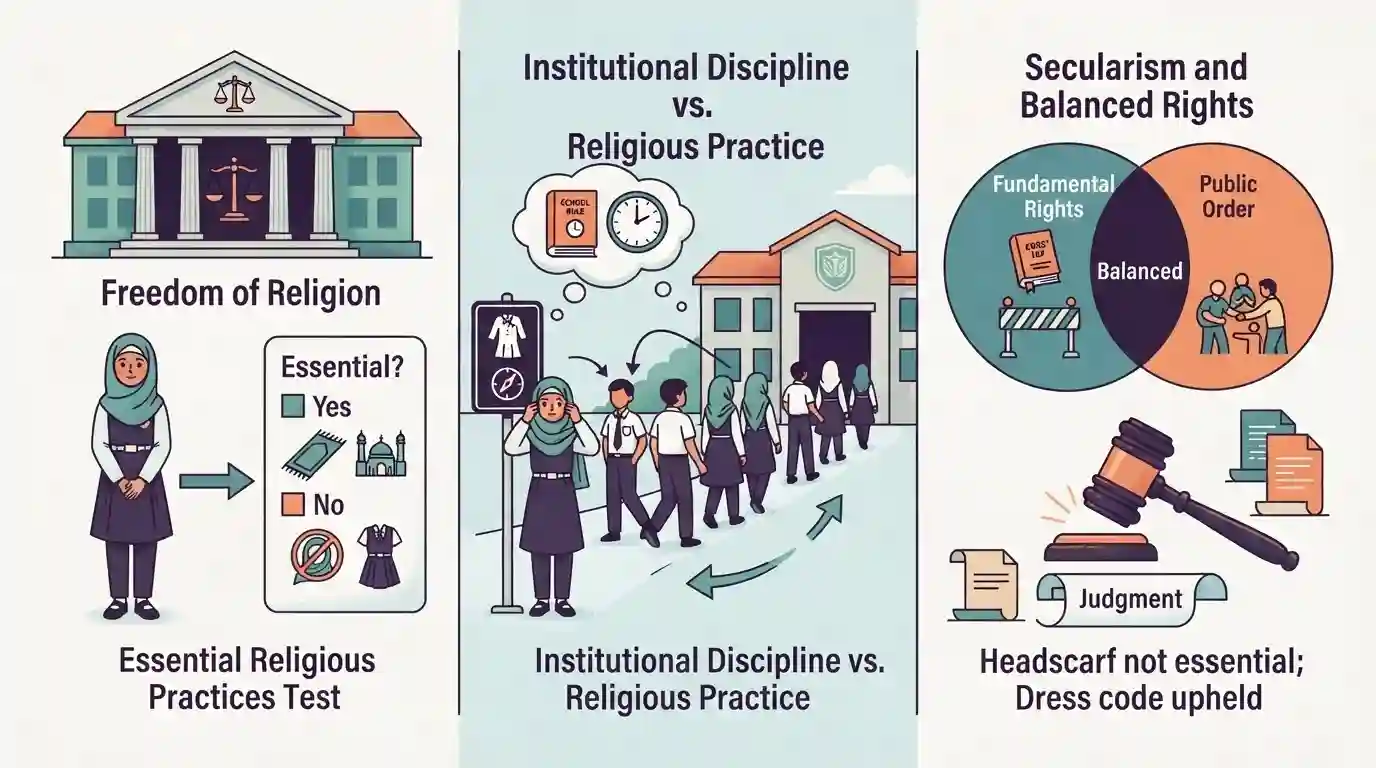
The Allahabad High Court has ruled that wearing a headscarf is not an "essential religious practice" in Islam, dismissing a Muslim student's petition to wear one with her school uniform in Prayagraj. The court emphasized that the dispute centered around adherence to an institutional dress code rather than the infringement of religious freedom. Citing precedents from the Bombay and Karnataka High Courts, the judgment reiterated that the right to freedom of religion under Article 25 is not absolute and must balance with institutional discipline and public order.
મુખ્ય મુદ્દા
- The Allahabad High Court ruled that wearing a headscarf (hijab) is not established as an "essential religious practice" for women in Islam.
- The court dismissed a petition by a Muslim student from Prayagraj who sought permission to wear a hijab with her school uniform, stating the issue pertained to institutional discipline, not interference with faith.
- Justice Shekhar B. Saraf noted that fundamental rights under Article 25 are subject to public order, morality, and health, and do not override a secular institution\'s uniform dress code.
- The judgment relied on similar rulings by the Bombay High Court and the Karnataka High Court, reaffirming the "essential religious practices" test in constitutional law.
મહત્વપૂર્ણ શબ્દો
Article 25

A constitutional provision guaranteeing freedom of conscience and the right to freely profess, practice, and propagate religion, subject to public order, morality, and health.
UPSC context
GS Paper II (Polity). Tests fundamental rights, freedom of religion, and limits on state intervention.
Article 19(1)(a)
A fundamental right guaranteeing all citizens the freedom of speech and expression, subject to reasonable restrictions like public order, decency, and morality.
UPSC context
GS Paper II (Polity). Tests fundamental freedoms, personal expression, and their intersection with institutional discipline.
Article 14
A constitutional right guaranteeing equality before the law and equal protection of the laws, prohibiting state discrimination based on religion, race, caste, sex, or birthplace.
UPSC context
GS Paper II (Polity). Tests right to equality, non-arbitrariness, and non-discrimination in state-enforced rules.
Karnataka High Court
The highest judicial body of Karnataka, which famously ruled in 2022 that wearing a hijab is not an essential religious practice in Islam.
UPSC context
GS Paper II (Judiciary). Tests critical precedents on religious practices, judicial tests, and institutional uniformity.
Allahabad High Court
The highest court in Uttar Pradesh, which in August 2026 dismissed a student's plea to wear a headscarf, upholding the school’s uniform policy.
UPSC context
GS Paper II (Judiciary). Tests judicial rulings on secularism, dress codes, and application of the essential religious practices test.
Bombay High Court
The high court with jurisdiction over Maharashtra and Goa, whose previous rulings (like Fathema Hussain Sayed) upheld institutional dress codes over religious claims.
UPSC context
GS Paper II (Judiciary). Tests judicial consistency and historical high court precedents on secular rules in educational institutions.
પ્રિલિમ્સ ટ્રેપ
The Constitution of India explicitly protects 'essential religious practices' under Article 25.
The ERP doctrine is nowhere mentioned in the Constitution. It is a judicial innovation introduced by the Supreme Court in the 1954 Shirur Mutt case.
સંલગ્ન સ્થિર ખ્યાલો
What is the Essential Religious Practices (ERP) Doctrine?
- Judicial Origin: Propounded by the Supreme Court in the 1954 Shirur Mutt case to differentiate between secular and religious activities.
- Core Protection: Constitutional protection under Article 25 is only granted to practices that are absolutely core and integral to a religion.
- Court's Prerogative: The courts, not religious leaders, determine what is 'essential' by examining religious texts, tenets, and historical practices.
What are the explicit Constitutional restrictions on Article 25?
- Primary Caveats: The right is explicitly subject to public order, morality, health, and other provisions of Part III (Fundamental Rights).
- Secular Regulation: Article 25(2)(a) allows the State to regulate economic, financial, political, or other secular activities associated with religious practice.
- Social Reform: The State retains the power to enact laws for social welfare and reform, such as temple entry rights.
આંતર-વિષય પેટર્ન
ERP Doctrine and the UCC Debate
The judicial narrowing of what constitutes an "essential" practice clears constitutional roadblocks for a Uniform Civil Code (Article 44) by separating secular civic laws from core religious tenets.
Contrasting Indian vs. French Secularism
Unlike France's 'Laïcité' which bans all conspicuous religious symbols in state schools, India's 'principled distance' allows religious attire unless it explicitly violates institutional discipline or public order.

Expect a multi-statement Prelims question contrasting the judicially evolved 'ERP test' with explicitly written Constitutional limits.
સંલગ્ન PYQ · 3
સંલગ્ન PYQ · 3
- 2024MainsGS2
Discuss India as a secular state and compare with the secular principles of the US constitution.
- 2019MainsGS2
What can France learn from the Indian Constitution's approach to secularism?
- 2024PrelimsGS1
Under which of the following Articles of the Constitution of India, has the Supreme Court of India placed the Right to Privacy ?
