Internal Security and Insurgency Challenges in Northeast India
Source:Indian Express ↗
Why It Matters
The recovery of looted weapons in Manipur is a direct case study for UPSC aspirants on the ongoing internal security challenges in Northeast India. It highlights the complexities of ethnic violence, the dangers of arms proliferation from looted armouries, and the indispensable role of joint operations between state police and CAPFs in restoring public order and securing vulnerable areas.
Summary
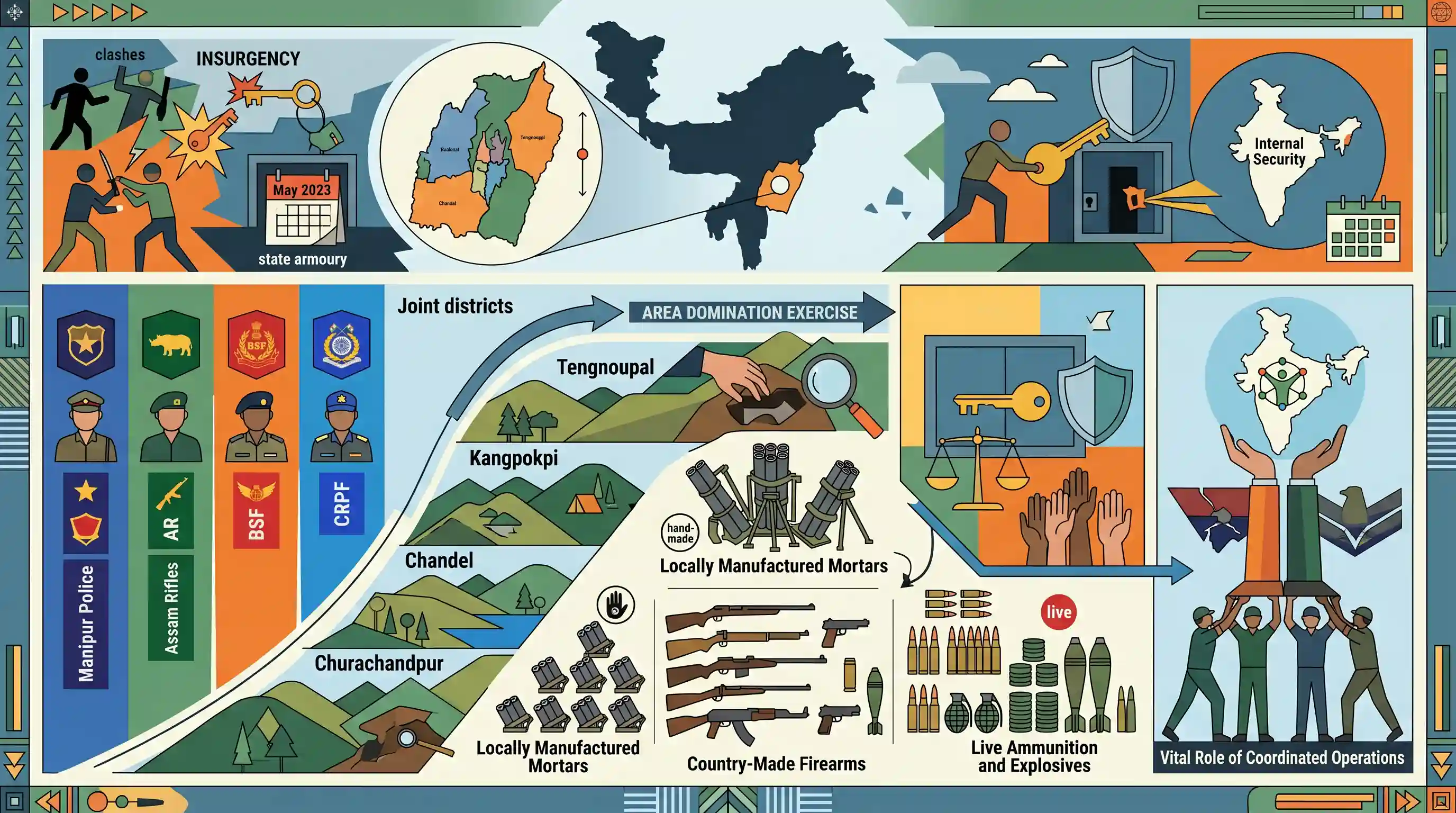
Joint operations by the Manipur Police and Central Armed Police Forces (CAPFs), including the Assam Rifles, BSF, and CRPF, led to the recovery of a massive cache of weapons and explosives across several hill districts in Manipur. The recovered arsenal includes locally manufactured mortars, country-made firearms, and live ammunition, found in districts like Tengnoupal, Kangpokpi, Chandel, and Churachandpur. These area domination exercises aim to recover the thousands of weapons looted from state armouries during the ethnic clashes that began in May 2023, underscoring the ongoing internal security challenges and the vital role of coordinated security operations in the state.
Key Points
- A large cache of weapons, explosives, and ammunition was recovered from the hill districts of Manipur by joint security forces.
- The operations were conducted in fringe and vulnerable areas of Tengnoupal, Kangpokpi, Chandel, and Churachandpur districts.
- The recoveries included locally made mortar (pompi) guns, country-made pistols, explosives, live ammunition, and tear smoke grenades.
- These operations are part of the ongoing effort to recover over 6,000 weapons looted from state armouries during the ethnic violence that broke out on May 3, 2023.
- The search operations highlight the critical role of coordinated efforts between state police and Central Armed Police Forces (Assam Rifles, BSF, CRPF) in restoring internal security.
Important Terms
Central Armed Police Forces (CAPF)

A group of seven security agencies under the Ministry of Home Affairs (MHA) responsible for border guarding, internal security, and counter-insurgency operations across India.
UPSC context
GS Paper III (Internal Security); tests mandates of various security forces and their role in maintaining national stability.
Assam Rifles
India’s oldest paramilitary force, primarily responsible for guarding the Indo-Myanmar border and conducting counter-insurgency in the North-East under dual MHA and Army control.
UPSC context
GS Paper III (Security Forces); crucial for topics on North-East insurgency and managing porous international borders.
Central Reserve Police Force (CRPF)
India's largest CAPF and premier internal security force, tasked with assisting states/UTs in law-and-order maintenance, counter-insurgency, and handling civil unrest.
UPSC context
GS Paper III (Internal Security); tests the role of central forces in supporting civil administration during disturbances.
Border Security Force (BSF)
India's primary border guarding organization for the Pakistan and Bangladesh borders, acting as the "First Line of Defence" against infiltration and trans-border crimes.
UPSC context
GS Paper III (Border Management); tests challenges in managing India's diverse and often porous international boundaries.
Area Domination Exercise
Tactical security operations involving intensive patrolling and visible presence to establish control over a region and deter hostile elements or insurgent activities.
UPSC context
GS Paper III (Internal Security); refers to operational strategies used by security forces in conflict-prone or insurgent-affected areas.
Insurgency in North-East India
Protracted security challenges involving ethnic conflicts and separatist movements in India's North-Eastern states, requiring coordinated military, paramilitary, and police responses.
UPSC context
GS Paper III (Internal Security); tests understanding of regional dynamics, ethnic tensions, and government counter-insurgency policies.
Prelims Trap
"Assam Rifles operates under the sole administrative and operational control of the Ministry of Defence."
Assam Rifles is uniquely under dual control: administrative control rests with the MHA, while operational control is with the Indian Army under MoD.
Static Concepts Connected
What is the mandate and control structure of the Assam Rifles?
- Border Guarding: It is the primary force responsible for guarding the porous 1,643 km Indo-Myanmar border.
- Dual Control: Administrative control lies with the Ministry of Home Affairs (MHA), while operational control rests with the Indian Army (MoD).
- Counter-insurgency: It actively conducts anti-insurgency and internal security operations in the North-East alongside regular armed forces.
What was the Free Movement Regime (FMR) along the Indo-Myanmar border?
- Historical Mandate: A bilateral arrangement allowing border-dwelling ethnic tribes to travel up to 16 km across the border without a visa.
- Suspension: India suspended the FMR to curb illegal immigration, illicit arms smuggling, and cross-border insurgency.
- Smart Fencing: The FMR's suspension is being coupled with a major infrastructure push to fence the entire un-demarcated Indo-Myanmar border.
Cross-Topic Patterns
Geography shaping ethnic conflict
The Meitei-Kuki ethnic conflict maps directly onto Manipur's topography, contrasting the densely populated Meitei-dominated Imphal Valley with the sparsely populated Kuki/Naga-dominated surrounding hill districts.
Golden Triangle & Border Security
Scrapping the Free Movement Regime intertwines India's border management strategy with the fight against narco-terrorism and arms smuggling emanating from Myanmar's Golden Triangle.

Expect a Prelims match-the-following on CAPF border mandates, specifically testing the dual-control anomaly of the Assam Rifles.
Linked PYQs · 4
Linked PYQs · 4
- 2017MainsGS3
The North-East region of India has been infested with insurgency for a very long time. Analyze the major reasons for the survival of armed insurgency in this region.
- 2019MainsGS3
Cross-border movement of insurgents is only one of the several security challenges facing the policing of the border in North-East India. Examine the various challenges currently emanating across the India-Myanmar border. Also, discuss the steps to counter the challenges.
- 2020MainsGS3
Analyze internal security threats and transborder crimes along Myanmar, Bangladesh and Pakistan borders including Line of Control (LoC). Also discuss the role played by various security forces in this regard.
- 2023MainsGS3
What are the internal security challenges being faced by India? Give out the role of Central Intelligence and Investigative Agencies tasked to counter such threats.
