NATO reinforces eastern flank following airspace violation in Poland
Source:Indian Express ↗
Why It Matters
Highlights the growing risk of the Russia-Ukraine conflict spilling over into neighboring NATO territories, testing collective defence commitments and the efficacy of international institutions like the UN Security Council in maintaining global security.
Summary
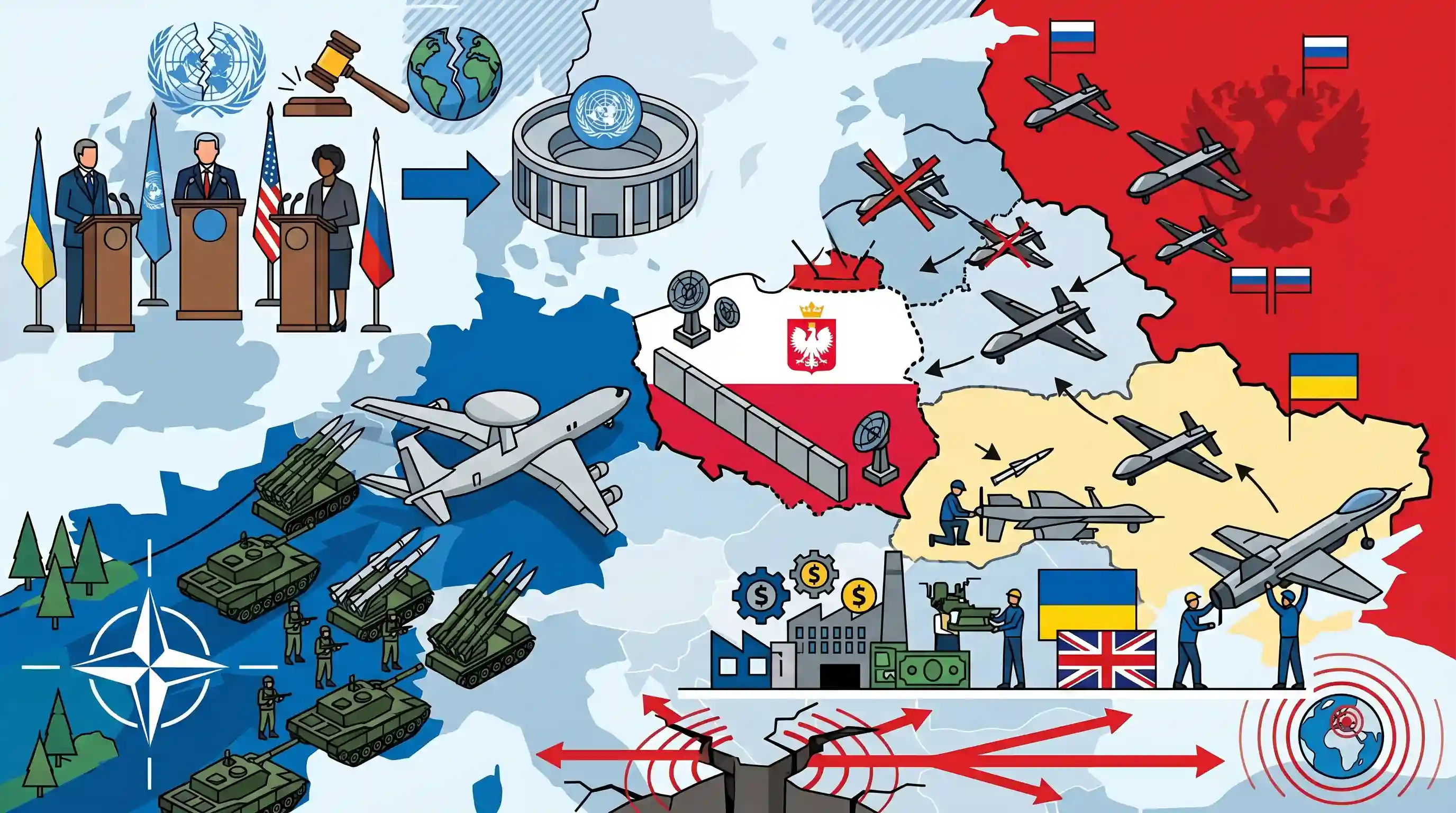
Following the entry of Russian drones into Polish airspace during strikes on Ukraine, NATO has announced plans to reinforce its eastern flank with new air-defence and surveillance assets. European and US leaders strongly condemned the incursions as violations of international law and the UN Charter, prompting an emergency UN Security Council meeting. The incident has raised fears of the conflict spilling over, leading Poland to accelerate its military modernisation and Ukraine to develop interceptor drones in collaboration with the UK.
Key Points
- Russian drones breached the airspace of NATO-member Poland during attacks on Ukraine, prompting NATO to scramble fighter jets for interception.
- In response to the incursion, NATO is reinforcing its eastern flank with advanced intelligence, surveillance, and reconnaissance (ISR) platforms and air-defence frigates.
- The violation of Poland's airspace was widely condemned by Western leaders as a breach of international law and the UN Charter, leading to an emergency UN Security Council meeting.
- Poland is accelerating its military modernisation with the acquisition of F-35 fighter jets, while Ukraine works with the UK to produce specialized interceptor drones.
- European leaders warned that the incident marks a potential new, escalated phase of the conflict, blurring the line between war and peace.
Important Terms
NATO

An intergovernmental military alliance established in 1949 by the North Atlantic Treaty, primarily focused on collective defense (Article 5) and security cooperation among its North American and European members.
UPSC context
GS II: Important International institutions; tests knowledge of collective security frameworks and their impact on global geopolitics.
UN Charter
The 1945 foundational treaty of the United Nations, codifying principles like sovereign equality, prohibition of the use of force (Article 2(4)), and the right to self-defense (Article 51).
UPSC context
GS II: International relations and global governance; tests understanding of the legal basis for state sovereignty and conflict resolution.
UN Security Council (UNSC)
One of the six principal organs of the UN, holding primary responsibility for maintaining international peace and security; it is the only body capable of issuing binding resolutions.
UPSC context
GS II: UN and its organs; tests knowledge of global security governance, P5 veto power, and institutional reform.
International Law
The body of rules governing the conduct of sovereign states, including principles of territorial integrity, airspace sovereignty, and the legal constraints on military aggression.
UPSC context
GS II: Global geopolitics and treaties; tests the ability to analyze violations of sovereignty and legal justifications for defense.
Eastern Flank
NATO's frontline member states bordering Russia and Belarus, including Poland, the Baltic states, and Romania, currently the focus of reinforced deterrence and air-defense measures.
UPSC context
GS II: Regional security and geopolitics; tests knowledge of strategic buffer zones and the military posture of global alliances.
Prelims Trap
An unauthorized drone breach into a NATO member state automatically triggers the collective defense clause under Article 5.
Article 5 requires an "armed attack" and consensus. Accidental or deniable drone breaches usually trigger Article 4 (consultations) instead, to prevent unwanted escalation.
Static Concepts Connected
What is the difference between NATO's Article 4 and Article 5?
- Article 4: Triggers formal consultations when any member state feels their territorial integrity, political independence, or security is threatened.
- Article 5: The collective defense clause declaring that an "armed attack" against one member is considered an attack against all.
- Invocation history: Article 5 has only been invoked once (post-9/11). Article 4 is used for regional spillovers, like stray missiles or drones.
What are Counter-UAS (C-UAS) technologies in modern warfare?
- Definition: Systems designed to detect, track, and neutralize hostile drones or drone swarms.
- Non-kinetic methods: Using electronic jamming, spoofing, or directed energy (lasers) to disable drones without physical projectiles.
- Kinetic interception: Deploying specialized "interceptor drones" to physically crash into targets, saving expensive surface-to-air missiles.
Cross-Topic Patterns
Gray zone tactics at Indian borders
The use of drones for deniable incursions mirrors Pakistan's use of UAVs for dropping contraband in Punjab and J&K, highlighting the growing threat of non-kinetic warfare at borders.
P5 veto and diplomatic gridlock
The UNSC's inability to penalize airspace violations by P5 states or their proxies perfectly illustrates the veto paralysis that drives India's demand for comprehensive UN reforms.

Expect a multi-statement prelims question on 'Gray Zone Warfare' linking cyber, stray drone incursions, and non-kinetic state aggression.
Linked PYQs · 3
Linked PYQs · 3
- 2023MainsGS2
‘The expansion and strengthening of NATO and a stronger US-Europe strategic partnership works well for India.’ What is your opinion about this statement ? Give reasons and examples to support your answer.
- 2025MainsGS2
"The reform process in the United Nations remains unresolved, because of the delicate imbalance of East and West and entanglement of the USA vs. Russo-Chinese alliance.” Examine and critically evaluate the East-West policy confrontations in this regard.
- 2023MainsGS3
The use of unmanned aerial vehicles (UAVs) by our adversaries across the borders to ferry arms/ammunitions, drugs, etc., is a serious threat to the internal security. Comment on the measures being taken to tackle this threat.
