Supreme Court Expresses Concern Over Himalayan Forest Felling
Source:The Hindu ↗
Why It Matters
The article highlights the pressing conflict between rapid infrastructure development and ecological conservation in fragile environments like the Himalayas. It is crucial for understanding the real-world consequences of ignoring Environmental Impact Assessments (EIA), sustainable construction guidelines, and the resulting human-induced disasters, which are recurring themes in UPSC Mains GS-1 and GS-3.
Summary
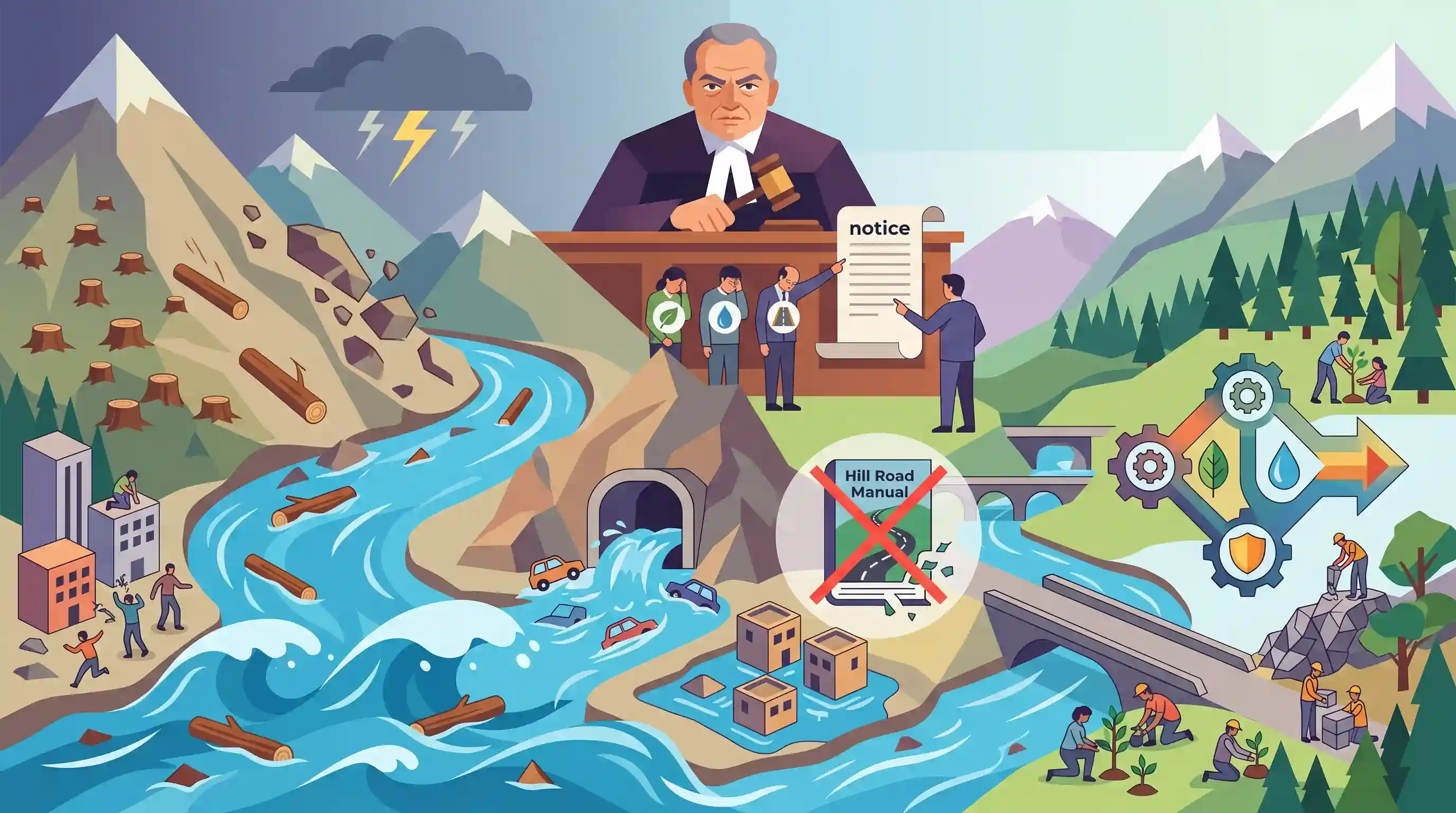
The Supreme Court has voiced profound concern over the escalating frequency of flash floods and landslides in the ecologically fragile Himalayan region, linking the devastation to illegal deforestation and unregulated infrastructure projects. The Court highlighted that logs from illegally felled trees are flowing into swollen rivers, increasing their destructive potential across Uttarakhand, Himachal Pradesh, Punjab, and Jammu & Kashmir. Scrutinizing the role of developmental activities, the apex court issued a notice to the NHAI over tunnels between Chandigarh and Manali that became 'death traps' during recent floods. Furthermore, it criticized the continuous encroachment of riverbeds and the blatant disregard for the Hill Road Manual. The SC reprimanded the Union Ministries of Environment and Jal Shakti for failing to enforce ecological safeguards, emphasizing the urgent need for a cohesive disaster management and preservation plan.
Key Points
- The Supreme Court expressed severe anguish over the repetitive flash floods and landslides ravaging ecologically sensitive Himalayan states.
- Logs from illegally felled trees have been observed exacerbating the destructive force of swollen rivers, highlighting rampant deforestation.
- The court scrutinized unregulated infrastructure projects, including continuous river encroachments and NHAI tunnels between Chandigarh and Manali that turned into 'death traps' during floods.
- There is widespread non-compliance with the Hill Road Manual, which provides guidelines for construction in fragile mountainous terrains.
- The MoEFCC and the Ministry of Jal Shakti were heavily criticized for regulatory failures and the lack of a cohesive disaster management action plan.
Important Terms
Hill Road Manual

IRC:52-2019 guidelines by the Indian Roads Congress prescribing technical standards for alignment, geometric design, and ecological safeguards for road construction in hilly terrains.
UPSC context
GS Paper III (Infrastructure/Disaster Management); tests knowledge of regulatory standards for sustainable development in mountain ecosystems.
National Highway Authority of India (NHAI)
A statutory body under the Ministry of Road Transport and Highways responsible for developing, maintaining, and managing India's National Highways network.
UPSC context
GS Paper III (Infrastructure); crucial for discussions on infrastructure vs. environment and disaster-resilient connectivity.
Ministry of Environment, Forests and Climate Change (MoEFCC)
The nodal agency for planning and overseeing India's environmental, forestry, and climate change policies, including the National Mission for Sustaining the Himalayan Ecosystem.
UPSC context
GS Paper III (Environment); relevant for policy implementation, forest clearances, and international climate commitments.
Ministry of Jal Shakti
The ministry responsible for integrated water resource management, river development, and flood forecasting through agencies like the Central Water Commission (CWC).
UPSC context
GS Paper III (Environment/Disaster Management); tests understanding of river basin management and flood mitigation strategies.
Himalayan Ecology
The unique, biodiversity-rich, and geologically sensitive mountain environment of the Indian Himalayan Region, highly vulnerable to climate change and human interference.
UPSC context
GS Paper I (Geography) and III (Environment); key for studying seismic risks, landslides, and glacial health.
Supreme Court (Environmental Jurisprudence)
The highest judicial body in India, which frequently intervenes in environmental matters using Article 21 and the Public Trust Doctrine.
UPSC context
GS Paper II (Judiciary/Governance); tests knowledge of judicial activism and the balance between development and fundamental rights.
Prelims Trap
The Hill Road Manual for fragile mountainous terrains is formulated and enforced by the Ministry of Environment, Forest and Climate Change (MoEFCC).
The Hill Road Manual (IRC:SP:48) is published by the Indian Roads Congress (IRC), not by environmental or disaster bodies like MoEFCC. Aspirants often misattribute it due to its ecological focus.
Static Concepts Connected
What are the EIA requirements for road construction in hilly terrains?
- Threshold limits: Expansion of National Highways >100km requires Category A clearance; state highways >30km in eco-sensitive areas need appraisal under EIA 2006.
- Altitude factor: Infrastructure projects located in hilly terrains (above 1,000 meters AMSL) face stricter scrutiny due to their ecological sensitivity.
- Bypass scrutiny: Any highway bypass or realignment passing through ecologically sensitive zones requires prior environmental clearance, regardless of the project's overall length.
What defines the 'Carrying Capacity' in the context of Himalayan ecosystems?
- Definition: The maximum infrastructure, tourism, and population density an ecologically fragile region can sustain without suffering permanent environmental degradation.
- Key parameters: Assessed via geological stability, groundwater limits, slope vulnerability, solid waste handling capacities, and forest cover integrity.
- Legal backing: The Supreme Court and NGT have mandated the Centre to conduct carrying capacity studies for 13 Himalayan states to regulate unchecked urbanization.
Cross-Topic Patterns
Infrastructure vs. Himalayan Fragility
The conflict between national infrastructure initiatives (like PM Gati Shakti or Char Dham Pariyojana) and the fragile Himalayan geology is a recurrent theme for GS-3 Disaster Management.
Judicial Environmentalism vs Executive Inaction
The Supreme Court repeatedly stepping in to enforce the 'Hill Road Manual' highlights judicial activism filling the vacuum of executive inaction, a core GS-2 governance concept.

Expect a GS-3 mains question directly linking unchecked tunneling/NHAI projects to the multiplier effect of Himalayan flash floods in 2026.
Linked PYQs · 5
Linked PYQs · 5
- 2016MainsGS1
The Himalayas are highly prone to landslides. Discuss the causes and suggest suitable measures of mitigation.
- 2021MainsGS1
Differentiate the causes of landslides in the Himalayan region and Western Ghats.
- 2013MainsGS1
Bring out the causes for more frequent occurrence of landslides in the Himalayas than in the Western Ghats.
- 2019MainsGS3
Disaster preparedness is the first step in any disaster management process. Explain how hazard zonation mapping will help disaster mitigation in the case of landslides.
- 2016MainsGS3
Rehabilitation of human settlements is one of the important environmental impacts which always attracts controversy while planning major projects. Discuss the measures to be adopted to mitigate the impact of the recent incidents of cloudbursts in many places of Uttarakhand.
