Jaishankar Outlines India Neighborhood Policy and Security Doctrine
Source:The Hindu ↗
Why It Matters
Provides an authoritative overview of India's current foreign policy doctrine, including neighborhood diplomacy, border security dynamics with China, proactive counter-terrorism strategies against Pakistan, and crisis management in global conflict zones. Crucial for GS-2 (International Relations) and GS-3 (Internal Security).
Summary
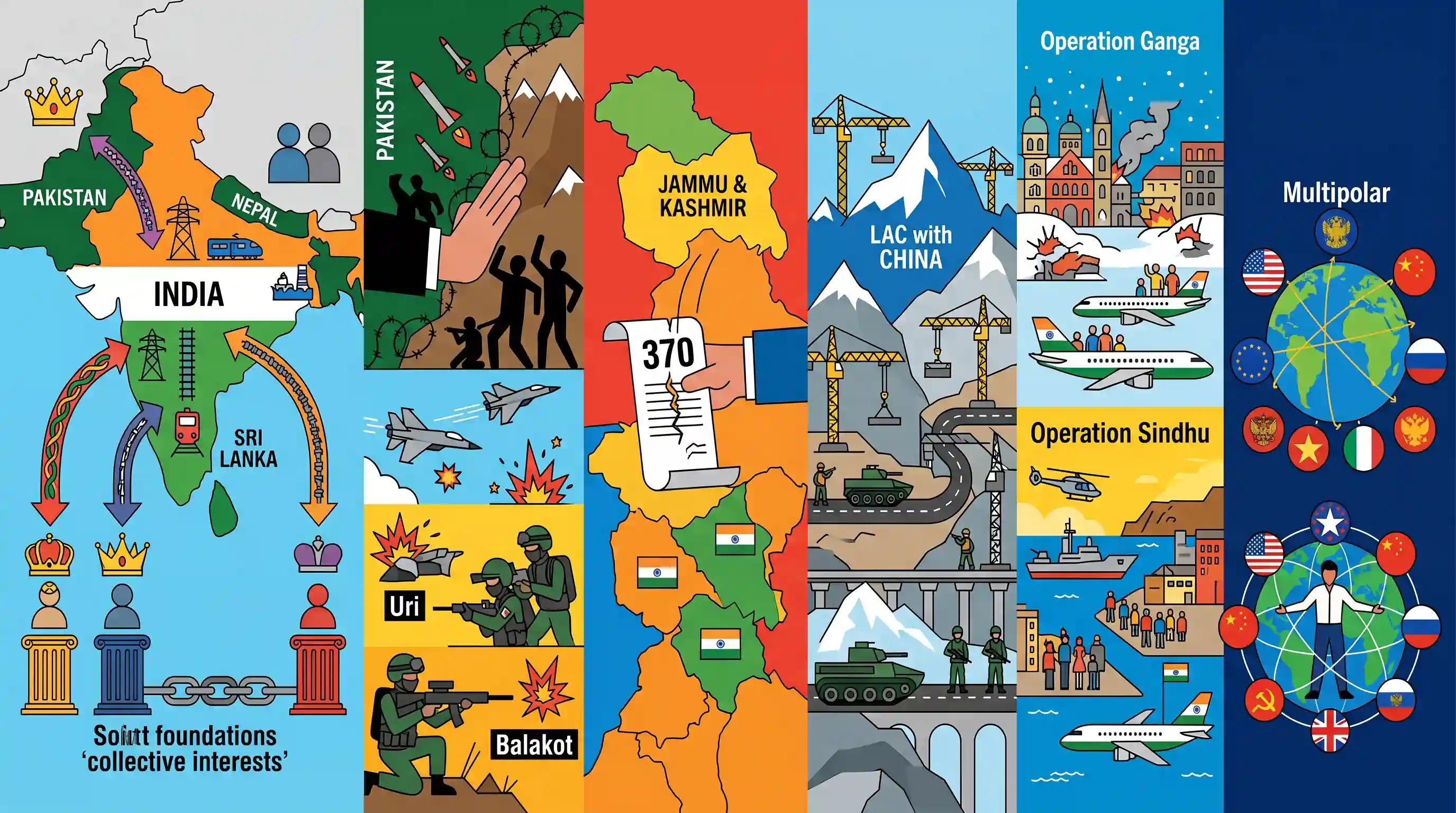
External Affairs Minister S. Jaishankar discussed the evolution of India's foreign policy, emphasizing that while relations with neighboring countries may not always be smooth, New Delhi focuses on creating "collective interests" to ensure long-term stability regardless of regime changes. He highlighted a firm shift in countering cross-border terrorism from Pakistan—citing responses like Uri, Balakot, and Operation Sindoor—and defended the abrogation of Article 370. Addressing ties with China, he underscored the importance of enhanced border infrastructure along the LAC to safeguard national interests. Furthermore, he noted India's successful evacuation efforts (Operation Sindhu and Operation Ganga) amid global conflicts, reflecting a strategic vision geared toward navigating an increasingly multipolar world order.
Key Points
- Acknowledged that while volatility in ties with neighbors like Nepal, Sri Lanka, and the Maldives is inevitable, India focuses on creating shared collective interests to ensure structural stability despite regime changes.
- Marked a shift in India's Pakistan policy post-26/11, highlighting a proactive 'new normal' against cross-border terrorism through actions like the Uri surgical strike, Balakot airstrike, Operation Sindoor, and the abrogation of Article 370.
- Criticized past neglect of border infrastructure with China, noting that recent enhancements along the Line of Actual Control (LAC) enable India to firmly defend its national interests, especially post-Galwan.
- Emphasized India's robust crisis response through diaspora evacuations like Operation Sindhu (Middle East) and Operation Ganga (Ukraine), aligning with a broader strategy to navigate and thrive in a multipolar world.
Important Terms
Operation Sindhu

A 2025 evacuation mission that rescued over 4,400 Indian nationals from Iran and Israel during regional conflict, also assisting citizens from Nepal and Sri Lanka.
UPSC context
GS Paper II (International Relations); tests India's 'Neighborhood First' policy and its growing capacity for large-scale humanitarian evacuation operations.
Operation Sindoor
A 2025 precision military response targeting terror infrastructure in Pakistan and PoJK following a major attack in Pahalgam, cited as a shift toward 'zero tolerance' for terrorism.
UPSC context
GS Paper III (Internal Security); relates to India's 'New Normal' in counter-terrorism and proactive border management strategies.
Operation Ganga
A major 2022 evacuation operation launched to rescue approximately 20,000 Indian students and nationals stranded in Ukraine during the Russia-Ukraine conflict.
UPSC context
GS Paper II (IR); focuses on the Indian Diaspora and the government's responsibility toward citizens during international crises.
Article 370
A constitutional provision providing special status to Jammu and Kashmir, which was effectively neutralized in 2019 to ensure full administrative integration with India.
UPSC context
GS Paper II (Polity and Governance); examines federalism, regional autonomy, and the legal framework of J&K's integration.
Collective Interests
A diplomatic strategy aimed at building structural, mutually beneficial dependencies (economic and security) with neighbors to maintain stable ties regardless of domestic regime changes.
UPSC context
GS Paper II (India and its Neighborhood); tests strategic vision in stabilizing bilateral relations amidst regional volatility.
ASEAN
A 10-member regional organization in Southeast Asia promoting intergovernmental cooperation; it is a central pillar of India’s 'Act East' and Indo-Pacific policies.
UPSC context
GS Paper II (Bilateral and Regional Groupings); essential for studying India’s regional integration and trade agreements.
Prelims Trap
"Operation Sindhu was launched to evacuate Indians from Ukraine, while Operation Ganga was for the Middle East."
UPSC frequently swaps operation targets in matching questions. Operation Ganga was for Ukraine (2022), while Operation Sindhu is a 2025 Middle East evacuation.
Static Concepts Connected
What are the core tenets of the Gujral Doctrine?
- Non-reciprocity: India grants unilateral concessions to smaller neighbors (like Nepal, Bangladesh, Maldives) without expecting immediate reciprocal returns.
- Non-interference: South Asian nations must not interfere in the internal affairs of one another.
- No hostile use: The territory of one neighbor should not be used against the security interests of another.
How does India manage border infrastructure along the LAC?
- Vibrant Villages Program: A scheme to comprehensively develop border villages to prevent out-migration and enhance civilian presence and intelligence gathering.
- BRO infrastructure: The BRO accelerates strategic roads, all-weather tunnels (like the Sela Tunnel), and bridges for rapid troop mobilization.
- Post-Galwan shift: A shift from defensive neglect to proactive 'cost-imposition' and assertiveness to counter China's rapid military buildup.
Cross-Topic Patterns
Infrastructure as regional diplomacy
India's 'regime-agnostic' strategy pivots on hard-wiring neighbors to its economy via cross-border power grids, petroleum pipelines, and UPI integration, effectively neutralizing political 'India Out' campaigns.
LAC security vs. Himalayan ecology
Rapid border militarization and BRO infrastructure buildup along the LAC directly intersect with GS3 Disaster Management concerns regarding Himalayan carrying capacity and glacial vulnerabilities.

Expect a Prelims 'Match the Pairs' on evacuations (Sindhu, Kaveri) and a 2026 Mains question on regime-agnostic neighbourhood diplomacy.
Linked PYQs · 4
Linked PYQs · 4
- 2022MainsGS2
India is an age-old friend of Sri Lanka.’ Discuss India's role in the recent crisis in Sri Lanka in the light of the preceding statement.
- 2024MainsGS2
Discuss the geopolitical and geostrategic importance of Maldives for India with a focus on global trade and energy flows. Further also discuss how this relationship affects India's maritime security and regional stability amidst international competition ?
- 2016MainsGS3
The terms 'Hot Pursuit' and 'Surgical Strikes' are often used in connection with armed action against terrorist attacks. Discuss the strategic impact of such actions.
- 2025MainsGS3
Terrorism is a global scourge. How has it manifested in India? Elaborate with contemporary examples. What are the counter measures adopted by the State? Explain.
