Molecular Mechanism Behind Vaccine Induced Blood Clots Identified
Source:The Hindu ↗
Why It Matters
Understanding the exact biological mechanisms behind vaccine adverse events is critical for maintaining public trust in immunisation programs. For UPSC aspirants, this issue bridges core science concepts (adenovirus, antibodies, platelets) with public health policy and the continuous evolution of applied biotechnology.
Summary
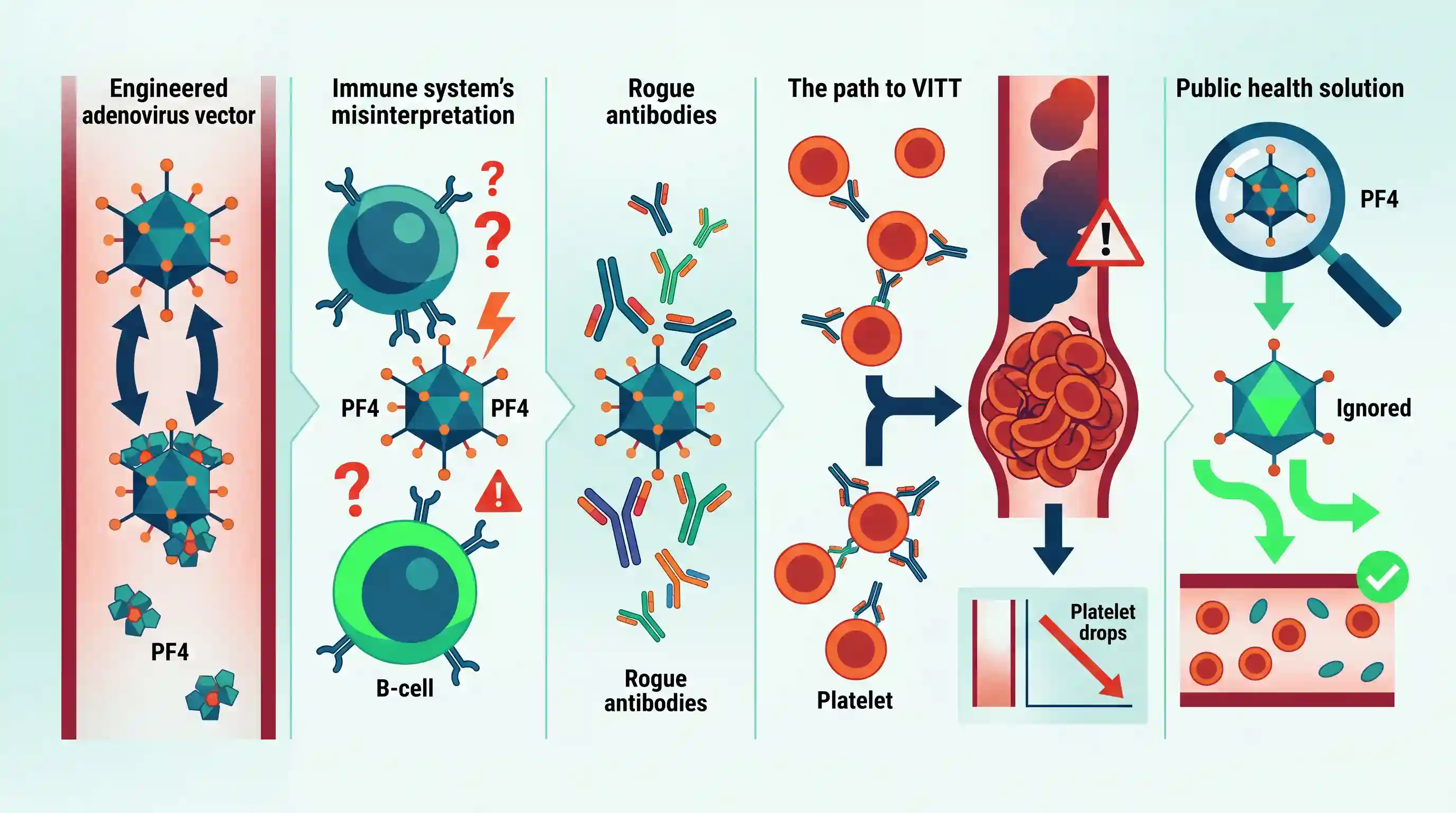
Scientists have uncovered the structural mechanism behind Vaccine-induced Immune Thrombotic Thrombocytopenia (VITT), a rare condition causing severe blood clots following the administration of adenovirus-vector COVID-19 vaccines such as AstraZeneca (Covishield) and Johnson & Johnson. The study reveals that the viral vector acts like a magnet, binding to a blood protein called Platelet Factor 4 (PF4). The immune system misinterprets this vector-PF4 complex as a pathogen, producing rogue antibodies that activate platelets. This leads to dangerous clotting alongside a simultaneous drop in platelet counts. This breakthrough in biotechnology will aid in designing safer, engineered viral vectors for future vaccines, minimizing autoimmune risks.
Key Points
- Researchers have identified the molecular mechanism behind Vaccine-induced Immune Thrombotic Thrombocytopenia (VITT), a rare condition causing severe blood clots linked to adenovirus-vector COVID-19 vaccines.
- The complication occurs when the adenovirus vector binds to a blood protein called Platelet Factor 4 (PF4), forming a complex.
- The immune system misidentifies this vector-PF4 complex as a foreign pathogen, triggering the production of rogue auto-antibodies.
- These antibodies activate platelets, causing them to clump together into dangerous blood clots while simultaneously reducing the overall platelet count in the bloodstream.
- This structural discovery provides scientists with a roadmap to genetically engineer safer viral vectors for future vaccines, thereby minimizing the risk of similar autoimmune reactions.
Important Terms
VITT (Vaccine-induced Immune Thrombotic Thrombocytopenia)

A rare, life-threatening condition characterized by the simultaneous occurrence of blood clots (thrombosis) and low platelet counts (thrombocytopenia). It is primarily associated with adenovirus-vector COVID-19 vaccines like AstraZeneca and Johnson & Johnson.
UPSC context
GS3: Science & Tech (Health). Important for understanding rare vaccine adverse events and the body's immunological response.
Adenovirus Vector Vaccine
A vaccine platform that uses a modified, harmless virus (adenovirus) as a "vector" to deliver genetic instructions for a target antigen (e.g., SARS-CoV-2 spike protein) into human cells.
UPSC context
GS3: Biotechnology. A frequent Prelims topic testing the distinction between viral vector, mRNA, and inactivated vaccine platforms.
Platelet Factor 4 (PF4)
A protein released by platelets that plays a key role in blood clotting. In VITT, antibodies mistakenly target PF4, leading to massive platelet activation, clotting, and subsequent platelet depletion.
UPSC context
GS3: Science & Tech. Specific biological mechanism involved in clotting disorders and modern vaccine safety research.
Covishield
The Indian brand name for the Oxford-AstraZeneca vaccine (ChAdOx1-S). It is a recombinant, replication-deficient chimpanzee adenovirus vector vaccine that formed the backbone of India's COVID-19 vaccination drive.
UPSC context
GS3: Health/GS2: Governance. Core component of India's pandemic response and large-scale public health programs.
Serum Institute of India (SII)
A Pune-based biotechnology company and the world's largest vaccine manufacturer by volume. It produced Covishield under license from AstraZeneca, playing a critical role in global vaccine supply.
UPSC context
GS3: Industry/S&T. Relevant for discussions on India as the "Pharmacy of the World" and indigenous manufacturing capabilities.
Prelims Trap
VITT causes severe blood clotting due to an abnormal surge in the body's overall platelet count.
VITT actually causes thrombocytopenia—a dangerously LOW platelet count. Rogue antibodies force existing platelets to clump together into clots, thereby depleting the free-circulating supply.
Static Concepts Connected
How do Viral Vector vaccines differ from mRNA vaccines?
- Viral Vector: Uses a harmless, modified virus (e.g., adenovirus) as a delivery system to carry genetic instructions for an antigen into host cells.
- mRNA Technology: Directly introduces synthetic messenger RNA, enclosed in a lipid nanoparticle, instructing cells to build the viral antigen without using a virus.
- Temperature Stability: Viral vector vaccines generally remain stable at standard refrigerator temperatures, whereas mRNA vaccines historically require ultra-cold chain storage.
What are Platelets and their role in the human body?
- Anucleate fragments: Platelets (thrombocytes) are tiny, nucleus-free blood cell fragments produced by megakaryocytes in the bone marrow.
- Hemostasis: Their primary function is hemostasis—clumping together to form blood clots to stop bleeding at sites of vascular injury.
- Granule Secretion: They contain alpha and dense granules that release proteins (like Platelet Factor 4) to regulate blood coagulation and inflammation.
Cross-Topic Patterns
Molecular Mimicry & Autoimmune Diseases
VITT illustrates how the immune system misidentifies harmless complexes as foreign threats, directly linking to UPSC static biology topics on autoimmune disorders and immune tolerance.
Pharmacovigilance in Mass Immunization
Identifying rare side effects like VITT post-deployment underscores the importance of Phase IV clinical trials and robust national pharmacovigilance mechanisms.

Expect a multi-statement question on the biological differences between viral vector and mRNA vaccines, testing 'thrombocytopenia'.
Linked PYQs · 4
Linked PYQs · 4
- 2021PrelimsGS1
Consider the following statements : 1. Adenoviruses have single-stranded DNA genomes whereas retroviruses have double-stranded DNA genomes. 2. Common cold is sometime caused by an adenovirus whereas AIDS is caused by a retrovirus. Which of the statements given above is/are correct?
- 2024PrelimsGS1
With reference to monoclonal antibodies, often mentioned in news, consider the following statements : I. They are man-made proteins. II. They stimulate immunological function due to their ability to bind to specific antigens. III. They are used in treating viral infections like that of Nipah virus. Which of the statements given above are correct?
- 2021MainsGS3
What are the research and developmental achievements in applied biotechnology? How will these achievements help to uplift the poorer sections of the society?
- 2024MainsGS2
In a crucial domain like the public healthcare system the Indian State should play a vital role to contain the adverse impact of marketisation of the system. Suggest some measures through which the State can enhance the reach of public healthcare at the grassroots level.
