India Negotiates Trade Deals from Strength
Source:The Hindu ↗
Why It Matters
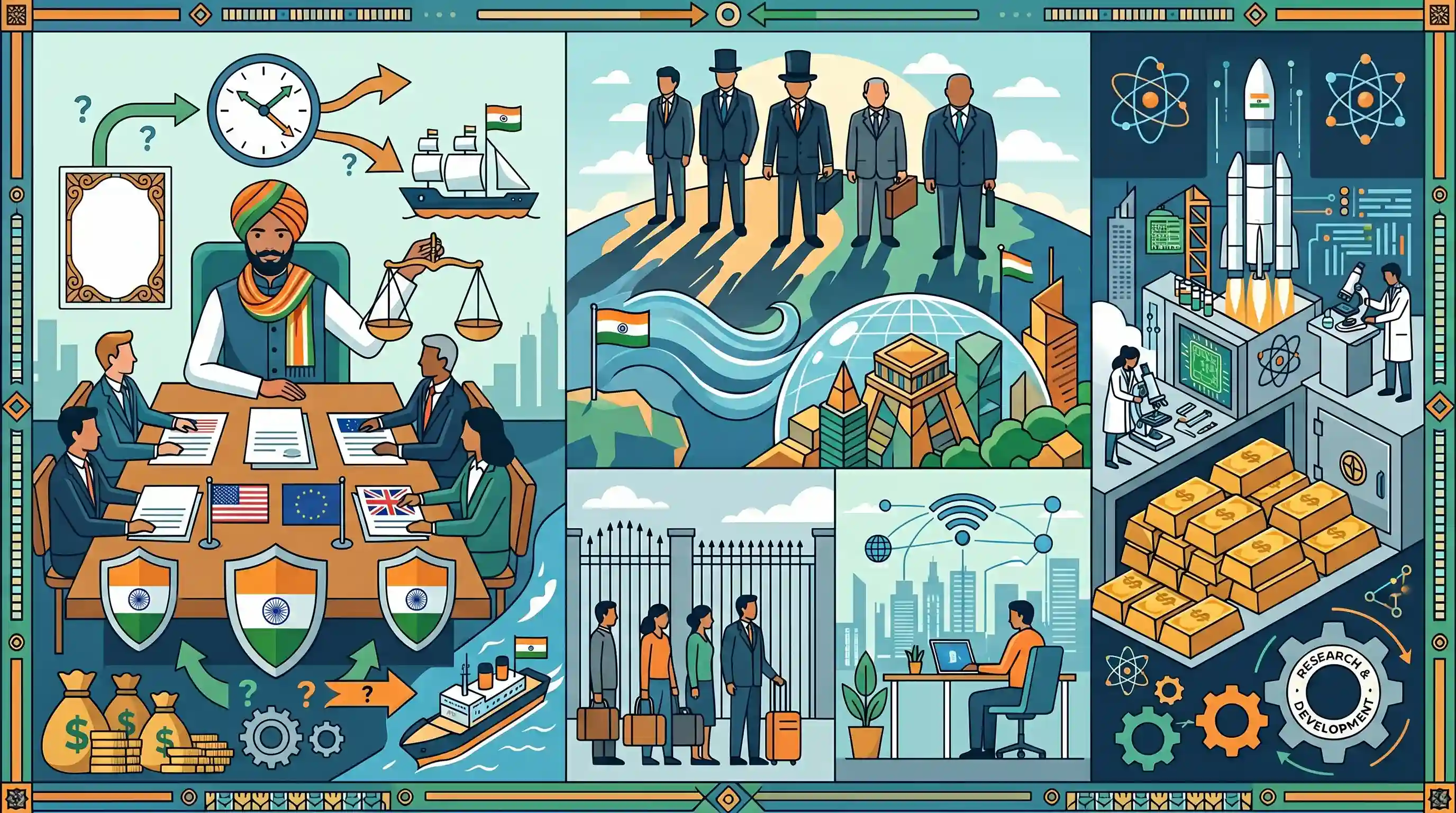
The article illustrates the evolving paradigm of India's foreign and economic policy, shifting towards assertive trade diplomacy and leveraging digital globalization to bypass traditional migration bottlenecks. It also underscores government interventions designed to foster a domestic innovation ecosystem through aggressive private-sector R&D funding.
Summary
Union Commerce and Industry Minister Piyush Goyal asserted that India negotiates international trade agreements, including an impending "mini-trade deal" with the United States, from a position of economic strength rather than adhering to rigid deadlines. Emphasizing national interest, he highlighted a string of recent successful Free Trade Agreements (FTAs) alongside ongoing negotiations with major economies like the EU and the UK. Addressing concerns over H-1B visas, Goyal noted that remote work increasingly mitigates the need for physical migration for Indian tech professionals. Additionally, he underscored India's commitment to self-reliance through the newly approved ₹1 lakh crore Research Development and Innovation (RDI) scheme and a dedicated Deep Tech fund to support private-sector research.
Key Points
- Union Commerce Minister Piyush Goyal asserted that India approaches free trade agreements (FTAs), including the upcoming U.S. mini-trade deal, from a position of economic strength rather than submitting to rigid deadlines.
- He emphasized prioritizing qualitative outcomes and national interest over speedy resolutions, contrasting the current administration's strategy with the previous UPA government's approach.
- Goyal highlighted recent successful FTAs with the UAE, Australia, Mauritius, and the EFTA bloc, and noted ongoing negotiations with the UK, EU, Oman, Peru, and Chile.
- Addressing the H-1B visa issue, he observed that the success of remote work enables Indian tech professionals to execute global roles locally without the need to migrate.
- To boost domestic innovation, Goyal underscored the newly approved ₹1 lakh crore RDI scheme offering zero-interest 50-year loans to private research outfits, alongside the second tranche of a ₹10,000 crore Deep Tech fund.
Important Terms
Free Trade Agreements (FTAs)

An agreement between two or more countries to reduce or eliminate barriers to trade, such as tariffs and quotas, on goods and services.
UPSC context
GS-II (Bilateral agreements) & GS-III (Indian Economy). Tests trade policy knowledge and India's economic diplomacy.
Research Development and Innovation (RDI) scheme
A ₹1 lakh crore government-backed fund providing long-term, low-interest financing to incentivize private-sector research and development in strategic sunrise sectors.
UPSC context
GS-III (S&T; Economy). Tests government initiatives for domestic innovation, indigenization, and achieving 'Atmanirbhar Bharat'.
Deep Tech fund
A dedicated financial pool under the RDI scheme designed to provide risk capital for breakthrough scientific and engineering innovations with long gestation periods.
UPSC context
GS-III (Science and Technology). Tests knowledge of support mechanisms for high-risk, capital-intensive emerging technologies.
H-1B visa
A U.S. non-immigrant visa allowing domestic employers to hire foreign workers in specialty occupations that require theoretical or technical expertise.
UPSC context
GS-II (Indian Diaspora; Effect of policies of developed countries). Tests impact on skilled labor mobility and remittances.
European Free Trade Association (EFTA)
An intergovernmental organization comprising Iceland, Liechtenstein, Norway, and Switzerland, which recently signed a Trade and Economic Partnership Agreement (TEPA) with India.
UPSC context
GS-II (Bilateral, regional and global groupings). Tests awareness of India's recent major trade milestones and investment pacts.
European Union (EU)
An economic and political union of 27 European nations with which India is negotiating a comprehensive trade and investment agreement.
UPSC context
GS-II (Regional and global groupings). Tests understanding of India's strategic economic engagement with major global markets.
Prelims Trap
The ₹1 Lakh Crore RDI scheme provides direct capital grants to private tech startups.
The RDI scheme establishes a corpus to provide 50-year zero or low-interest loans to the private sector, not non-repayable grants.
Static Concepts Connected
What are the four modes of service supply under WTO GATS?
- Mode 1 (Cross-border): Service crosses the border without people moving, such as remote IT work or telehealth.
- Mode 2 (Consumption abroad): The consumer travels to the service country, such as for tourism or international education.
- Mode 3 (Commercial presence): Establishing a physical corporate branch or subsidiary in a foreign country.
- Mode 4 (Natural persons): Temporary movement of professionals (like H-1B visa holders) to provide services abroad.
How do CEPA and CECA differ from standard Free Trade Agreements?
- Standard FTA: Primarily focuses on reducing or eliminating customs duties on a specific list of traded goods.
- CECA: Covers tariff reduction on goods and some services, but is generally less comprehensive than a CEPA.
- CEPA: Highly comprehensive, encompassing trade in goods, services, investments, competition, and intellectual property rights (e.g., India-UAE).
Cross-Topic Patterns
Shifting GATS Mode 4 to Mode 1
Reduced reliance on H-1B visas due to remote work shifts India's IT services exports from WTO GATS Mode 4 (movement of natural persons) to Mode 1 (cross-border supply).
Deep Tech R&D + Long-term capital
The ₹1 lakh crore RDI corpus provides 50-year interest-free loans, operationalizing the 'Jai Anusandhan' budget mandate to crowd-in private capital for strategic and sunrise sector research.

Expect a Prelims matched-pair question on recent trade pacts (India-EFTA TEPA vs UAE CEPA) or WTO GATS modes of supply for IT exports.
Linked PYQs · 3
Linked PYQs · 3
- 2019MainsGS2
‘What introduces friction into the ties between India and the United States is that Washington is still unable to find for India a position in its global strategy, which would satisfy India's national self-esteem and ambitions.’ Explain with suitable examples.
- 2018PrelimsGS1
Consider the following countries: 1. Australia 2. Canada 3. China 4. India 5. Japan 6. USA Which of the above are among the 'free-trade partners' of ASEAN?
- 2012MainsGS2
Discuss the likely negative impact of the protectionist measures proposed by the US on India's software industry.
