Climate Change Multilateralism North South Divide Climate Finance
Source:Indian Express ↗
Why It Matters
Provides critical talking points on climate diplomacy, the North-South divide, and the structural necessity of multilateralism for GS2 International Relations and GS3 Environment/Ecology answers.
Summary
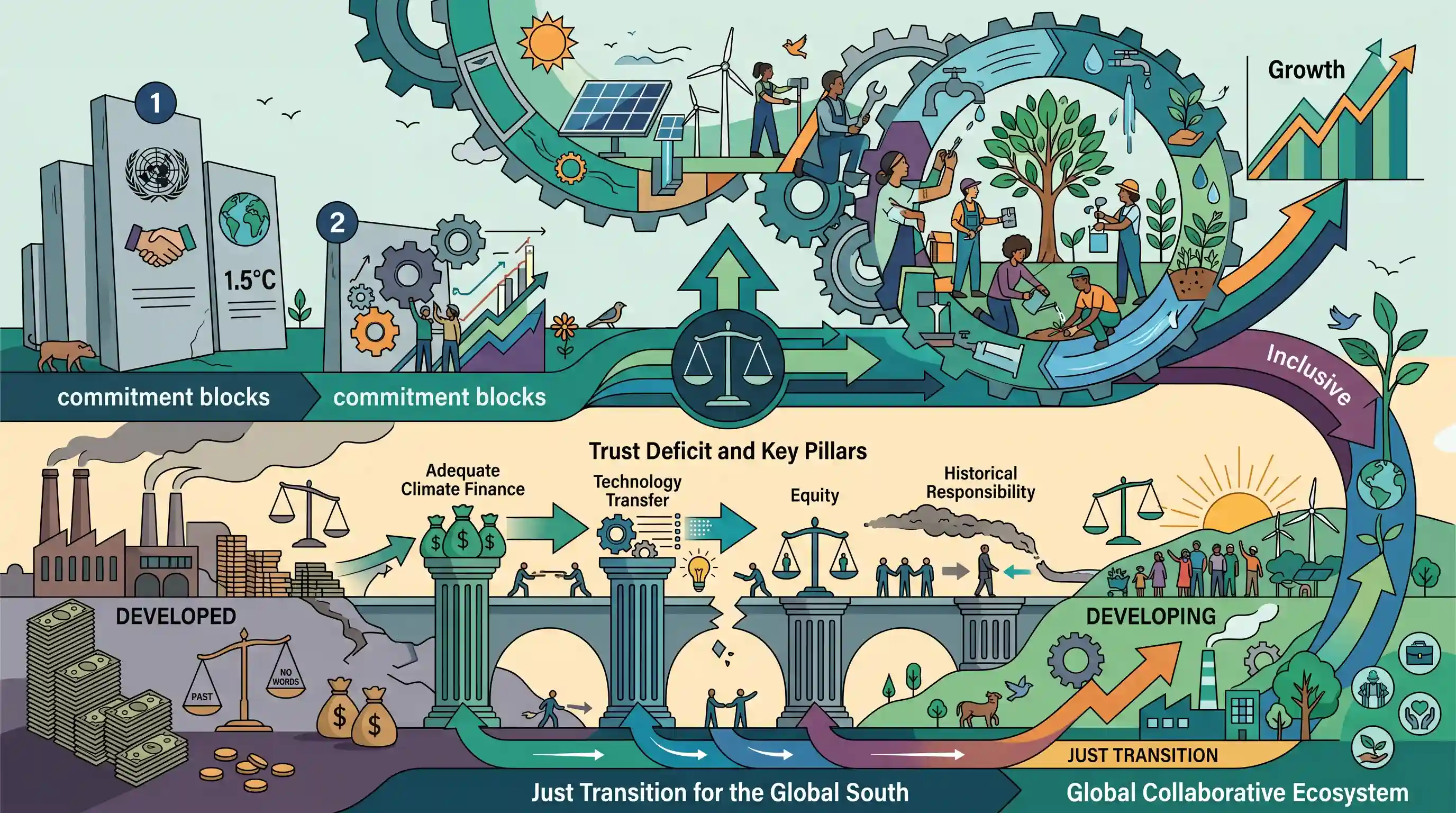
The article underscores the indispensable role of international collaboration in combating climate change. It highlights the necessity of honoring multilateral commitments under frameworks like the UNFCCC and the Paris Agreement. A major focus is placed on bridging the trust deficit between developed and developing countries through adequate climate finance, technology transfer, and adherence to the principles of equity and historical responsibility, ensuring a just transition for the Global South.
Key Points
- Addressing climate change requires robust multilateral collaboration, as unilateral efforts are insufficient for a global commons issue.
- The realization of global climate goals is heavily contingent on fulfilling the climate finance and technology transfer commitments by developed nations to the Global South.
- Bridging the trust deficit between the Global North and South demands a focus on historical responsibility and equitable burden-sharing.
- Ensuring a 'just transition' requires aligning climate action strategies with broader inclusive growth and sustainable development objectives.
Important Terms
Paris Agreement

A legally binding international treaty adopted at COP21 in 2015. It aims to limit global warming to well below 2°C, pursuing efforts for 1.5°C, through self-determined national climate commitments.
UPSC context
GS Paper II & III. Essential for analyzing global climate frameworks, mitigation targets, and India's international environmental commitments.
UNFCCC
Adopted at the 1992 Rio Earth Summit, this international treaty aims to stabilize greenhouse gas concentrations to prevent dangerous human interference with the climate system. It has near-universal membership (197 parties).
UPSC context
GS Paper III. Tests understanding of international environmental governance, multilateral treaties, and climate negotiations under the Rio Conventions.
Nationally Determined Contributions (NDCs)
Climate action plans submitted by countries under the Paris Agreement, outlining mitigation and adaptation targets. These are updated every five years to reflect increasing ambition via the "ratchet mechanism."
UPSC context
GS Paper III. Evaluates understanding of the bottom-up climate model and India’s specific pledges, such as the Panchamrit targets.
IPCC (Intergovernmental Panel on Climate Change)
The UN body established in 1988 to assess climate change science. It synthesizes peer-reviewed research into Assessment Reports to provide policymakers with scientific evidence, risks, and mitigation options.
UPSC context
GS Paper III. Tests knowledge of global scientific consensus on climate change and the implications of Assessment Report findings.
Sustainable Development Goals (SDGs)
A collection of 17 interlinked global goals adopted by the UN in 2015 to end poverty and protect the planet by 2030. Goal 13 specifically addresses climate action.
UPSC context
GS Paper II & III. Critical for questions on inclusive growth, environmental sustainability, and India’s domestic implementation through NITI Aayog.
Prelims Trap
Both developed and developing nations share mandatory financial obligations for global climate mitigation.
The UNFCCC and Paris Agreement operate on the CBDR-RC principle. Mandatory climate finance obligations fall strictly on developed nations due to historical emissions.
Static Concepts Connected
What is the principle of CBDR-RC under the UNFCCC?
- Origin: Formally enshrined at the 1992 Rio Earth Summit within the UNFCCC framework.
- Core Premise: Acknowledges a shared obligation to protect the environment, but differing historical contributions to global greenhouse gases.
- Operationalization: Requires developed nations (Annex I/II) to take the lead in absolute emission cuts and provide climate finance/technology.
What are the primary climate finance funds under the UNFCCC?
- Global Environment Facility (GEF): Established in 1992, it serves as the longest-standing operating entity of the UNFCCC financial mechanism.
- Green Climate Fund (GCF): Established at COP16 (Cancun), it is the world's largest dedicated fund helping developing countries with adaptation and mitigation.
- Loss & Damage Fund: Agreed upon at COP27 and operationalized at COP28 to compensate vulnerable countries facing irreversible climate impacts.
Cross-Topic Patterns
Green Tech IPR vs. Tech Transfer
Developed nations' push for strict TRIPS (WTO) patent protections often contradicts the UNFCCC's mandate for affordable clean-tech transfer to the Global South.
Just Transition & Coal Economies
Phasing out fossil fuels links global climate goals directly to domestic inclusive growth, particularly structural unemployment in coal-dependent states like Jharkhand and Chhattisgarh.

Expect a mains question linking 'Just Transition' in coal-rich Indian states to global climate finance and NCQG negotiations.
Linked PYQs · 5
Linked PYQs · 5
- 2025MainsGS3
Write a review on India's climate commitments under the Paris Agreement (2015) and mention how these have been further strengthened in COP26 (2021). In this direction, how has the first Nationally Determined Contribution intended by India been updated in 2022?
- 2021MainsGS3
Describe the major outcomes of the 26th session of the Conference of the Parties (COP) to the United Nations Framework Convention on Climate Change (UNFCCC). What are the commitments made by India in this conference?
- 2020MainsGS3
Explain intra-generational and inter-generational issues of equity from the perspective of inclusive growth and sustainable development.
- 2025PrelimsGS1
Consider the following statements : Statement I: Article 6 of the Paris Agreement on climate change is frequently discussed in global discussions on sustainable development and climate change. Statement II: Article 6 of the Paris Agreement on climate change sets out the principles of carbon markets. Statement III : Article 6 of the Paris Agreement on climate change intends to promote inter-country non-market strategies to reach their climate targets. Which one of the following is correct in respect of the above statements?
- 2016PrelimsGS1
With reference to the Agreement at the UNFCCC Meeting in Paris in 2015, which of the following statements is/are correct? 1. The Agreement was signed by all the member countries of the UN and it will go into effect in 2017. 2. The Agreement aims to limit the greenhouse gas emissions so that the rise in average global temperature by the end of this century does not exceed 2°C or even 1.5°C above pre-industrial levels. 3. Developed countries acknowledged their historical responsibility in global warming and committed to donate $ 1000 billion a year from 2020 to help developing countries to cope with climate change. Select the correct answer using the code given below.
