Post-Polio Syndrome: Addressing India's Aging Survivor Crisis
Source:The Hindu ↗
Why It Matters
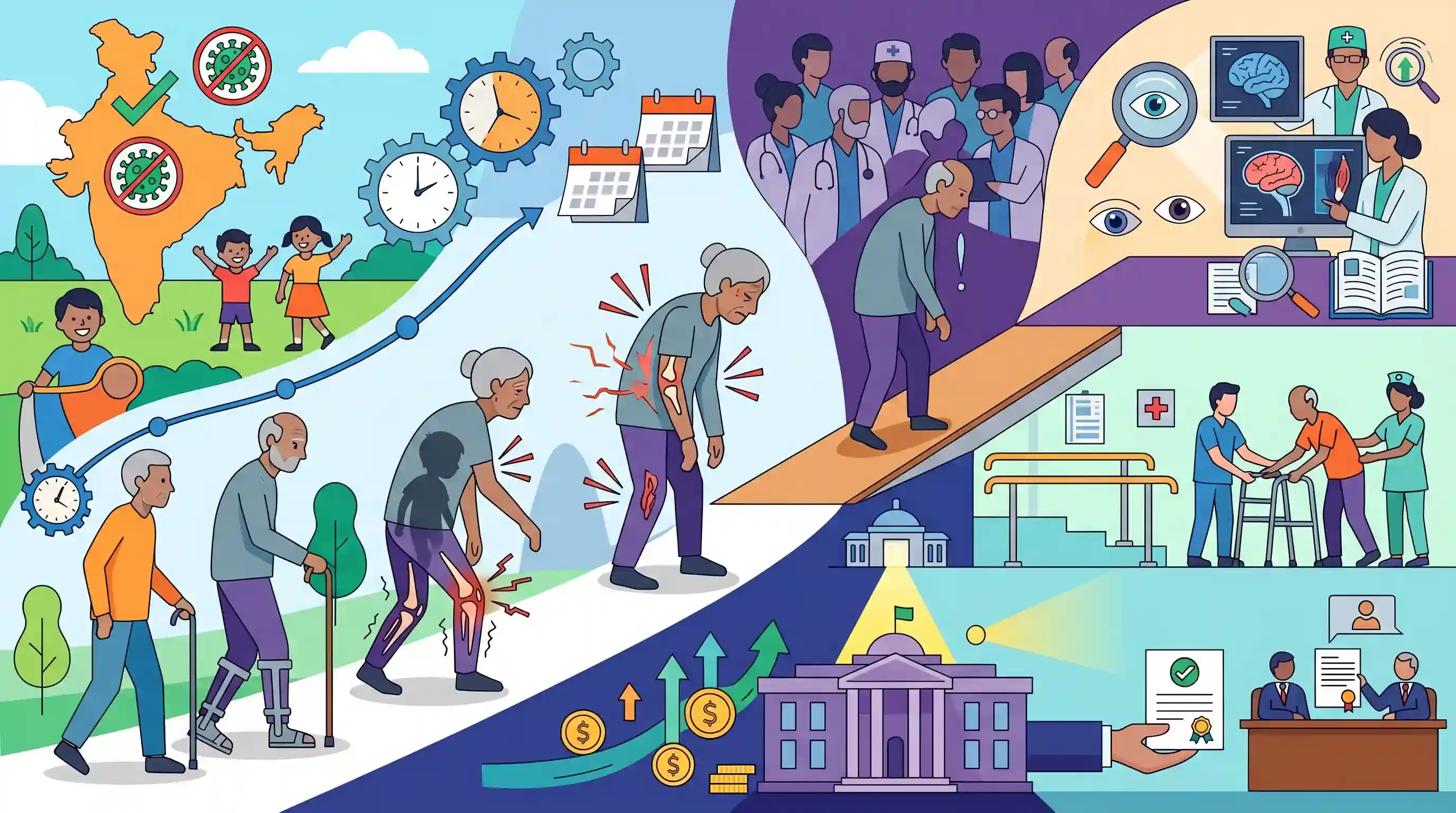
India's triumph over polio left a large population of survivors who are now aging into PPS. Understanding this syndrome is essential for civil servants framing inclusive geriatric health policies, managing disability rights, and anticipating the long-term infrastructural needs of an aging population.
Summary
The article highlights the growing but overlooked public health issue of Post-Polio Syndrome (PPS) among aging polio survivors in India. Despite the country's historic achievement of becoming polio-free, millions who survived the initial viral infection decades ago are now experiencing new, debilitating symptoms as they age. The piece underscores the urgent need for greater clinical awareness, specialized geriatric and rehabilitative care, and policy recognition to support this vulnerable demographic, illustrating the delayed healthcare challenges associated with increased life expectancy.
Key Points
- Post-Polio Syndrome (PPS) affects polio survivors decades after their initial recovery, causing progressive muscle weakness, severe fatigue, and joint pain.
- Although India was certified polio-free in 2014, a massive aging cohort of survivors from the pre-eradication era is now developing PPS.
- The condition is frequently misdiagnosed as arthritis or general age-related decline due to a lack of awareness among medical professionals.
- Addressing PPS requires targeted geriatric healthcare policies, multi-disciplinary rehabilitation, and better diagnostic protocols.
- The emergence of PPS underscores a broader public health challenge: as life expectancy increases, the long-term consequences of eradicated or historical diseases demand renewed state healthcare intervention.
Important Terms
Post-Polio Syndrome (PPS)

A neurological condition where polio survivors experience new muscle weakness, fatigue, and pain decades after the initial infection, caused by the deterioration of overworked motor neurons.
UPSC context
GS Paper 2 (Health) and GS Paper 3 (S&T); tests knowledge of disease sequelae and long-term public health management.
Rights of Persons with Disabilities (RPwD) Act, 2016
A landmark 2016 law replacing the 1995 Act, expanding recognized disabilities from 7 to 21 and mandating a rights-based approach to inclusion and accessibility.
UPSC context
GS Paper 2 (Social Justice); critical for understanding legal frameworks for vulnerable sections and empowerment.
Pulse Polio Programme
A mass immunization drive launched in 1995 using National Immunization Days (NIDs) to vaccinate all children under five, leading to India's 2014 polio-free status.
UPSC context
GS Paper 2 (Health/Governance); a major case study for successful large-scale health interventions and administrative coordination.
Geriatric Care
Specialized healthcare addressing the complex medical, functional, and psychological needs of the elderly (60+), focusing on chronic multi-morbidity and rehabilitation.
UPSC context
GS Paper 2 (Social Justice/Health); relevant for demographic transition and aging population challenges in India.
World Health Organization (WHO)
The UN's specialized agency for global health that provides technical support and monitors disease eradication; it certified India as polio-free in 2014.
UPSC context
GS Paper 2 (International Relations/Health); tests understanding of global institutional roles in domestic health outcomes.
Ministry of Health and Family Welfare (MoHFW)
The central Indian ministry responsible for health policy, including the Universal Immunization Programme and the National Programme for Health Care of the Elderly.
UPSC context
GS Paper 2 (Governance/Health Policy); key for understanding the executive's role in public health administration.
Prelims Trap
Post-Polio Syndrome is caused by the reactivation of the dormant poliovirus in older adults.
PPS is NOT a viral reactivation or re-infection. It is a non-infectious neurological deterioration caused by the chronic metabolic stress of surviving motor neurons overworking for decades.
Static Concepts Connected
What are the criteria and status of Polio eradication in India?
- Causative agent: Caused by the Poliovirus (a highly infectious RNA virus) that mainly attacks the central nervous system, leading to spinal or bulbar paralysis.
- Eradication criteria: A WHO region is certified polio-free after three consecutive years of zero wild poliovirus cases under high-quality surveillance.
- India's status: India was certified polio-free by the WHO in 2014. The last recorded case of wild polio in India occurred in 2011 in Howrah, West Bengal.
How does the RPwD Act 2016 cover conditions like Post-Polio Syndrome?
- Expanded scope: The Act increased recognized disabilities from 7 to 21, explicitly covering locomotor disabilities, chronic neurological conditions, and multiple disabilities.
- Employment and Education: It mandates a 4% reservation in government jobs and educational institutions for persons with benchmark disabilities (having at least 40% of a specified disability).
- Accessibility mandate: The state is mandated to provide barrier-free access in public buildings, transport, and comprehensive rehabilitation programs for disabled persons.
Cross-Topic Patterns
Viral Eradication vs. Disease Sequelae
The shift from managing acute outbreaks to addressing long-tail neurological sequelae (like PPS or Long-COVID) highlights a necessary public health transition toward chronic rehabilitation.
Demographic Shift & Geriatric Burden
India's rising life expectancy exposes historical health debts. PPS exemplifies how an aging population introduces novel strains on currently inadequate geriatric healthcare infrastructure.

Expect a Prelims statement confusing PPS with viral reactivation, paired with India's 2014 WHO polio-free certification criteria.
Linked PYQs · 3
Linked PYQs · 3
- 2022MainsGS3
The increase in life expectancy in the country has led to newer health challenges in the community. What are those challenges and what steps need to be taken to meet them?
- 2020MainsGS2
In order to enhance the prospects of social development, sound and adequate health care policies are needed particularly in the fields of geriatric and maternal health care. Discuss.
- 2024MainsGS2
In a crucial domain like the public healthcare system the Indian State should play a vital role to contain the adverse impact of marketisation of the system. Suggest some measures through which the State can enhance the reach of public healthcare at the grassroots level.
