Call for Community Centric Mental Health Care in India
Source:Indian Express ↗
Why It Matters
Mental health is an emerging and critical aspect of India's public health challenge, characterized by a massive treatment gap and significant social stigma. A community-based approach represents a paradigm shift essential for policymakers, demonstrating how grassroots participation and primary healthcare integration can ensure sustainable and inclusive development.
Summary
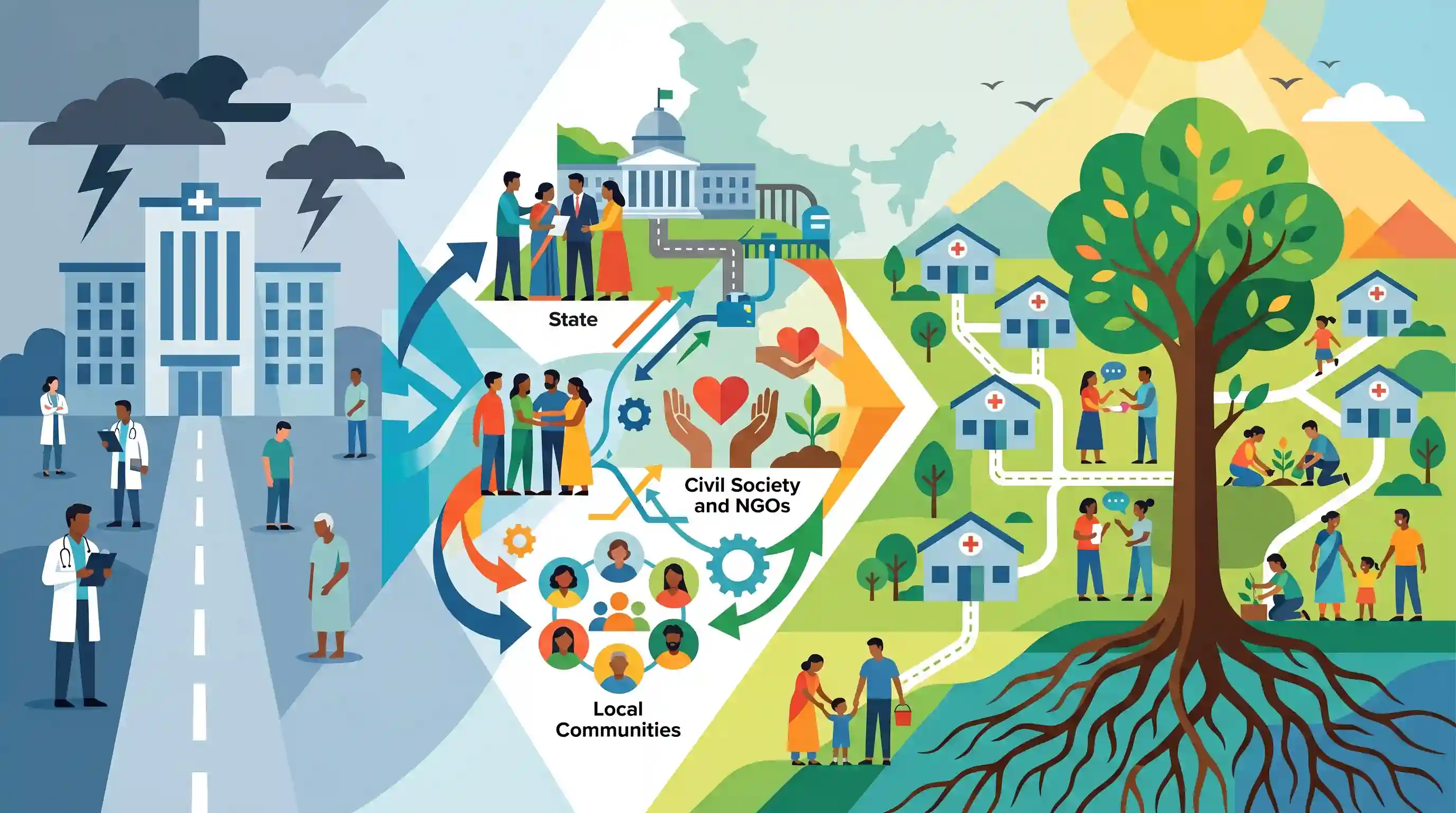
The article emphasizes the necessity of shifting the mental health discourse in India from a strictly clinical model to a community-rooted movement. Highlighting the growing burden of mental illnesses and the pervasive social stigma, it advocates for decentralizing care by strengthening primary health structures and encouraging community participation. A collaborative approach involving the State, local communities, and civil society is proposed to make mental healthcare more accessible, inclusive, and effective at the grassroots level.
Key Points
- A purely medicalized or clinical approach is insufficient to tackle the growing burden of mental health issues in India; a community-based model is required.
- Integrating mental health services into the primary health structure is crucial for accessibility and early intervention.
- Empowering communities and fostering grassroots awareness helps in reducing the deep-seated social stigma associated with mental illnesses.
- State intervention alongside public charitable trusts and civil society organizations is vital to enhance the reach of public healthcare and ensure inclusive development.
Important Terms
Mental Healthcare Act, 2017

Progressive 2017 legislation ensuring the right to access mental healthcare, decriminalizing suicide attempts, and empowering patients via 'Advance Directives' regarding their own treatment.
UPSC context
GS Paper II: Governance/Social Justice; crucial for understanding rights-based frameworks for vulnerable populations.
National Mental Health Programme (NMHP)
A flagship scheme launched in 1982 to ensure minimum mental healthcare is available, accessible, and integrated into general health services and social development programs.
UPSC context
GS Paper II: Social Sector/Health; tests knowledge of institutional frameworks for public health management.
District Mental Health Programme (DMHP)
The decentralized operational arm of the NMHP that integrates mental health services with primary healthcare at the district level using the 'Bellary Model' of training general doctors.
UPSC context
GS Paper II: Social Sector/Health; vital for discussing grassroots delivery and decentralization of healthcare.
Tele-MANAS
A 24/7 national tele-mental health helpline (14416) launched in 2022 to provide free, universal access to counseling and specialist consultations across India.
UPSC context
GS Paper II/III: Digital Governance; represents technology-led interventions in the social sector and health.
Treatment Gap
The significant disparity—estimated at nearly 85% in India—between the number of people requiring mental health care and those who actually receive formal services.
UPSC context
GS Paper II: Issues relating to Health/Social Sector; a key metric used to analyze public health outcomes.
Social Stigma
Widespread negative beliefs and discrimination against persons with mental illness, acting as a major social barrier to seeking treatment and rehabilitation.
UPSC context
GS Paper I/II: Social Empowerment/Health; relevant for discussing socio-cultural challenges in development.
Prelims Trap
The Mental Healthcare Act, 2017 prioritizes long-term institutionalization for persons with severe mental illness.
The Act actually discourages long-term institutionalization and legally mandates the government to create less restrictive community-based alternatives like halfway homes.
Static Concepts Connected
What are the key patient rights guaranteed under the Mental Healthcare Act, 2017?
- Right to Care: Guarantees access to mental healthcare and treatment from government-funded services.
- Advance Directive: Allows individuals to specify how they wish to be treated (or not treated) during a future mental health crisis.
- Decriminalization of Suicide: Attempted suicide is presumed to be under severe stress and is effectively decriminalized (exempt from Section 309 IPC).
How is mental healthcare integrated into India's public health infrastructure?
- District Mental Health Programme: Operates at the district level to integrate mental health services with primary healthcare (PHCs and CHCs).
- Tele-MANAS: Launched recently as a digital extension to provide free, 24/7 tele-mental health services across the country.
- ASHA Workers: Serve as the first point of contact for community mobilization, though they currently lack specialized mental health training.
Cross-Topic Patterns
Mental Health + Demographic Dividend
Rising mental health burdens and youth suicides directly threaten India's human capital formation, tightly linking GS-II (Health) with GS-III (Demographic Dividend & Employment).
Local Governance + Behavioral Economics
Effective community care requires Panchayati Raj Institutions and NGOs to dismantle social stigma, mirroring the behavioral-change decentralization seen in the Swachh Bharat Abhiyan.

Expect a Mains GS-II question linking India's massive mental health treatment gap with the failure to decentralize care to PHCs and NGOs.
Linked PYQs · 3
Linked PYQs · 3
- 2024MainsGS2
In a crucial domain like the public healthcare system the Indian State should play a vital role to contain the adverse impact of marketisation of the system. Suggest some measures through which the State can enhance the reach of public healthcare at the grassroots level.
- 2021MainsGS2
“Besides being a moral imperative of a Welfare State, primary health structure is a necessary precondition for sustainable development.” Analyze.
- 2024MainsGS2
Public charitable trusts have the potential to make India's development more inclusive as they relate to certain vital public issues. Comment.
