Defense Minister Stresses Indigenous Manufacturing and Self Reliance
Source:The Hindu ↗
Why It Matters
This highlights a critical challenge in Make in India (defence)—the difference between merely assembling imported parts ('screwdriver technology') versus genuine indigenization. It provides excellent data points (current production, export targets) and policy updates (Defence Procurement Manual 2025) for answers on defence sector self-reliance and minimizing import dependency.
Summary
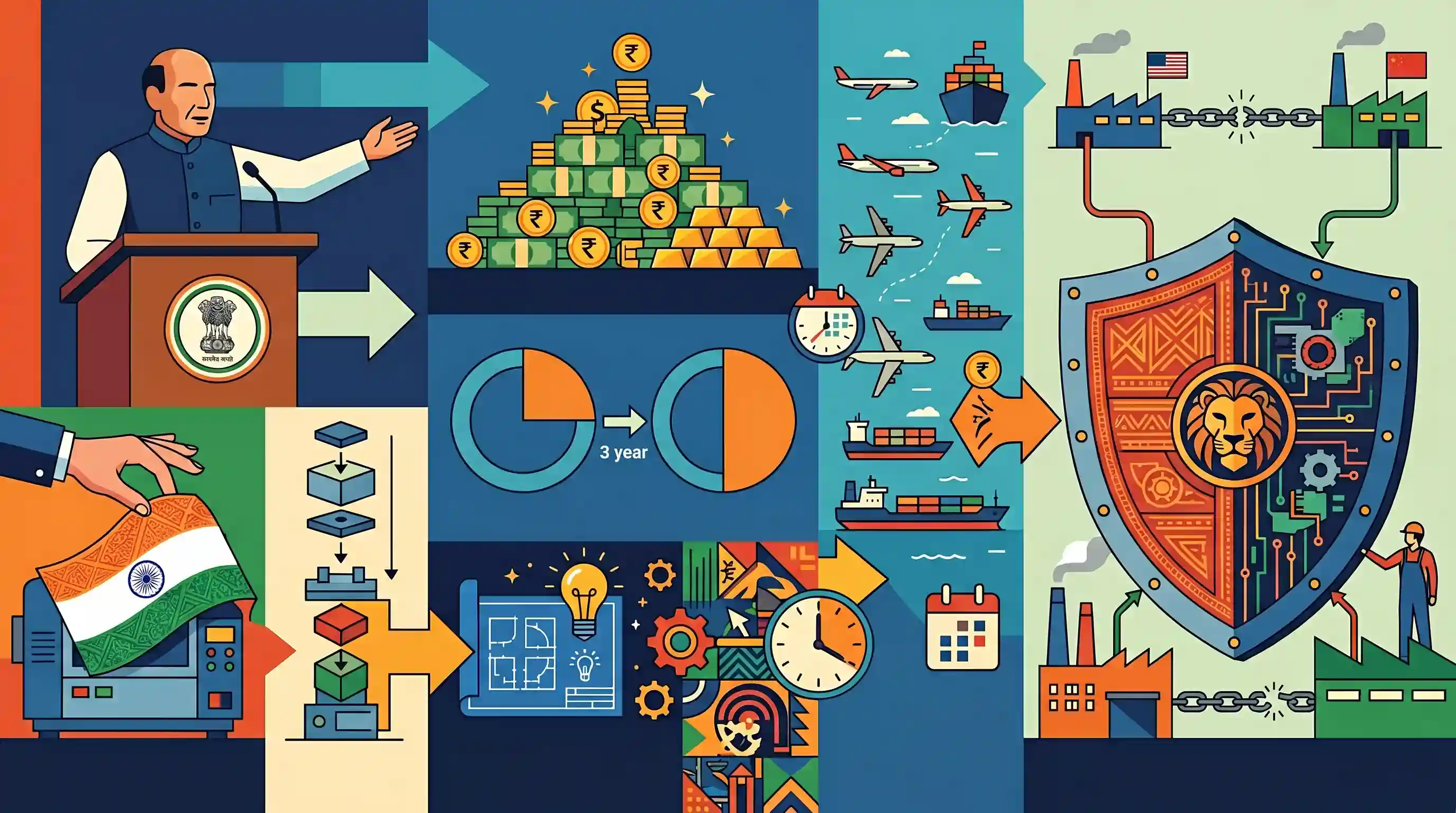
Addressing the Society of Indian Defence Manufacturers, Defence Minister Rajnath Singh emphasized the need for genuine indigenization in India's defence sector. He cautioned private companies against making misleading claims about indigenous content, urging them to shift from mere assembly operations to developing their own R&D and manufacturing capabilities. Highlighting a record defence production of ₹1.51 lakh crore and exports expected to hit ₹30,000 crore by 2026, he called on the private sector to increase its share of domestic manufacturing from 25% to at least 50% over the next three years to reduce long-term dependencies on foreign suppliers for spares and maintenance.
Key Points
- Defence Minister urged the private sector to scale up its share of domestic defence manufacturing from 25% to 50% in three years, cautioning against acting merely as assembly lines for foreign platforms.
- India's defence production stands at a record ₹1.51 lakh crore, with the private sector accounting for ₹33,000 crore.
- Defence exports have reached ₹24,000 crore and are projected to hit ₹30,000 crore by March 2026.
- The government recently launched the Defence Procurement Manual 2025 and is revising the Defence Acquisition Procedure 2020 to streamline processes.
- Highlighted the vulnerability of importing platforms, which creates long-term dependency on foreign suppliers for maintenance, repair, overhaul, and spare parts.
Important Terms
Defence Procurement Manual (DPM) 2025

A 2025 policy framework governing 'revenue procurement' (spares, repairs, and services) for the Armed Forces. It prioritizes indigenous innovation, relaxes penalty clauses, and simplifies processes for private sector and MSME participation.
UPSC context
GS Paper 3 (Security); relevant for 'Indigenization of Technology' and defense budgeting reforms.
Defence Acquisition Procedure (DAP) 2020
The primary regulatory framework governing 'capital acquisitions' (new platforms and systems) for India’s military. It prioritizes 'Buy Indian-IDDM' categories to enhance self-reliance under the Aatmanirbhar Bharat initiative.
UPSC context
GS Paper 3 (Security); tests understanding of policy frameworks for military modernization and indigenous manufacturing.
Society of Indian Defence Manufacturers (SIDM)
The apex non-profit body representing India's defense industry. It facilitates dialogue between the government and manufacturers, advocating for policy reforms to boost domestic R&D and manufacturing capabilities.
UPSC context
GS Paper 3 (Security/Economy); important for 'Private Sector in Defence' and industry-government linkages.
Positive Indigenisation List
Periodic lists notified by the Ministry of Defence identifying specific items, components, or systems that must be sourced exclusively from domestic manufacturers to reduce import dependency.
UPSC context
GS Paper 3 (Security); tests strategies for reducing foreign dependency and strengthening the defense industrial base.
Indigenisation of Technology
The capability to design, develop, and manufacture defense equipment within India. It seeks to achieve strategic autonomy and reduce the financial burden of foreign life-cycle maintenance.
UPSC context
GS Paper 3 (Security/S&T); a core syllabus topic regarding self-reliance in the defense sector.
Revenue Procurement
The acquisition of goods and services for the daily operational maintenance of military assets, such as fuel, spares, and repairs, as distinct from capital acquisition for new hardware.
UPSC context
GS Paper 3 (Security); relevant for distinguishing between operational readiness and military modernization in budget analysis.
Prelims Trap
The newly launched Defence Procurement Manual (DPM) 2025 governs the capital acquisition of new weapon systems.
DPM 2025 handles 'revenue procurements' (day-to-day operations, spares, MRO), whereas the Defence Acquisition Procedure (DAP) 2020 governs 'capital procurements' (new platforms and modernization).
Static Concepts Connected
What is the difference between Capital and Revenue Defence Procurements?
- Capital Procurement: Focuses on acquiring new platforms (tanks, ships) for force modernization. This is governed by the Defence Acquisition Procedure (DAP) 2020.
- Revenue Procurement: Covers running expenses, daily operational needs, spares, and MRO (Maintenance, Repair, Overhaul). This is governed by the Defence Procurement Manual (DPM).
What are the top priority procurement categories under DAP 2020?
- Buy (Indian-IDDM): Highest priority category. Requires indigenous design, development, and manufacturing with a minimum of 50% Indigenous Content (IC).
- Buy (Global-Make in India): Mandates that foreign vendors must manufacture equipment in India (via subsidiaries or joint ventures) with at least 50% IC.
Cross-Topic Patterns
Defence MRO and FDI limits
The push to reduce MRO dependency connects directly to the 2020 policy allowing 74% FDI under the automatic route, encouraging foreign OEMs to shift operations to India.
True Indigenization vs Screwdriver Tech
The warning against "mere assembly lines" mirrors critiques of the electronics PLI scheme, emphasizing the strategic leap from simple import substitution to true domestic Intellectual Property (IP) creation.

Expect a prelims statement swapping DPM 2025 (revenue/spares) and DAP 2020 (capital) mandates, linked to Indigenous Content rules.
Linked PYQs · 1
Linked PYQs · 1
- 2014MainsGS3
Foreign Direct Investment (FDI) in the defence sector is now set to be liberalized. What influence this is expected to have on Indian defence and economy in the short and long run?
