India Multilateral Diplomacy and Regional Cooperation Frameworks
Source:The Hindu ↗
Why It Matters
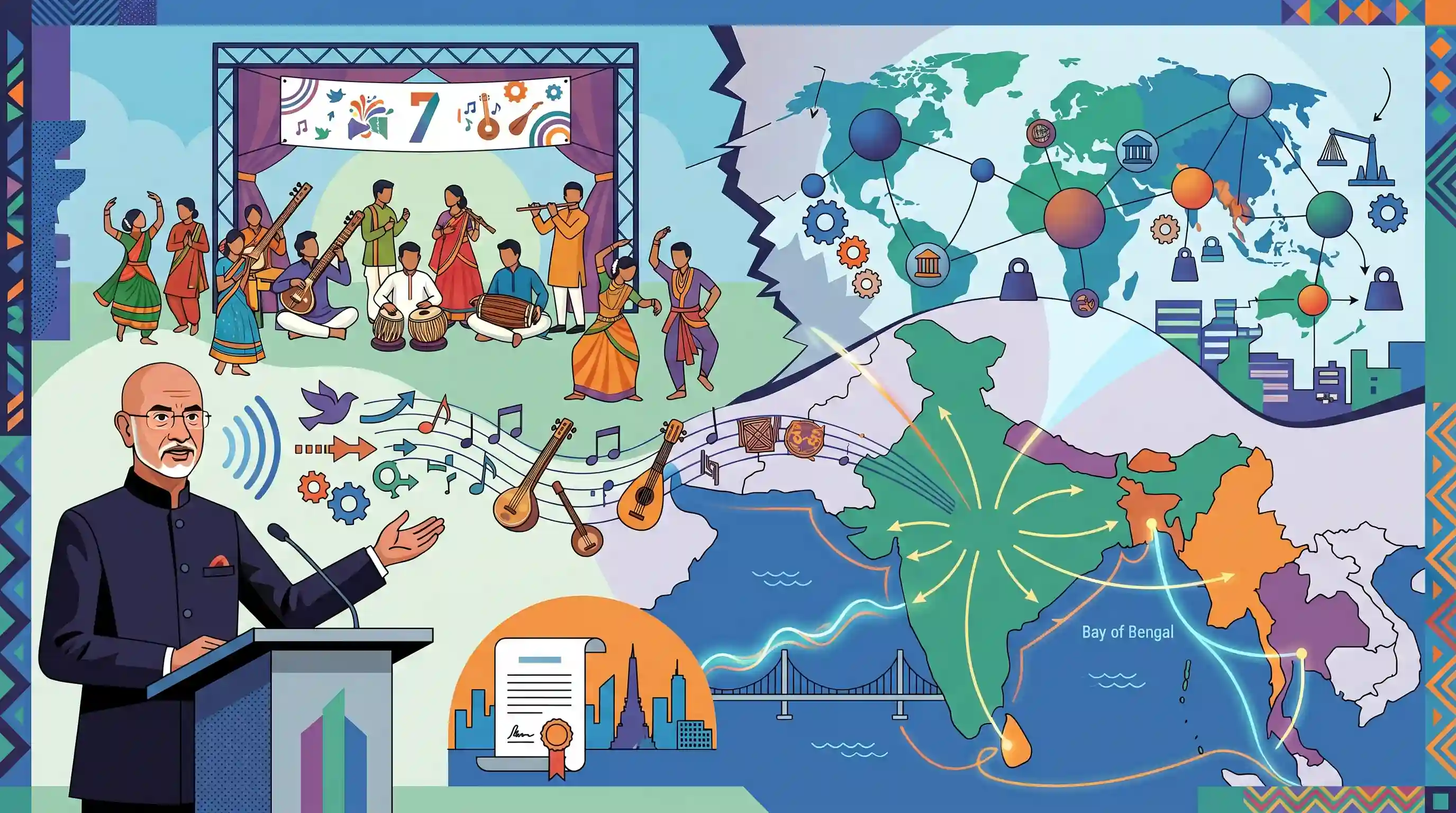
It underscores India's strategic pivot towards BIMSTEC for regional integration in South and Southeast Asia, highlighting the use of soft power (cultural diplomacy) to strengthen ties and navigate a multipolar global order.
Summary
External Affairs Minister S. Jaishankar emphasized the need for a fair, representative, and multipolar global order amid uncertain times during the inaugural BIMSTEC Traditional Music Festival 'Saptasur' in New Delhi. He highlighted the ongoing political and economic rebalancing worldwide, asserting that the international architecture should not be dominated by a few nations. Discussing the origins of BIMSTEC via the 1997 Bangkok Declaration, Jaishankar underlined the significance of cultural diplomacy, shared heritage, and traditional music in fostering regional cooperation and connectivity across the Bay of Bengal region.
Key Points
- EAM S. Jaishankar highlighted the global shift towards a fair, representative, and multipolar order amidst an uncertain and complicated international environment.
- He emphasized the ongoing political and economic rebalancing, asserting that global architecture must reflect diverse voices rather than domination by a few.
- The remarks were made at the inaugural BIMSTEC Traditional Music Festival 'Saptasur' in New Delhi, underscoring the role of cultural diplomacy and soft power in regional cooperation.
- BIMSTEC was established in 1997 via the Bangkok Declaration, originally as BIST-EC, and later expanded to include Myanmar, Bhutan, and Nepal.
- The festival serves as a bridge for the Bay of Bengal nations to celebrate shared heritage, respect, and traditional identity.
Important Terms
BIMSTEC

A regional organization of seven South and Southeast Asian nations (Bangladesh, Bhutan, India, Myanmar, Nepal, Sri Lanka, Thailand) fostering cooperation in the Bay of Bengal region.
UPSC context
GS Paper II: Bilateral/Regional Groupings. Tests understanding of regional integration and India's 'Neighbourhood First' and 'Act East' policies.
Bangkok Declaration (1997)
The founding document signed on June 6, 1997, which established the BIMSTEC (initially BIST-EC) to promote sub-regional economic and technical cooperation.
UPSC context
Prelims/GS Paper II. Relevant for historical genesis of regional blocs and international agreements involving India.
Multipolar Global Order
A global system where power is dispersed among multiple states or blocs (e.g., India, China, USA) rather than dominated by one or two superpowers.
UPSC context
GS Paper II: International Relations. Tests India's vision of 'Strategic Autonomy' and its role in a changing global architecture.
Cultural Diplomacy
The use of a nation's culture, heritage, and values (Soft Power) to foster mutual understanding and strengthen international relationships and influence.
UPSC context
GS Paper II: Soft Power. Tests how non-traditional diplomatic tools like music/heritage promote India's interests.
Act East Policy
India's strategic initiative to strengthen economic, cultural, and security ties with Southeast Asian nations, with BIMSTEC serving as a primary link.
UPSC context
GS Paper II: Foreign Policy. Tests India's regional outreach and the shift from 'Look East' to a more proactive stance.
Multilateralism
A framework of international cooperation involving multiple countries to address global issues, often through institutions like the UN, G20, or BIMSTEC.
UPSC context
GS Paper II: Global Groupings. Tests understanding of collaborative governance and challenges to the rules-based international order.
Prelims Trap
"BIMSTEC includes exclusively coastal countries of the Bay of Bengal and was established via the Dhaka Declaration."
BIMSTEC was established by the 1997 Bangkok Declaration, not Dhaka. Additionally, Nepal and Bhutan are landlocked members, while Indonesia/Malaysia share the Bay but aren't members.
Static Concepts Connected
What are the foundational geopolitical differences between SAARC and BIMSTEC?
- Founding Declarations: SAARC was established by the 1985 Dhaka Declaration, whereas BIMSTEC emerged from the 1997 Bangkok Declaration, initially as BIST-EC.
- Member Composition: BIMSTEC excludes Pakistan, Afghanistan, and Maldives, but acts as a bridge to Southeast Asia by including Myanmar and Thailand alongside landlocked Nepal and Bhutan.
- Bilateral disputes: SAARC’s progress is often paralyzed by bilateral political disputes, whereas BIMSTEC explicitly focuses on sector-driven technical and economic cooperation, avoiding contentious bilateral politics.
What are the primary instruments of India's Soft Power diplomacy?
- Cultural Diplomacy: Promoting civilizational links such as Buddhism circuits, the International Day of Yoga, and traditional arts/music festivals to foster organic geopolitical goodwill.
- Development Assistance: Providing non-coercive capacity building through ITEC programs, developmental lines of credit, and rapid Humanitarian Assistance and Disaster Relief (HADR) in the region.
- Diaspora Leverage: Mobilizing the vast Indian diaspora to advocate for Indian interests, drive foreign direct investment, and act as cultural ambassadors in host nations.
Cross-Topic Patterns
BIMSTEC and Act East synergy
India uses BIMSTEC as the institutional bridge between its Neighbourhood First and Act East policies, centering Northeast India's development through connectivity projects like the Kaladan Multi-Modal Transit Transport Project.
Soft power countering hard economic diplomacy
India's cultural push for a "multipolar order" helps counter China's aggressive economic diplomacy (BRI) by emphasizing historical parity, shared regional heritage, and mutual respect over debt-heavy infrastructure.

BIMSTEC’s member additions (Nepal/Bhutan in 2004) and Bangkok Declaration origins are prime traps for a 2026 Prelims multi-statement MCQ.
Linked PYQs · 4
Linked PYQs · 4
- 2025PrelimsGS1
Consider the following statements in respect of BIMSTEC : I. It is a regional organization consisting of seven member States till January 2025. II. It came into existence with the signing of the Dhaka Declaration, 1999. III. Bangladesh, India, Sri Lanka, Thailand and Nepal are founding member States of BIMSTEC. IV. In BIMSTEC, the subsector of 'tourism' is being led by India. Which of the statements given above is/are correct?
- 2022MainsGS2
Do you think that BIMSTEC is a parallel organisation like the SAARC ? What are the similarities and dissimilarities between the two ? How are Indian foreign policy objectives realized by forming this new organisation?
- 2011MainsGS2
Compared to the South Asian Free Trade Area (SAFTA), the Bay of Bengal Initiative for Multisectoral Technical and Economic Cooperation Free Trade Area (BIMSTEC FTA) seems to be more promising." Critically evaluate.
- 2015MainsGS2
Terrorist activities and mutual distrust have clouded India-Pakistan relations. To what extent the use of soft power like sports and cultural exchanges could help generate goodwill between the two countries? Discuss with suitable examples.
