Supreme Court Directive on Ganga Floodplain Encroachments in Patna
Source:rediff ↗
Why It Matters
Highlights the active role of the Supreme Court in environmental jurisprudence and overseeing the protection of eco-fragile zones like river floodplains, which are essential topics under GS Paper 2 (Judiciary/Governance) and GS Paper 3 (Environment/Ecology).
Summary
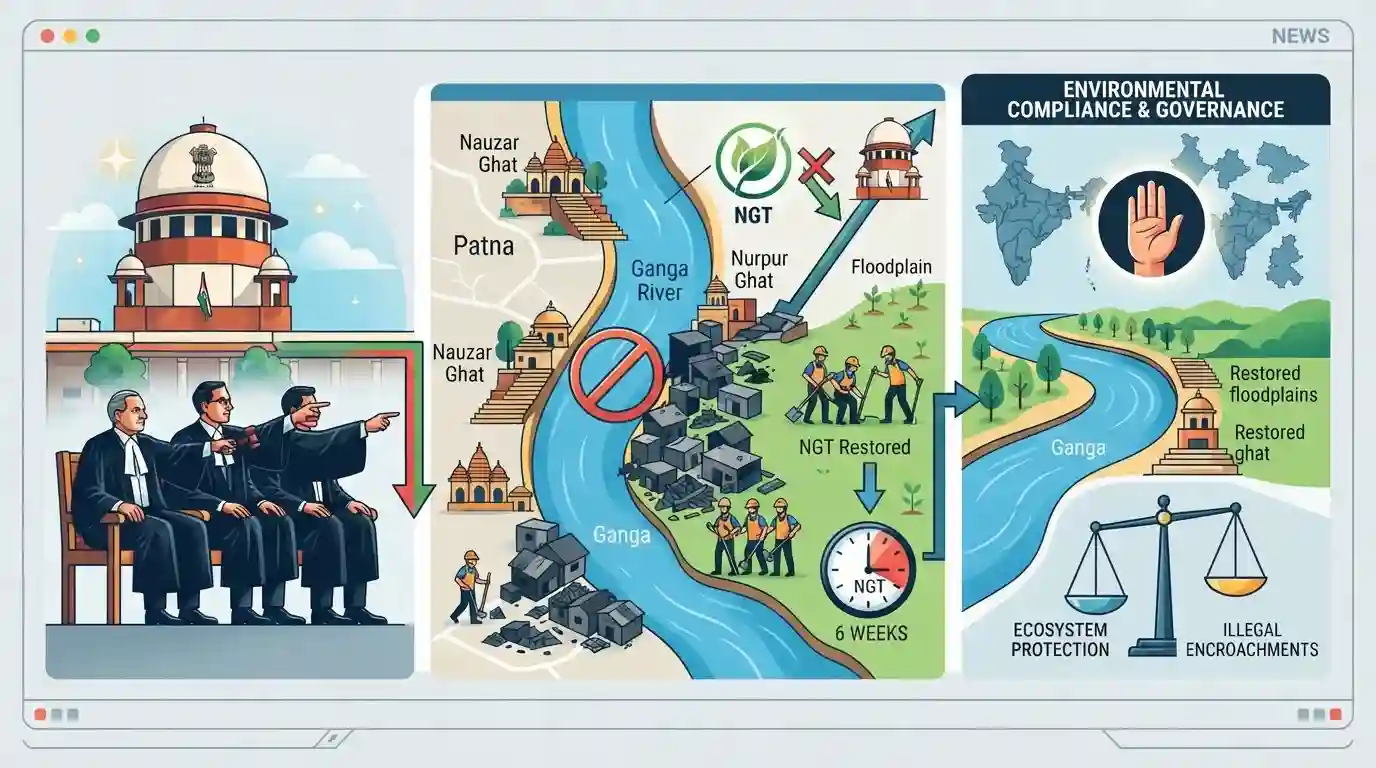
The Supreme Court of India has ordered the Bihar government to remove all illegal constructions and encroachments along the Ganga riverbanks in Patna within six weeks. The directive focuses on the eco-fragile floodplains between Nauzar Ghat and Nurpur Ghat. This decision overturned an earlier National Green Tribunal (NGT) order that had dismissed a plea regarding these encroachments. The Court issued a stern warning for strict compliance to protect the river's ecosystem and signaled broader scrutiny of environmental compliance across other states.
Key Points
- The Supreme Court of India has given the Bihar government a six-week deadline to clear all illegal constructions along the Ganga riverbanks in Patna.
- The targeted encroachments are primarily situated between Nauzar Ghat and Nurpur Ghat.
- The ruling stems from a plea challenging a National Green Tribunal (NGT) order that had dismissed an application against illegal constructions on the eco-fragile floodplains.
- The Supreme Court emphasized the critical need to protect the environmental integrity of the Ganga floodplains and warned of contempt proceedings for non-compliance.
- The apex court has also issued warnings to other states regarding environmental compliance and illegal encroachments.
Important Terms
Supreme Court of India

The apex judicial body in India, established under the Constitution. It holds the power of judicial review and actively issues directives for environmental protection, interpreting a healthy environment as a fundamental right under Article 21.
UPSC context
GS-II (Judiciary); tests constitutional powers, judicial activism, and the judiciary's role in environmental governance.
National Green Tribunal (NGT)
A specialized statutory body established under the NGT Act, 2010. It handles the effective and expeditious disposal of civil cases relating to environmental protection, forest conservation, and the enforcement of environmental legal rights.
UPSC context
GS-III (Environment) & GS-II (Statutory Bodies); tests specialized environmental dispute resolution mechanisms and tribunal functions.
Government of Bihar
The sub-national executive authority of Bihar. Under India's federal structure, state governments carry constitutional and statutory obligations to prevent encroachments, manage floodplains, and enforce environmental conservation within their jurisdictions.
UPSC context
GS-II (Federalism) & GS-III (Environment); highlights state-level responsibilities and executive accountability in ecological governance.
Supreme Court of India
The apex judicial body in India, established under the Constitution. It holds the power of judicial review and actively issues directives for environmental protection, interpreting a healthy environment as a fundamental right under Article 21.
UPSC context
GS-II (Judiciary); tests constitutional powers, judicial activism, and the judiciary's role in environmental governance.
Prelims Trap
"Appeals against National Green Tribunal (NGT) orders must be routed through the High Court before reaching the Supreme Court."
While HC writ jurisdiction exists, Section 22 of the NGT Act 2010 provides a direct statutory appeal to the Supreme Court within 90 days.
Static Concepts Connected
What are the foundational rules and principles guiding the National Green Tribunal (NGT)?
- Natural Justice: The NGT is not bound by the Code of Civil Procedure (1908) or Indian Evidence Act (1872), relying instead on principles of natural justice.
- Statutory Principles: Section 20 of the NGT Act mandates applying Sustainable Development, the Precautionary Principle, and the Polluter Pays Principle in its orders.
- Civil Jurisdiction: It handles civil cases involving substantial environmental questions linked to seven specific laws, including the Water Act and Forest (Conservation) Act.
Why are river floodplains critical for ecological stability and disaster mitigation?
- Hydrological Buffer: They absorb excess water during heavy monsoons, acting as a natural sponge that significantly mitigates downstream flood intensity.
- Groundwater Recharge: The slow percolation of stored floodwater replenishes local aquifers and maintains the regional groundwater table during dry seasons.
- Biodiversity Hub: Floodplains support unique riparian flora and fauna, serving as essential breeding grounds for riverine species like the endangered Gangetic Dolphin.
Cross-Topic Patterns
Floodplain Encroachment & Urban Flooding
The SC's focus on floodplain clearing links to GS3 Disaster Management. Encroachments in Patna mirror the root causes of recent catastrophic urban floods in Chennai, Delhi, and Bengaluru.
Tribunal Decisions vs. Judicial Review
The SC overturning the NGT highlights the ongoing dynamic between statutory environmental tribunals and the overarching appellate and writ jurisdictions of India's constitutional courts.

Expect a 2026 Prelims question mixing the NGT's statutory guiding principles (Precautionary/Polluter Pays) with its exact appellate route.
Linked PYQs · 3
Linked PYQs · 3
- 2023BPSC_PRELIMSGS1
Consider the following statements regarding the ‘Gangetic Dolphin’: 1. The Gangetic River Dolphin has been categorized as ‘endangered’ under the IUCN’s Red List. 2. It does not have a crystalline eye lens rendering it effectively blind. 3. Navigation and hunting are carried out using echolocation. 4. It has been recognized as India’s National Aquatic Animal.
- 2022BPSC_PRELIMSGS1
Ganga Plain has been described as a
- 2024-EBPSC_PRELIMSGS1
Which of the following drainage systems drains the lands of Bihar?
