Tribal Displacement Concerns in Ken Betwa River Linking Project
Source:The Hindu ↗
Why It Matters
It provides a real-world case study of the development vs. conservation debate, illustrating the socio-ecological costs of large infrastructure projects and highlighting critical vulnerabilities in tribal rights and rehabilitation policies.
Summary
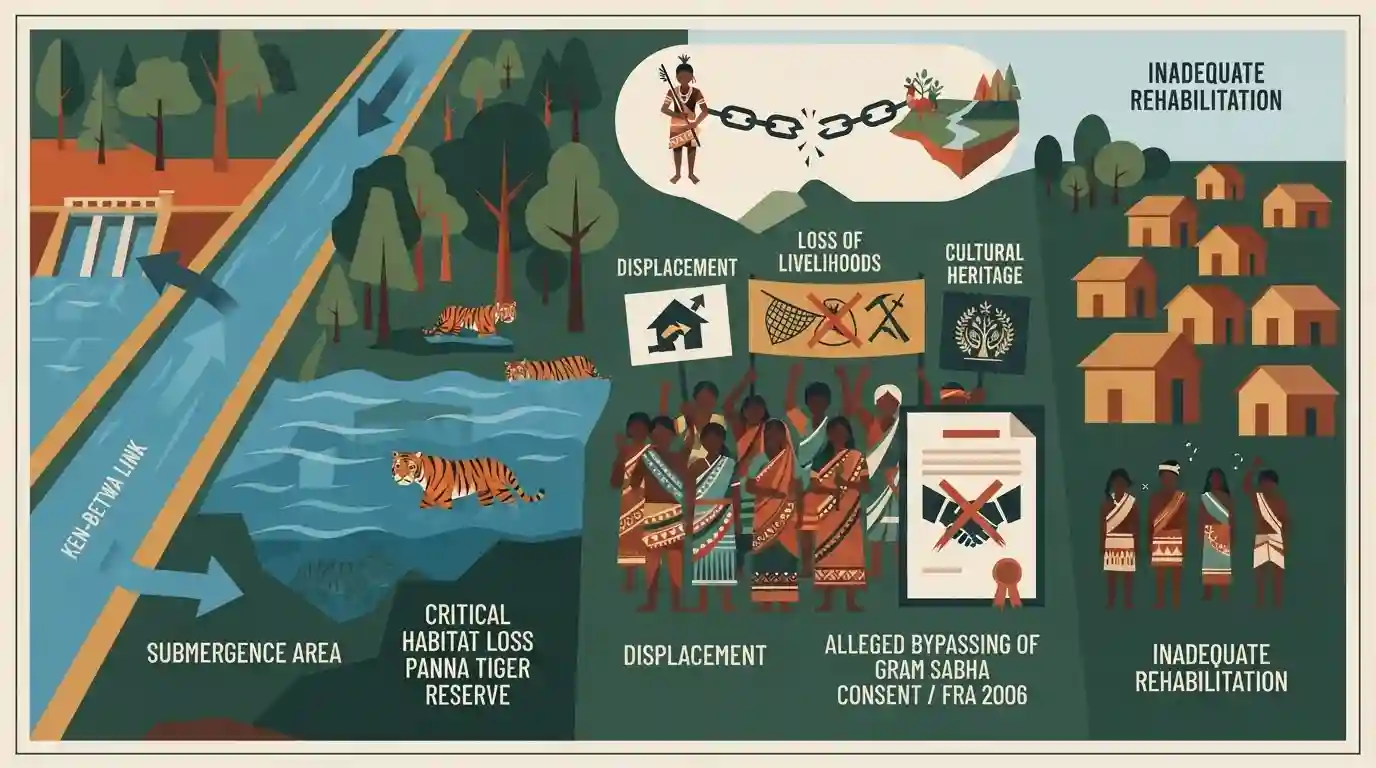
The article examines the resistance of Adivasi communities against the Ken-Betwa river interlinking project. While the project is designed to address water scarcity in the Bundelkhand region, it poses severe socio-ecological threats, notably the submergence of critical habitats within the Panna Tiger Reserve. Local tribal populations are protesting their imminent displacement, highlighting concerns over the loss of their ancestral lands, forest-dependent livelihoods, and cultural heritage. The resistance also underscores broader governance issues, including inadequate rehabilitation measures and the alleged bypassing of mandatory Gram Sabha consent under the Forest Rights Act (FRA), 2006, reflecting the perennial conflict between large-scale infrastructure development and the rights of marginalized communities.
Key Points
- The Ken-Betwa river interlinking project aims to transfer surplus water from the Ken basin to the deficit Betwa basin to irrigate the drought-prone Bundelkhand region.
- The project will lead to the submergence of a large area of the Panna Tiger Reserve, causing severe ecological disruption and loss of critical wildlife habitats.
- Local Adivasi communities are resisting the project due to the threat of displacement, loss of traditional forest-based livelihoods, and detachment from their ancestral lands.
- Tribal resistance highlights systemic issues with inadequate Rehabilitation and Resettlement (R&R) policies and alleged violations of the Forest Rights Act (FRA), particularly regarding the mandatory consent of the Gram Sabha.
Important Terms
Ken-Betwa River Link Project

A massive river-interlinking project aiming to divert surplus water from the Ken basin to the Betwa basin to alleviate drought in the Bundelkhand region, involving the construction of the Daudhan Dam.
UPSC context
Crucial for GS Paper III (Infrastructure, Environment). Tests understanding of inter-basin transfers, water sharing, and conflict between development and conservation.
Forest Rights Act (FRA), 2006
A landmark 2006 legislation that formally recognizes and vests forest rights, such as land tenure, self-cultivation, and livelihood rights, to forest-dwelling Scheduled Tribes and other traditional forest dwellers.
UPSC context
Vital for GS Paper II (Social Justice). Often appears in Prelims/Mains regarding tribal empowerment, land acquisition, and historical injustice.
Panna Tiger Reserve
A critical tiger habitat in Madhya Pradesh that faces partial submergence due to the Ken-Betwa River Link Project's proposed Daudhan Dam, threatening local biodiversity and key species corridors.
UPSC context
Important for GS Paper III (Environment). Highlights the trade-offs between mega-infrastructure projects and mandatory wildlife conservation commitments.
Gram Sabha
The village assembly, acting as the primary authority under the FRA 2006, responsible for initiating the process of determining and protecting individual and community forest rights.
UPSC context
Key in GS Paper II (Governance) and Prelims. Tests knowledge of decentralized decision-making, statutory consent for land diversion, and FRA mechanisms.
National Tiger Conservation Authority (NTCA)
A statutory body under the Ministry of Environment, Forest and Climate Change, established in 2005 to oversee Project Tiger and provide regulatory oversight for tiger reserve management.
UPSC context
High-yield for Prelims and GS Paper III. Candidates must know its statutory backing (Wildlife Protection Act) and clearance requirements for projects.
Prelims Trap
Once a mega-project receives MoEFCC forest clearance, traditional forest dwellers can be legally evicted.
Under Section 4(5) of the FRA 2006, eviction of forest dwellers is strictly prohibited until the entire rights recognition process is complete, regardless of environmental clearances.
Static Concepts Connected
What is the geographical profile of the Ken and Betwa rivers?
- Origin and flow: Both originate in the Vindhya Range in Madhya Pradesh and flow generally northwards.
- Yamuna tributaries: They are major right-bank tributaries of the Yamuna River, primarily draining the drought-prone Bundelkhand region.
- Interlinking direction: The Ken-Betwa link transfers surplus water from Ken to the deficit Betwa basin, forming the first project under the National Perspective Plan.
What are the statutory powers of the Gram Sabha under the FRA, 2006?
- Rights initiation: It is the legally mandated authority to initiate the process for determining the nature and extent of Individual (IFR) and Community Forest Rights (CFR).
- Diversion consent: Statutory prior informed consent from the Gram Sabha is mandatory before forest land can be diverted for non-forest infrastructure projects.
Cross-Topic Patterns
Infrastructure vs. FRA (Polity + Env)
Relates to the systemic tension seen in Polavaram and Hasdeo Arand, frequently testing the intersection of environmental clearances, PESA, and FRA in Schedule V areas.
Tiger Reserve Compensatory Landscapes
The mandate to integrate Panna with Nauradehi and Veerangana Durgavati sanctuaries links infrastructure mitigation directly to NTCA landscape corridor strategies and the NBWL's statutory role.

Expect a multi-statement question mapping Ken-Betwa (Yamuna tributaries) with Panna Tiger Reserve submergence and Gram Sabha FRA powers.
Linked PYQs · 3
Linked PYQs · 3
- 2017MainsGS3
Not many years ago, river linking was a concept but it is becoming a reality in the country. Discuss the advantages of river linking and its possible impact on the environment.
- 2025MainsGS1
Does tribal development in India centre around two axes, those of displacement and of rehabilitation? Give your opinion.
- 2013PrelimsGS1
Under the Scheduled Tribes and Other Traditional Forest Dwellers (Recognition of Forest Rights) Act, 2006, who shall be the authority to initiate the process for determining the nature and extent of individual or community forest rights or both?
