WhatsApp Data Sharing Privacy Policy Supreme Court Competition Law
Source:The Hindu ↗
Why It Matters
The case highlights the complex intersection of fundamental rights (Right to Privacy under Article 21), competition law, and emerging data governance frameworks like the DPDP Act, 2023. It demonstrates the evolving challenges in regulating Big Tech, securing digital consumer rights, and addressing monopolistic practices in the digital economy, all of which are highly relevant for GS2 (Polity & Governance) and GS3 (Economy & Cyber Security).
Summary
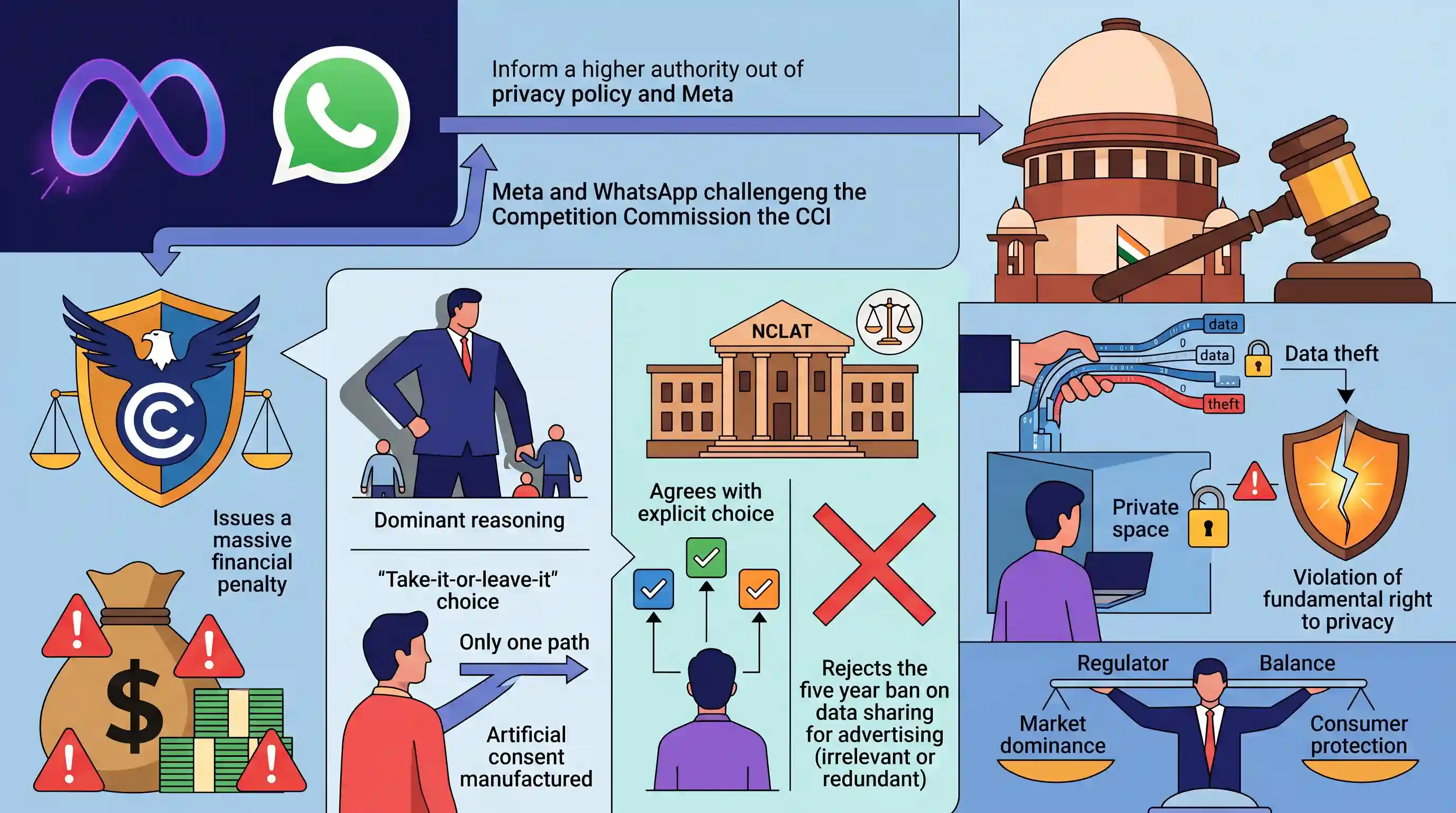
WhatsApp and its parent company Meta informed the Supreme Court that they do not share user data, highlighting their compliance with the NCLAT's directives concerning their 2021 privacy policy. Both tech firms are challenging a ₹213.14 crore penalty issued by the Competition Commission of India (CCI), which had deemed WhatsApp's “take-it-or-leave-it” policy as an abuse of its dominant market position and labeled user consent as “manufactured.” Although the NCLAT concurred that users must have explicit choices regarding data collection, it found CCI’s five-year ban on sharing data for advertising purposes "redundant." The Supreme Court previously observed that non-consensual commercial exploitation of the data of millions of consumers equates to "theft" and an infringement of the fundamental right to privacy. The CCI maintains the case is a crucial competition law concern regarding protecting markets and consumers from data monopolies.
Key Points
- Meta and WhatsApp assured the Supreme Court they do not share user data among themselves, contesting a ₹213.14 crore penalty levied by the Competition Commission of India (CCI).
- The CCI previously ruled that WhatsApp's 2021 privacy policy was an abuse of its market dominance, coercing users with a "take-it-or-leave-it" approach resulting in "manufactured" consent.
- The National Company Law Appellate Tribunal (NCLAT) upheld that data collection must offer users a choice but struck down the CCI's five-year ban on sharing data for advertising, deeming it redundant.
- WhatsApp argued it aligns with the Digital Personal Data Protection (DPDP) Act, 2023, while the Supreme Court emphasized that non-consensual exploitation of user data is akin to theft.
- The CCI stressed that the issue spans beyond privacy, constituting a significant competition law concern related to market protection and preventing data monopolies.
Important Terms
Competition Commission of India (CCI)

A statutory body established under the Competition Act, 2002, responsible for enforcing competition laws to prevent anti-competitive practices and protect consumer interests in India.
UPSC context
GS-II (Statutory and Quasi-judicial bodies) and GS-III (Indian Economy); tests knowledge of market regulation and consumer protection frameworks.
National Company Law Appellate Tribunal (NCLAT)
A statutory tribunal established under the Companies Act, 2013, to hear appeals against decisions from the National Company Law Tribunal (NCLT) and the Competition Commission of India (CCI).
UPSC context
GS-II (Quasi-judicial bodies); essential for understanding the corporate legal hierarchy and dispute resolution in governance.
Digital Personal Data Protection (DPDP) Act, 2023
India's primary legal framework for governing the processing of personal data, mandating user consent, and balancing individual privacy rights with legitimate business needs.
UPSC context
GS-II (Governance and Privacy) and GS-III (Technology/Cybersecurity); central to questions on digital rights and state-citizen relations.
Right to Privacy (Article 21)
Declared a fundamental right under Article 21 by the Supreme Court in the 2017 Puttaswamy judgment, ensuring protection against unauthorized data collection or surveillance.
UPSC context
GS-II (Polity and Fundamental Rights); a frequent focus in constitutional law and contemporary human rights debates.
Abuse of Dominant Position
A legal violation under the Competition Act where a company uses its market power to impose unfair terms, restrict competition, or exploit consumers.
UPSC context
GS-III (Indian Economy); critical for analyzing market monopolies, Big Tech regulation, and fair trade practices.
Supreme Court
The apex judicial body of India with the power of judicial review and the final authority on constitutional interpretation and fundamental rights protection.
UPSC context
GS-II (Judiciary); tests understanding of its role in upholding the Constitution and checking executive or private overreach.
Prelims Trap
Appeals against the orders of the Competition Commission of India (CCI) lie exclusively and directly with the Supreme Court.
Since 2017, appeals against CCI orders first go to the National Company Law Appellate Tribunal (NCLAT), which replaced the defunct COMPAT. Only subsequent appeals go to the Supreme Court.
Static Concepts Connected
What is the appellate structure for the Competition Commission of India (CCI)?
- NCLAT Jurisdiction: NCLAT acts as the appellate authority to hear and dispose of appeals against any direction issued or decision made by the CCI.
- COMPAT Replacement: In 2017, the Competition Appellate Tribunal (COMPAT) was dissolved, and its appellate functions over CCI were formally transferred to NCLAT.
- Supreme Court Appeals: Further appeals against the orders of the NCLAT in competition matters lie directly with the Supreme Court of India.
How does the DPDP Act 2023 conceptualize user consent?
- Fiduciaries vs Principals: Entities collecting data are Fiduciaries; users are Principals. Fiduciaries can only process data for lawful purposes based on explicit consent.
- Explicit Consent: Processing requires free, specific, informed, unconditional, and unambiguous consent with a clear, itemized notice. "Take-it-or-leave-it" bundles often violate this.
- Legitimate Uses: Exemptions exist for State services, medical emergencies, and employment purposes where data can be processed without explicit consent.
Cross-Topic Patterns
Data Monopolies & Antitrust Regulation
The CCI treating data dominance as an antitrust issue bridges tech governance (DPDP Act) with economic regulation, treating consumer data as an anti-competitive economic moat rather than just a privacy concern.
Horizontal Application of Article 21
The SC equating non-consensual commercial data exploitation to "theft" signals a shift towards enforcing the Puttaswamy framework horizontally against private corporate entities via statutory regulators.

Expect a multi-statement question interlinking CCI's mandate on data monopolies, NCLAT's appellate jurisdiction, and DPDP Act provisions.
Linked PYQs · 5
Linked PYQs · 5
- 2024MainsGS2
Right to privacy is intrinsic to life and personal liberty and is inherently protected under Article 21 of the constitution. Explain. In this reference discuss the law relating to D.N.A. testing of child in the womb to establish its paternity.
- 2017MainsGS2
Examine the scope of Fundamental Rights in the light of the latest judgement of the Supreme Court on Right to Privacy.
- 2024PrelimsGS1
Under which of the following Articles of the Constitution of India, has the Supreme Court of India placed the Right to Privacy ?
- 2021PrelimsGS1
'Right to Privacy' is protected under which Article of the Constitution of India?
- 2018PrelimsGS1
Right to Privacy is protected as an intrinsic part of Right to Life and Personal Liberty. Which of the following in the Constitution of India correctly and appropriately imply the above statement?
