Human Wildlife Conflict and Urban Habitat Fragmentation in Delhi
Source:Indian Express ↗
Why It Matters
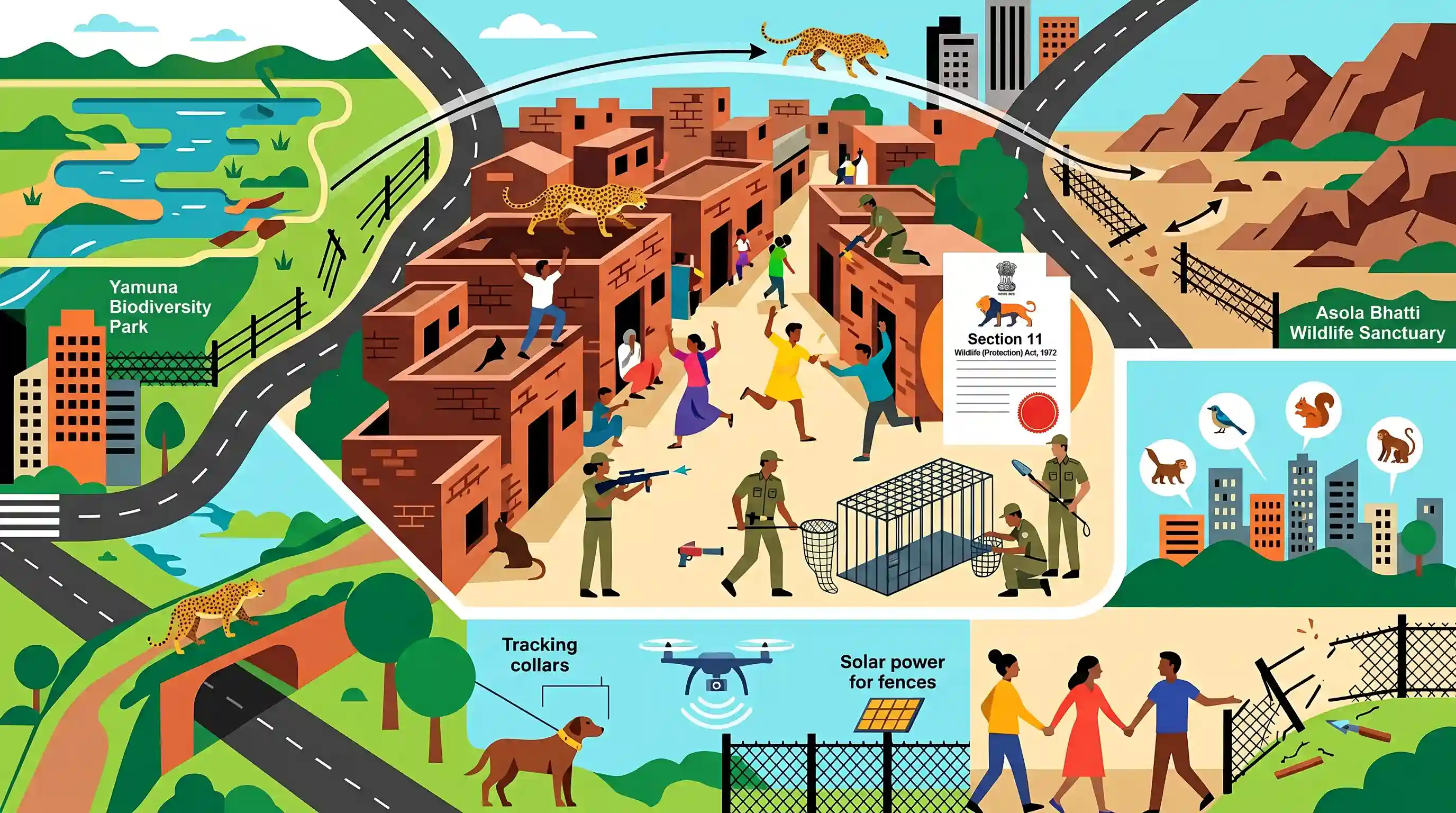
Illustrates the practical application of the Wildlife (Protection) Act (specifically Section 11 regarding capturing animals posing danger to human life) and serves as a case study for human-wildlife conflict and coexistence in urban environments.
Summary
A leopard sighted in Delhi's Jagatpur village has caused widespread panic among residents, prompting the Department of Forests and Wildlife to initiate rescue operations. Authorities invoked Section 11 of the Wildlife (Protection) Act, 1972, to legally set traps for capturing and relocating the animal. The leopard is believed to have strayed from nearby protected areas such as the Yamuna Biodiversity Park or Asola Bhatti Wildlife Sanctuary. The incident highlights the growing challenges of urban wildlife management, habitat fragmentation, and the need for effective human-animal coexistence strategies.
Key Points
- A leopard roaming in Delhi's Jagatpur village injured several people, causing widespread panic and halting agricultural activities.
- The Forest Department invoked Section 11 of the Wildlife (Protection) Act, 1972, to legally trap and relocate the animal, as it poses a danger to human life.
- The leopard is believed to have strayed from the Yamuna Biodiversity Park or the Asola Bhatti Wildlife Sanctuary, drawing attention to habitat fragmentation and shrinking wildlife corridors around urban centers.
- Experts highlight the necessity of public awareness to prevent provoking stranded wild animals, advocating for better human-wildlife coexistence models similar to those near Sanjay Gandhi National Park in Mumbai.
Important Terms
Wildlife (Protection) Act, 1972 (WPA)

Enacted in 1972, this landmark Indian legislation provides a legal framework for protecting wild animals, birds, and plants. it establishes various schedules of protection and prohibits hunting or trading of endangered species.
UPSC context
GS Paper III (Environment & Biodiversity); central to questions on conservation laws, protected areas, and species-specific protection schedules.
Section 11 of WPA 1972
A legal provision empowering the Chief Wildlife Warden to permit the hunting, capture, or relocation of Schedule I wild animals if they become dangerous to human life or are beyond recovery.
UPSC context
GS Paper III (Internal Security/Environment); tests knowledge of administrative powers in managing human-animal conflict and legal exceptions to hunting bans.
Centre for Environmental Management of Degraded Ecosystems (CEMDE)
A University of Delhi research center that provides technical expertise for restoring degraded landscapes and manages Delhi’s biodiversity parks, focusing on reviving native ecosystems and urban biodiversity.
UPSC context
GS Paper III (Environment); relevant for urban planning, ecological restoration models, and collaborative governance in biodiversity conservation.
Human-Wildlife Conflict (HWC)
Interactions between humans and wildlife that result in negative impacts on human social, economic, or cultural life, or on the conservation of wildlife populations and their environment.
UPSC context
GS Paper III (Environment); a recurring theme in Mains regarding habitat loss, urban sprawl, and coexistence strategies.
Yamuna Biodiversity Park
A 457-acre restored floodplain ecosystem in Delhi developed by the DDA and CEMDE. It serves as a vital urban carbon sink and a habitat for diverse flora and fauna.
UPSC context
GS Paper III (Environment); an example of successful ecosystem restoration and "green infrastructure" in a mega-city context.
Habitat Fragmentation
The process where large, continuous habitats are divided into smaller, isolated patches, often due to infrastructure development, leading to biodiversity loss and increased human-wildlife encounters.
UPSC context
GS Paper III (Environment); critical for understanding ecological degradation, wildlife corridors, and the impacts of linear infrastructure projects.
Prelims Trap
"The Central Government or NBWL must authorize the trapping of a Schedule I animal."
Under Section 11 of the WPA 1972, the Chief Wildlife Warden of the State (not the Centre/NBWL) authorizes hunting or trapping of a dangerous Schedule I animal.
Static Concepts Connected
When can a Schedule I animal be legally hunted or trapped under WPA 1972?
- Danger to Life: If the Chief Wildlife Warden is satisfied the animal has become a danger to human life, or is diseased/disabled beyond recovery.
- Capture over Kill: The law mandates capture, tranquilization, or translocation first; killing is permitted only as an absolute last resort.
- State Authority: The Chief Wildlife Warden (a state-level authority) grants the permission in writing, stating the specific reasons.
What is the ecological significance of the Asola Bhatti Wildlife Sanctuary?
- Geographic Location: It is situated on the Southern Delhi Ridge of the Aravalli hill range on the Delhi-Haryana border.
- Sariska-Delhi Corridor: It functions as a vital wildlife corridor linking the Sariska Tiger Reserve in Rajasthan to the Delhi Ridge, facilitating species movement.
Cross-Topic Patterns
SGNP, Warlis & Waghoba Deity
Coexistence in Mumbai's SGNP is aided by the indigenous Warli tribe's reverence for leopards as 'Waghoba', blending cultural conservation with urban wildlife management.
Aravallis & Shrinking Wildlife Corridors
The straying of leopards into Delhi directly links to the degradation of the Sariska-Delhi wildlife corridor caused by illegal mining and urban sprawl.

Expect a 2026 Prelims pair-matching question linking urban wildlife sanctuaries (Asola Bhatti, SGNP) to their hill ranges or tribal links.
Linked PYQs · 2
Linked PYQs · 2
- 2022PrelimsGS1
With reference to Indian laws about wildlife protection, consider the following statements : 1. Wild animals are the sole property of the government. 2. When a wild animal is declared protected, such animal is entitled for equal protection whether it is found in protected areas or outside. 3. Apprehension of a protected wild animal becoming a danger to human life is sufficient ground for its capture or killing. Which of the statements given above is/are correct?
- 2017PrelimsGS1
According to the Wildlife (Protection) Act, 1972, which of the following animals cannot be hunted by any person except under some provisions provided by law? 1. Gharial 2. Indian wild ass 3. Wild buffalo Select the correct answer using the code given below:
