Indigenization of Artificial Intelligence and Tech Sovereignty
Source:Indian Express ↗
Why It Matters
The shift from consuming to creating AI technologies directly addresses the GS3 syllabus topic of 'indigenization of technology'. It highlights the intersection of technological advancement with socio-economic development, making it a highly probable theme for Mains questions regarding digital sovereignty, AI applications, and tech policy.
Summary
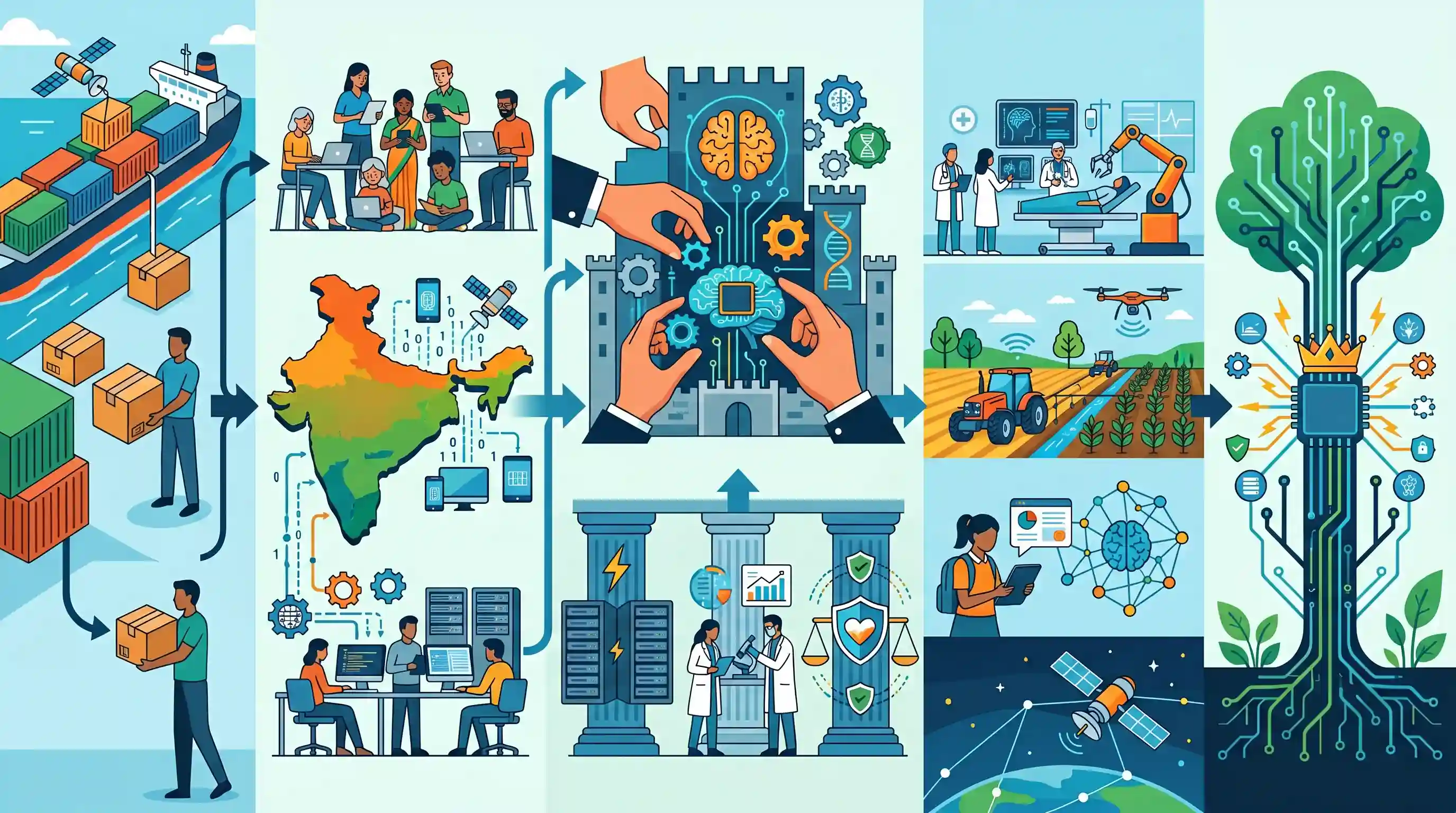
The article argues that India must transition from being a mere consumer of Western-developed Artificial Intelligence (AI) to becoming an active co-creator. By leveraging its vast demographic dividend, massive data generation, and skilled IT workforce, India can develop indigenous AI solutions tailored to local challenges in healthcare, agriculture, and education. Achieving this "tech sovereignty" requires robust investments in compute infrastructure, localized research, and ethical AI frameworks to ensure the technology serves domestic societal needs without leading to digital dependency.
Key Points
- India’s current reliance on foreign-developed AI models risks long-term digital dependency and technological subservience.
- The country must shift from being a mere consumer to a co-creator of AI by leveraging its massive data generation, linguistic diversity, and skilled IT workforce.
- Indigenous AI development should prioritize solving local, India-specific challenges in sectors like healthcare, agriculture, and education.
- Achieving AI sovereignty requires robust investments in domestic compute infrastructure (such as GPUs) and fostering deep-tech research ecosystems.
- A localized, ethical regulatory framework is essential to govern AI development and ensure equitable societal benefits.
Prelims Trap
The IndiaAI Mission mandates that all AI models deployed in India must be trained exclusively on domestic servers.
The mission funds 10,000+ domestic GPUs to promote indigenous LMMs, but it does NOT ban or mandate exclusivity against foreign AI models.
Static Concepts Connected
What are the core components of India's Digital Public Infrastructure (DPI)?
- Identity Layer: Aadhaar provides unique, biometric-backed digital identity, forming the base for social inclusion.
- Payments Layer: UPI enables seamless, interoperable, real-time financial transactions at a population scale.
- Data Layer: Data Empowerment and Protection Architecture (DEPA) allows secure, consent-based personal data sharing.
What is the difference between Narrow AI and Artificial General Intelligence (AGI)?
- Narrow AI: Trained to perform specific tasks (e.g., language translation via Bhashini). All existing commercial AI systems fall under this category.
- General AI (AGI): Theoretical systems with human-equivalent cognitive capabilities, able to learn and adapt across any generalized task independently without explicit programming.
Cross-Topic Patterns
AI Sovereignty + Data Colonization
Links tech indigenization with 'data colonialism,' where raw demographic data from the Global South is harvested, processed in the West, and sold back as premium AI services.
BHASHINI + Digital Divide
Connects Natural Language Processing (NLP) to inclusive governance. BHASHINI bridges the language barrier, ensuring non-English speakers can access e-governance and digital public services.

Expect a Mains GS3 question linking AI sovereignty, the IndiaAI Mission (10k GPUs), and India Stack to tech-independence.
Linked PYQs · 4
Linked PYQs · 4
- 2023MainsGS3
Introduce the concept of Artificial Intelligence (AI). How does Al help clinical diagnosis? Do you perceive any threat to privacy of the individual in the use of Al in healthcare?
- 2020PrelimsGS1
With the present state of development, Artificial Intelligence can effectively do which of the following? 1. Bring down electricity consumption in industrial units 2. Create meaningful short stories and songs 3. Disease diagnosis 4. Text-to-Speech Conversion 5. Wireless transmission of electrical energy Select the correct answer using the code given below:
- 2023MainsGS3
What is the status of digitalization in the Indian economy? Examine the problems faced in this regard and suggest improvements.
- 2025PrelimsGS1
Consider the following statements: I. It is expected that Majorana 1 chip will enable quantum computing. II. Majorana 1 chip has been introduced by Amazon Web Services (AWS). III. Deep learning is a subset of machine learning. Which of the statements given above are correct?
