Gomti River restoration target set for completion by year end
Source:hindustantimes ↗
Why It Matters
UPPSC PCS heavily emphasizes the geography of UP rivers (especially Yamuna and Gomti pollution/origins), localized history of the 1857 rebellion (including local leaders and subaltern icons like Uda Devi Pasi), and regional development projects like the UP Defence Industrial Corridor nodes.
Summary
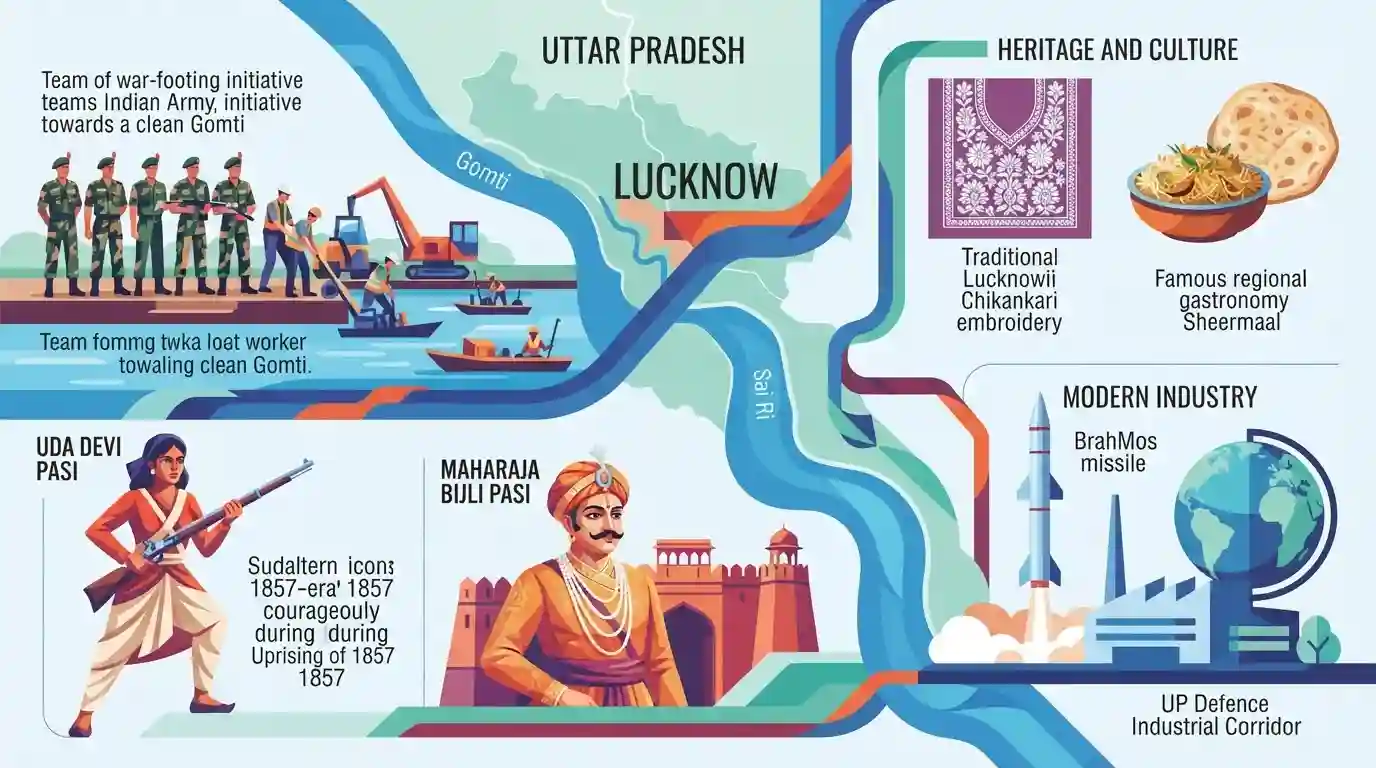
Uttar Pradesh Chief Minister Yogi Adityanath announced a war-footing initiative to clean the Gomti River fully by the end of 2026 in collaboration with the Indian Army's Central Command. Highlighting Lucknow's modern development alongside its rich heritage, he paid tribute to regional subaltern icons like Uda Devi Pasi and Maharaja Bijli Pasi, and emphasized Lucknow's dual identity as a center for world-famous Chikankari/gastronomy and a key node of the UP Defence Industrial Corridor hosting the BrahMos project.
Key Points
- The Gomti River is targeted to be fully cleaned and restored to a pristine, continuous flow by the end of 2026, supported by waste-management cooperation with the Indian Army's Central Command.
- Gomti River Geography: It is a critical, entirely land-fed (alluvial) tributary of the Ganga in Uttar Pradesh. It originates at Gomat Taal (formerly Fulhar Jheel) in Pilibhit and flows into the Ganga at Kaithi, Ghazipur. Its major tributaries include Kathna, Sarayan, and its longest tributary, the Sai River.
- Subaltern Freedom Fighters: The article highlights Uda Devi Pasi, a Dalit woman warrior of the 1857 Rebellion who fought under Begum Hazrat Mahal and killed over 30 British soldiers at the Battle of Sikandar Bagh, and Maharaja Bijli Pasi, a legendary 12th-century king of Bijnor (near Lucknow) who built the historic Bijli Kot fort.
- Industrial and Cultural Milestones: Lucknow is celebrated for its traditional Chikankari handicraft and its global reputation in Awadhi gastronomy. It has also emerged as a vital hub of defense manufacturing, hosting the BrahMos-NG missile project under the UP Defence Industrial Corridor.
Important Terms
Uttar Pradesh Defence Industrial Corridor (UPDIC)

An infrastructure initiative spanning six nodes in Uttar Pradesh to promote self-reliance in aerospace and defense manufacturing and attract global investments.
UPSC context
GS Paper V (UP Economy); tests state industrial policies, regional manufacturing hubs, and defense investment corridors.
UNESCO Creative Cities Network (UCCN)
A global network of cities utilizing creativity for sustainable development; it designated Lucknow as a Creative City of Gastronomy in October 2025.
UPSC context
GS Paper VI (UP Art and Culture); tests international recognition of Uttar Pradesh's cultural, gastronomic, and artistic heritage.
BrahMos Aerospace
An Indo-Russian joint venture (DRDO and NPOM) manufacturing supersonic cruise missiles, currently setting up a key next-generation production and testing facility in Lucknow.
UPSC context
GS Paper III & V; tests key defense technology, international joint ventures, and state-level industrial milestones.
Central Command
One of the Indian Army's operational commands, headquartered in Lucknow, collaborating with the state government on strategic defense and regional ecological initiatives like river cleaning.
UPSC context
GS Paper V (UP Geography); tests military administration, civil-military collaboration, and local ecological partnerships.
UNESCO
The UN specialized agency promoting peace through education, science, and culture, which designated Lucknow's historic Awadhi cuisine to its Creative Cities Network.
UPSC context
GS Paper I & VI; tests global cultural institutions, heritage preservation, and tourism prospects of Uttar Pradesh.
Prelims Trap
The Gomti River is a Himalayan-fed glacial tributary of the Ganga.
Aspirants often assume all major perennial Ganga tributaries are glacial-fed. Gomti is completely land-fed, originating in the alluvial plains of Pilibhit.
Static Concepts Connected
Geography of the Gomti River System
- Origin and Confluence: Originates at Gomat Taal (Fulhar Jheel) in Pilibhit and flows into the Ganga at Kaithi, Ghazipur.
- Hydrological Nature: It is entirely groundwater-fed (alluvial plain river), not fed by Himalayan glaciers.
- Major Tributary: The Sai River (originating in Hardoi) is its longest right-bank tributary, joining it near Jaunpur.
Subaltern Heroes of the 1857 Rebellion in UP
- Uda Devi Pasi: Dalit woman sniper in the Royal Guard of Begum Hazrat Mahal who fought at Sikandar Bagh, Lucknow.
- Begum Hazrat Mahal: Led the 1857 rebellion in Lucknow/Awadh after the British annexed the territory and exiled Wajid Ali Shah.
- Sikandar Bagh: A fierce battle site in Lucknow where Indian rebels, including Uda Devi, resisted British troops in November 1857.
Cross-Topic Patterns
Eco-conservation + Defense corridors
The Army's involvement in cleaning the Gomti while Lucknow expands as a BrahMos defense node showcases integrated military-civilian urban planning and environmental security.
Subaltern history + Syllabus shift
UPPSC increasingly shifts focus from elite rulers to subaltern regional warriors like Uda Devi Pasi, mirroring state cultural and historiographical revision.

UP river systems (Gomti/Sai) and 1857 subaltern icons (Uda Devi Pasi) are high-yield areas for match-the-following questions.
Linked PYQs · 2
Linked PYQs · 2
- 2018UPPSC_PRELIMSGS1
Which of the following rivers of Uttar Pradesh has been declared a 'Biological Disaster' due to environmental pollution?
- 2023UPPSC_PRELIMSGS1
Which one of the following (Place of the revolt of 1857 – Start of rebellion) is not correctly matched?
