US Venezuela Intervention and Energy Infrastructure Restructuring
Source:Indian Express ↗
Why It Matters
The unprecedented military intervention and regime change in Venezuela highlight shifts in US foreign policy and raise questions about state sovereignty in the post-Cold War era. For India, a stabilized and accessible Venezuelan oil market is a strategic boon, offering essential diversification for energy security amid complex geopolitical pressures and sanctions on Russian oil.
Summary
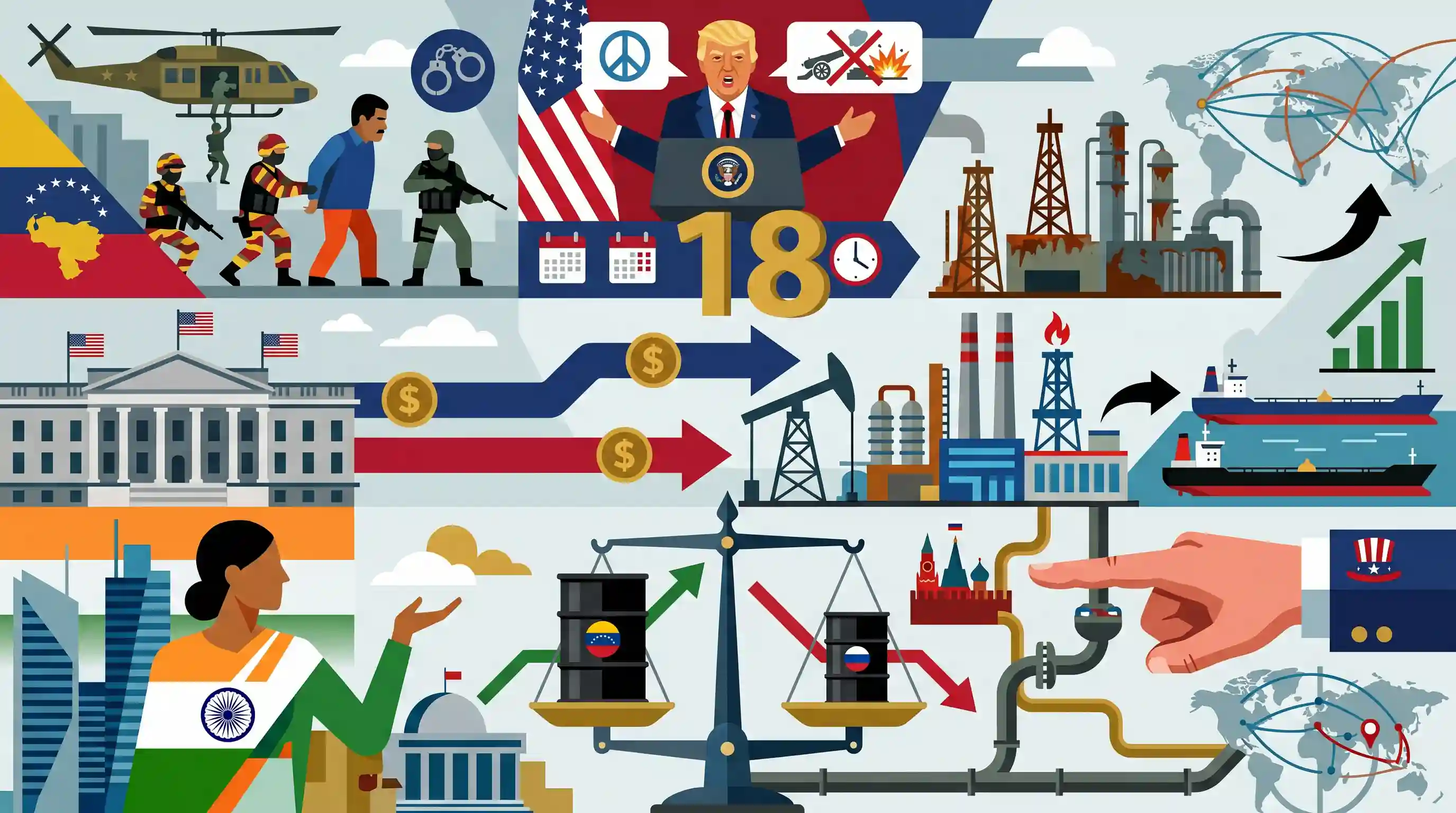
Following a US military raid in Caracas that resulted in the arrest of Venezuelan President Nicolas Maduro, US President Donald Trump stated that the US is not at war with Venezuela. Trump indicated the US administration may subsidize American oil giants like Chevron and Exxon Mobil to rebuild Venezuela’s neglected energy infrastructure and boost production within 18 months. For India, a revitalized Venezuelan oil sector provides a vital strategic opportunity to diversify its crude oil imports, balancing its energy needs while facing US pressure to reduce reliance on Russian oil.
Key Points
- US forces executed a military raid in Caracas to arrest Venezuelan President Nicolas Maduro on narcotics charges, though President Trump asserted the US is not at war with Venezuela.
- The US administration is considering subsidizing major American oil companies, including Chevron and Exxon Mobil, to rebuild Venezuela's dilapidated energy infrastructure over an estimated 18-month period.
- Trump announced there will be no new elections in Venezuela within the next 30 days and maintained he does not require congressional approval for troop deployments.
- A revitalized Venezuelan oil industry offers India a critical opportunity to diversify its crude oil imports away from Russia, addressing its energy security needs amid ongoing US pressure.
Important Terms
Energy Security

The continuous availability of energy sources in sufficient quantities at affordable and stable prices, ensuring a nation's economic growth and social welfare without interruption.
UPSC context
GS Paper 3: Infrastructure/Energy. Essential for discussing India's import dependence (85% for crude) and strategic reserves.
Strategic Autonomy
India's foreign policy principle of making independent decisions based on national interest, free from external coercion by major powers or alignment with specific blocs.
UPSC context
GS Paper 2: International Relations. Tested by US pressure to halt Russian/Venezuelan oil imports while prioritizing domestic energy needs.
Chevron
A leading US multinational energy 'supermajor' and the only American major currently operating in Venezuela's oilfields, playing a central role in the country's potential infrastructure rebuilding.
UPSC context
GS Paper 2/3: Geopolitics/Energy. Represents the role of multinational corporations (MNCs) in energy diplomacy and infrastructure development.
Exxon Mobil
A US-based global energy giant ('supermajor') with significant historical claims against the Venezuelan government for expropriated assets, now eyed by the US administration to restore production.
UPSC context
GS Paper 2: Bilateral Relations. Highlights the intersection of private corporate interests and US foreign policy in Latin America.
ConocoPhillips
An American independent energy corporation holding multi-billion dollar legal claims against Venezuela, cited as a key potential investor in the US-led plan to revitalize Venezuelan energy.
UPSC context
GS Paper 2/3: International Law/Energy. Illustrates risks of nationalization and the use of international arbitration in energy geopolitics.
Crude Oil Diversification
India's policy of expanding its oil import basket beyond traditional Middle Eastern sources to include suppliers like Russia, USA, and Venezuela to mitigate supply shocks.
UPSC context
GS Paper 3: Economic Development. A vital strategy to manage the Current Account Deficit (CAD) and global price volatility.
Oil Diplomacy
The strategic use of petroleum resources and energy trade as a diplomatic instrument to secure national interests, build alliances, or exert geopolitical pressure.
UPSC context
GS Paper 2: IR. Relevant for analyzing how US-Venezuela developments create strategic opportunities for India's energy diplomacy.
Prelims Trap
"Venezuela is currently the world's largest producer of crude oil due to its vast proven reserves in the Orinoco Belt."
UPSC often swaps "reserves" with "production." While Venezuela holds the largest proven reserves globally, years of underinvestment and sanctions mean it is not among the top global producers.
Static Concepts Connected
What distinguishes heavy/sour crude, and why is it relevant to Venezuela and India?
- Heavy & Sour: Heavy crude has high viscosity and doesn't flow easily, unlike light crude. Sour crude has high sulphur content, requiring advanced, expensive processing units to refine.
- Refining Complexity: Indian private refineries (like Reliance) possess exceptionally high complexity indices, making them uniquely capable of profitably processing cheap, heavy, sour Venezuelan crude.
How do secondary sanctions restrict India's strategic autonomy in energy trade?
- Secondary Sanctions: Penalties imposed by a country (like the US) on third-party nations or entities for doing business with a sanctioned state (like Venezuela or Iran).
- The Chilling Effect: Even without UN backing, the threat of losing access to the US dollar financial system forces independent nations to halt critical energy imports from sanctioned regimes.
Cross-Topic Patterns
Strategic Autonomy & Energy Multi-alignment
India's potential return to Venezuelan oil parallels its discounted Russian purchases, highlighting its strategy to prioritize domestic energy security and inflation control over Western geopolitical pressure.
US State Capitalism Shift
US proposals to subsidize private energy giants for rebuilding foreign infrastructure reflect a pivot towards state-backed resource diplomacy, attempting to counter China's Belt and Road Initiative (BRI) model.

Expect a 2026 Prelims question mapping global oil reserves (Orinoco Belt) against crude quality (heavy/sour) and refining complexity.
Linked PYQs · 2
Linked PYQs · 2
- 2025MainsGS2
"Energy security constitutes the dominant kingpin of India's foreign policy, and is linked with India's overarching influence in Middle Eastern countries.” How would you integrate energy security with India's foreign policy trajectories in the coming years?
- 2025MainsGS2
"With the waning of globalization, post-Cold War world is becoming a site of sovereign nationalism.” Elucidate.
