Democratic partnerships and multilateral global stability
Source:Indian Express ↗
Why It Matters
It articulates the philosophical and strategic basis of India's current foreign policy engagements, illustrating how democratic credentials are used as a soft-power tool to forge crucial geopolitical alliances and shape the global order.
Summary
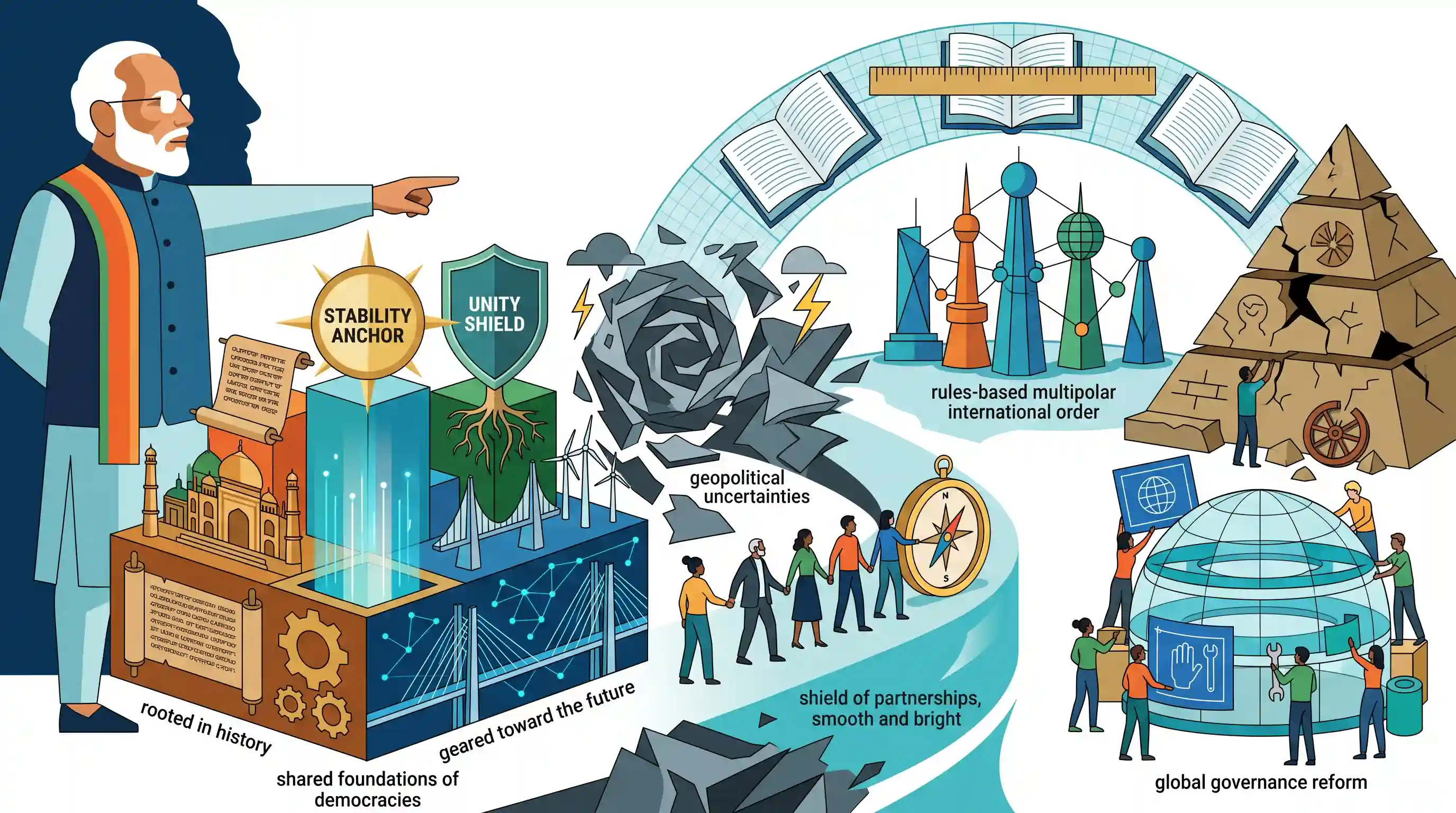
In this piece, Prime Minister Narendra Modi emphasizes the shared foundations of democracies—rooted in history but geared toward the future—as a cornerstone of global stability. He underscores that partnerships among likeminded democratic nations are essential for navigating current geopolitical uncertainties, maintaining a rules-based multipolar international order, and reforming global governance structures.
Key Points
- Democratic values provide a resilient foundation for long-term strategic and economic partnerships.
- Historical ties between democratic nations are being leveraged to collaborate on future-oriented sectors like technology, clean energy, and secure supply chains.
- Partnerships among likeminded democracies transcend bilateral benefits, significantly contributing to peace, a rules-based international order, and global stability.
- India’s foreign policy explicitly integrates its democratic credentials to forge geopolitical alliances, address global challenges, and advocate for reformed multilateralism.
Important Terms
Multipolarity

A global system where power is distributed among several states rather than one or two, ensuring no single nation dominates international affairs.
UPSC context
GS Paper 2: International Relations; critical for understanding India's pursuit of a balanced global power structure.
Rules-based International Order
An international framework where state behavior is governed by shared laws, norms, and institutions (like UNCLOS) rather than unilateral force or power politics.
UPSC context
GS Paper 2: International Relations; tests knowledge of global stability and India's commitment to international law.
Reformed Multilateralism
India's diplomatic push to modernize 20th-century global institutions (like the UNSC) to reflect contemporary geopolitical realities and ensure fair representation for emerging powers.
UPSC context
GS Paper 2: Global Institutions; key pillar of India's foreign policy and UN reform agenda.
Strategic Autonomy
A foreign policy doctrine where a state makes independent decisions based on national interest, avoiding formal military alliances that could constrain its sovereign choices.
UPSC context
GS Paper 2: India's Foreign Policy; fundamental for explaining India's balancing act between major powers.
Special Strategic Partnership
An elevated bilateral relationship status involving deep cooperation in sensitive sectors like defense, intelligence, space, and high-end technology.
UPSC context
GS Paper 2: Bilateral Relations; essential for identifying the depth of ties with key allies like Israel.
Global South
Developing nations in Africa, Asia, and Latin America. India often champions their interests in global forums regarding climate finance and economic equity.
UPSC context
GS Paper 2: International Relations; highlights India's leadership role and solidarity with developing economies.
United Nations
The premier global intergovernmental organization founded to maintain international peace; currently the primary target of India's institutional reform efforts.
UPSC context
GS Paper 2: Important International Institutions; central to topics on global governance and Security Council membership.
Prelims Trap
"The Quad and I2U2 are formal treaty-based alliances strictly restricted to democratic nations."
Quad, I2U2, and SCRI are informal strategic and economic dialogues driven by shared interests, not formal, legally binding military treaties like NATO.
Static Concepts Connected
What is the shift towards 'Minilateralism' in international relations?
- Multilateralism: Broad, consensus-driven global forums (like the UN or WTO) which are increasingly deadlocked by major power rivalries.
- Minilateralism: Smaller, issue-specific, flexible, and ad-hoc coalitions of like-minded countries seeking quick consensus (e.g., Quad, I2U2).
- India's Approach: Using minilateral networks for agile, interest-based cooperation in tech and security, while still advocating for structural UN reforms.
What are the key pillars of the Supply Chain Resilience Initiative (SCRI)?
- Origins: A trilateral initiative launched in 2021 by India, Japan, and Australia to counter vulnerabilities exposed by the pandemic and geopolitical tensions.
- Core Objective: To reduce over-dependence on a single nation (China) and build sustainable, resilient trade networks in the Indo-Pacific region.
- Focus Areas: Sharing best practices, matching buyers with sellers, and promoting joint investments in critical sectors.
Cross-Topic Patterns
Minilaterals + Emerging Technology
India's integration into groups like the Quad involves critical and emerging tech working groups, linking GS2 diplomacy directly with GS3 semiconductor supply chains, cybersecurity, and AI standards.
Historical soft power + Strategic trust
Framing India as the historical 'Mother of Democracy' serves as a soft-power tool (GS1/GS2) to build strategic trust with Western capitals, buffering against criticisms of democratic backsliding.

Expect a matched-pair Prelims question on minilaterals (I2U2, Quad, SCRI, Colombo Security Conclave) vs their primary strategic goals.
Linked PYQs · 3
Linked PYQs · 3
- 2019MainsGS2
‘What introduces friction into the ties between India and the United States is that Washington is still unable to find for India a position in its global strategy, which would satisfy India's national self-esteem and ambitions.’ Explain with suitable examples.
- 2025MainsGS2
"The reform process in the United Nations remains unresolved, because of the delicate imbalance of East and West and entanglement of the USA vs. Russo-Chinese alliance.” Examine and critically evaluate the East-West policy confrontations in this regard.
- 2022MainsGS2
How will I2U2 (India, Israel, UAE and USA) grouping transform India's position in global politics?
