Calcutta High Court quashes public service commission appointment
Source:livelaw ↗
Why It Matters
This case underscores the strict requirement for constitutional bodies like SPSCs to adhere to procedural fairness and statutory rules in public recruitment. It also highlights the crucial role of High Courts in exercising writ jurisdiction when statutory bodies like State Administrative Tribunals become non-functional.
Summary
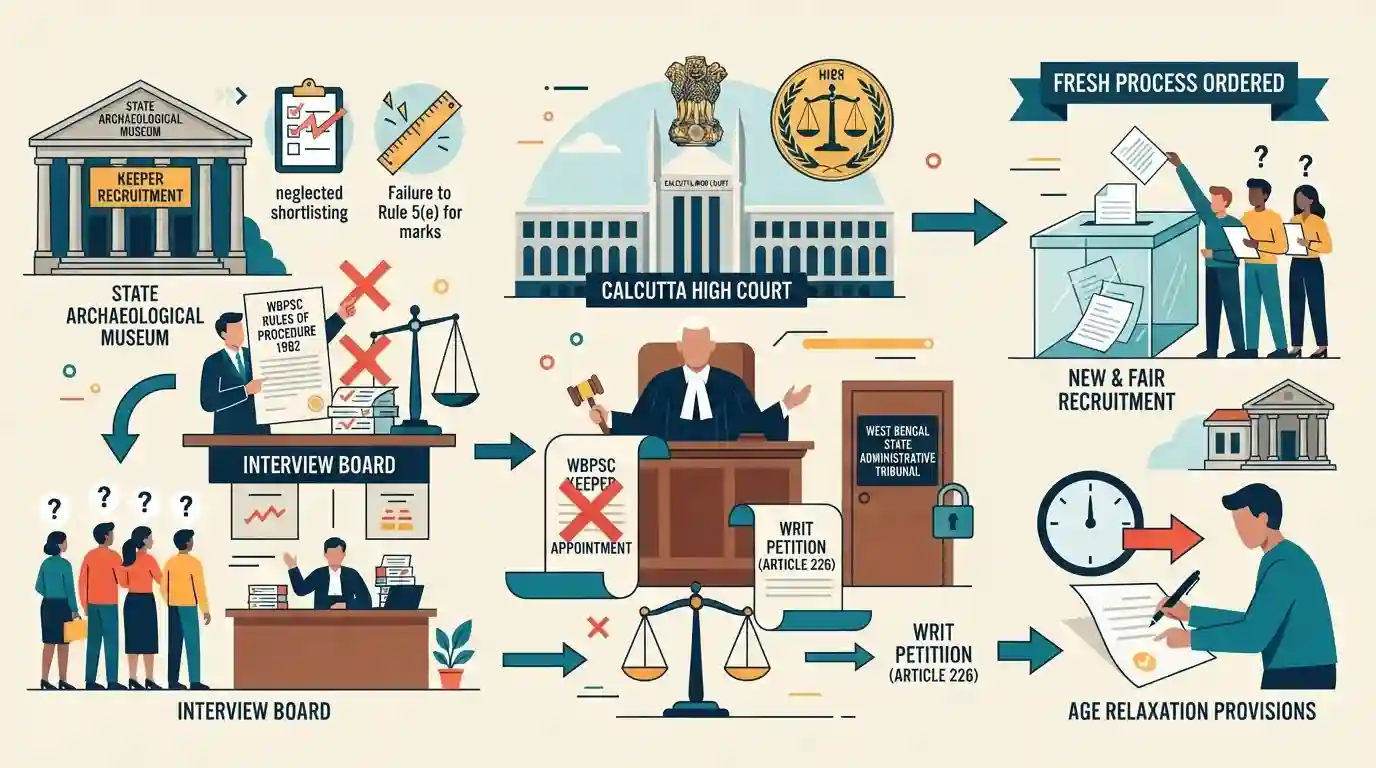
The Calcutta High Court has set aside the WBPSC's recruitment process and subsequent appointment for the post of Keeper at the State Archaeological Museum due to gross violations of the West Bengal Public Service Commission Rules of Procedure, 1982. The Court noted that the Interview Board failed to follow Rule 5(e) for awarding marks and neglected advertised shortlisting procedures. Furthermore, the High Court accepted the writ petition's maintainability under its jurisdiction because the West Bengal State Administrative Tribunal was non-functional. The Court has ordered a fresh, fair recruitment process with age-relaxation provisions.
Key Points
- The Calcutta High Court quashed the WBPSC's recruitment process for the Keeper at the State Archaeological Museum for failing to adhere to the West Bengal Public Service Commission Rules of Procedure, 1982.
- The Court found procedural lapses, including the Interview Board's failure to justify its scoring mechanism under Rule 5(e) and the Commission's failure to conduct a screening test or objective shortlisting.
- The Court upheld the maintainability of the writ petition, rejecting WBPSC's argument that it should be heard by the West Bengal State Administrative Tribunal, as the Tribunal was non-functional.
- WBPSC was directed to initiate a fresh recruitment process and provide age relaxation to candidates who became overage during the delay.
Important Terms
West Bengal Public Service Commission (WBPSC)

A constitutional body established under Article 315 of the Constitution. It conducts civil service examinations and advises the West Bengal state government on recruitment, promotions, and disciplinary matters.
UPSC context
Crucial for Polity (Articles 315-323); tests knowledge of State Public Service Commissions and their constitutional mandate.
West Bengal State Administrative Tribunal
A statutory body set up under the Administrative Tribunals Act, 1985 (pursuant to Article 323A) to adjudicate disputes concerning the recruitment and service conditions of West Bengal state public servants.
UPSC context
Relevant for Polity (Article 323A); tests the role of administrative tribunals and principles of alternate dispute resolution.
Calcutta High Court
India's oldest High Court, exercising jurisdiction over West Bengal and Andaman and Nicobar Islands. It has the constitutional power under Article 226 to issue writs for correcting administrative errors.
UPSC context
Important for Polity (Article 226, Judicial Review); tests the scope of High Court writ jurisdiction over administrative actions.
West Bengal Public Service Commission Rules of Procedure, 1982
The statutory framework governing WBPSC's procedural conduct, including shortlisting and interview criteria. Non-compliance with these rules renders administrative recruitment decisions liable to be quashed by constitutional courts.
UPSC context
Highlights procedural propriety and delegated legislation; tests grounds for judicial review of statutory rule violations in recruitment.
Prelims Trap
State Administrative Tribunals completely divest High Courts of their Article 226 writ jurisdiction over public employment disputes.
Under the L. Chandra Kumar ruling, SATs act as courts of first instance, but they do not permanently oust Article 226, which is part of the basic structure of the Constitution.
Static Concepts Connected
What constitutional provisions ensure the independence of State Public Service Commissions (SPSCs)?
- Removal authority: Appointed by the Governor but can only be removed by the President of India under Article 317.
- Service conditions: Salaries and conditions of service cannot be varied to their disadvantage after appointment under Article 318.
- Financial security: Expenses, including salaries and pensions, are charged on the Consolidated Fund of the State (Article 322).
What is the status of Administrative Tribunals vis-à-vis High Court jurisdiction after L. Chandra Kumar?
- Basic structure: The Supreme Court held that judicial review under Articles 226 and 227 is a part of the basic structure.
- First instance: Tribunals act as courts of first instance; their decisions are subject to scrutiny by a Division Bench of the High Court.
- No exclusion: Parliament cannot exclude the constitutional writ jurisdiction of High Courts over service matters.
Cross-Topic Patterns
Judicial review vs administrative vacuum
When state administrative tribunals fall non-functional due to executive delay, High Courts directly exercise Article 226 to protect the fundamental right to speedy justice.
SPSC autonomy vs executive discretion
Constitutional protections under Article 317 prevent arbitrary removal of SPSC members, but their executive selections remain strictly bound by published rules and judicial review.

Statement questions in 2026 will likely test the limits of Article 226 writ jurisdiction when Administrative Tribunals are non-functional.
Linked PYQs · 2
Linked PYQs · 2
- 2022WBCS_PRELIMSGS1
Members of the State Public Service Commission are appointed by
- 2023WBCS_PRELIMSGS1
A Public Service Commission was established in India for the first time by
