State Seeks Centre Intervention on Ganga Water Treaty Renewal
Source:newindianexpress ↗
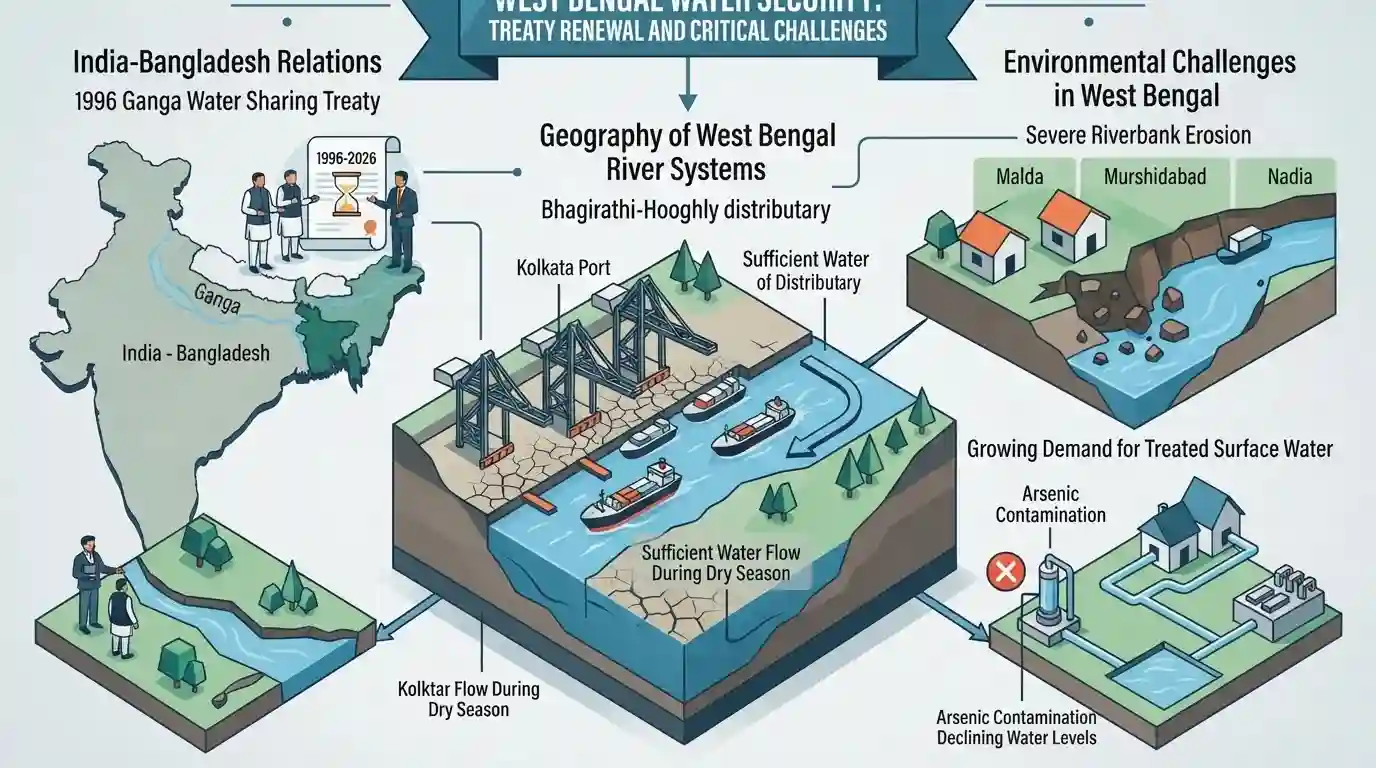
Why It Matters
The Ganga Water Sharing Treaty has direct ramifications for both international diplomacy and the internal geography and economy of West Bengal. For WBCS aspirants, understanding the dynamics of the Farakka Barrage, river erosion, Kolkata Port's navigability, and environmental crises like arsenic poisoning are high-yield areas frequently featured in both Prelims and Mains papers.
Summary
Ahead of the expiration of the 1996 Ganga Water Sharing Treaty in December 2026, the West Bengal government has requested the Union Jal Shakti Ministry to ensure that the state's interests in water supply, river conservation, and port operations are protected. The state highlighted critical issues, including the need for sufficient water flow into the Bhagirathi-Hooghly system during the dry season to sustain Kolkata's Syama Prasad Mookerjee Port, severe riverbank erosion in districts like Malda, Murshidabad, and Nadia, and the growing demand for treated surface water to combat declining groundwater levels and regional arsenic contamination.
Key Points
- The 30-year-old bilateral Ganga Water Sharing Treaty, signed in December 1996 between India and Bangladesh, is set to expire in December 2026.
- The West Bengal government has urged the Central government to safeguard the state's economic, environmental, and developmental interests before renewing the pact.
- The state emphasizes that adequate downstream flow must be maintained through the Farakka Barrage into the Bhagirathi-Hooghly system during the dry season (January 1 to May 31).
- Inadequate water flow has caused severe siltation at the Syama Prasad Mookerjee Port (Kolkata Port), creating navigability issues and disrupting vessel movement.
- Large areas of Malda, Murshidabad, and Nadia districts face devastating riverbank erosion both upstream and downstream of the Farakka Barrage.
- Declining groundwater levels and widespread arsenic contamination in West Bengal increase the dependence on treated Ganga water for drinking, irrigation, and industrial needs.
Important Terms
Ganga Water Sharing Treaty (1996)

A 30-year bilateral agreement between India and Bangladesh regulating transboundary Ganga water sharing at Farakka Barrage during the dry season (January 1–May 31), scheduled to expire in December 2026.
UPSC context
WBCS GS Paper III (Indian Geography) & Paper V; tests India-Bangladesh transboundary water sharing and diplomatic relations.
Farakka Barrage
A 2,240-meter diversion structure on the Ganga River in Murshidabad, West Bengal, commissioned in 1975 to divert freshwater into the Bhagirathi-Hooghly system, preserving Kolkata Port’s navigability.
UPSC context
WBCS GS Paper III (Geography of West Bengal); tests knowledge of river valley projects, irrigation, and transboundary water disputes.
Bhagirathi-Hooghly River System
A major distributary of the Ganga River in West Bengal, forming the vital National Waterway 1, and serving as the primary hydrological lifeline for Kolkata and surrounding districts.
UPSC context
WBCS GS Paper III (Physical Geography of West Bengal); tests river courses, drainage patterns, and estuarine challenges.
Syama Prasad Mookerjee Port
India's oldest operating and sole major riverine port, located in Kolkata, West Bengal. It depends heavily on freshwater headwater flows from Farakka to flush out estuary silt.
UPSC context
WBCS GS Paper III (Economic Geography & Transport); tests West Bengal's port infrastructure, river silting, and trade waterways.
Arsenic Contamination
A geogenic groundwater pollution crisis in West Bengal, where high arsenic levels affect multiple districts, presenting severe public health risks and driving demand for treated surface water.
UPSC context
WBCS GS Paper IV (Environment); tests groundwater hazards, ecological issues of West Bengal, and health remediation policies.
Prelims Trap
The primary objective of the Farakka Barrage is flood mitigation and hydroelectric power generation for Southern West Bengal.
Farakka Barrage was built primarily to divert water (40,000 cusecs) to flush silt from the Hooghly river for Kolkata Port's navigability, not for flood control or power generation.
Static Concepts Connected
How does the Bhagirathi River divide the physiography of Murshidabad?
- Rarh region: Located west of the river, characterized by older, undulating, reddish, clayey, and lateritic soil.
- Bagri region: Located east of the river, characterized by fertile, low-lying, recent alluvial plains prone to flooding.
Which constitutional provisions govern international water treaties in India?
- Article 253: Empowers Parliament to make laws for implementing any treaty, agreement, or convention with foreign nations, overriding state jurisdiction.
- State List Entry 17: Covers water supply, irrigation, and canals, making water primarily a state subject but subject to central regulation of interstate rivers.
Cross-Topic Patterns
Federalism vs foreign policy in transboundary waters
Explores how water (State List Entry 17) intersects with the Union's exclusive power over international treaties (Article 253), creating Centre-State friction over transboundary rivers.
River hydrology and arsenic contamination mitigation
Reduced river flows aggravate arsenic leaching in deltaic aquifers. Adequate Ganga surface water is crucial to substitute contaminated groundwater in West Bengal's clayey-alluvial belts.

WBCS likely to link the 2026 Ganga Treaty renewal with Murshidabad's physiography (Rarh/Bagri) or Article 253 treaty-making powers.
Linked PYQs · 5
Linked PYQs · 5
- 2008WBCS_PRELIMSGS1
India's dispute over sharing of water with Bangladesh arises out of the distribution of water from
- 2012WBCS_PRELIMSGS1
When was Ganga Water Treaty was signed between India and Bangladesh ?
- 2002WBCS_PRELIMSGS1
The India-Bangladesh Agreement over the sharing of Ganga Water (Farakka-11) was signed in
- 2017WBCS_PRELIMSGS1
What was the primary objective of construction of the Farakka Barrage?
- 2018WBCS_PRELIMSGS1
The largest Arsenic de-contamination/purification plant in West Bengal is located at
