Halisahar Custodial Death: State Admits Lapses and Orders Inquiry
Source:The Hindu ↗
Why It Matters
Highlights the administrative protocol and legal requirements (like a mandatory magistrate-level inquiry) following a custodial death, as well as the political dynamics and law-and-order situation in West Bengal's North 24 Parganas district.
Summary
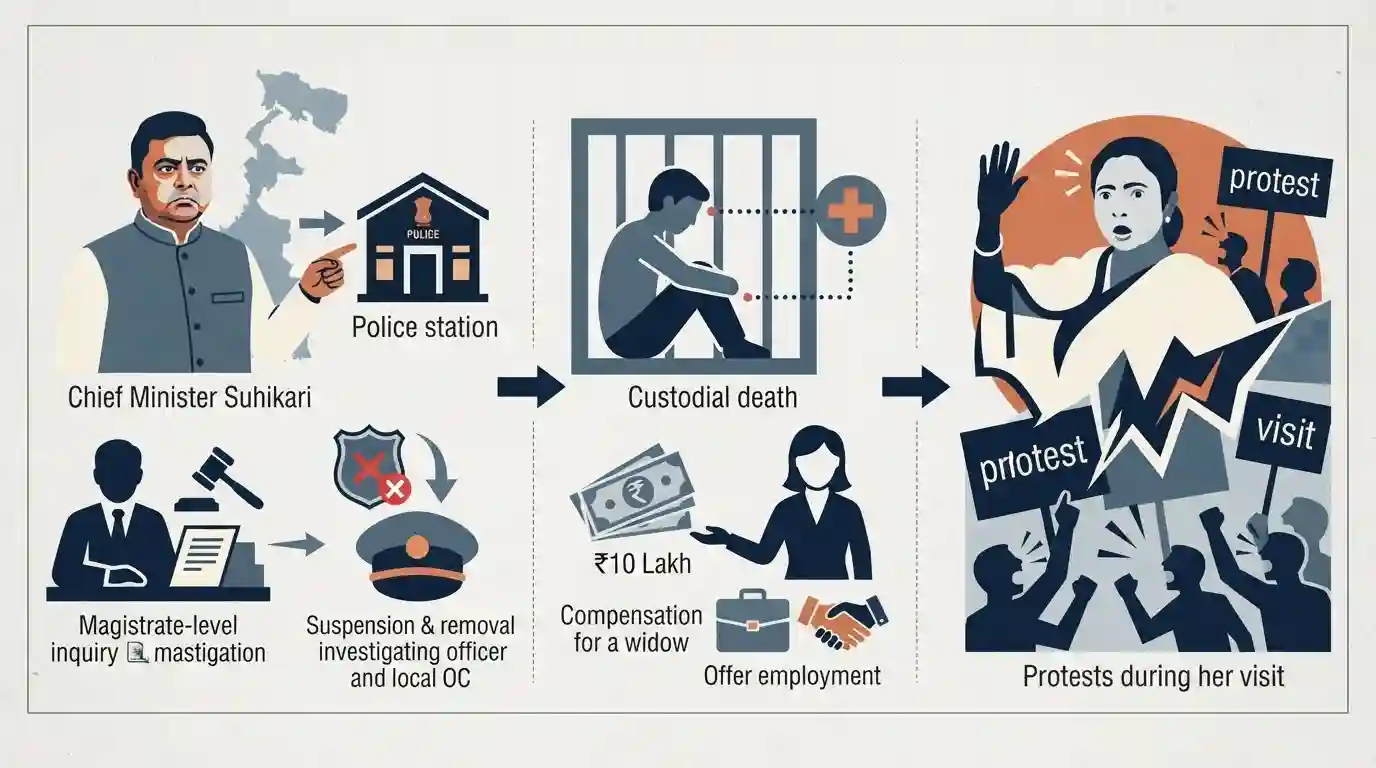
West Bengal Chief Minister Suvendu Adhikari acknowledged police negligence leading to the custodial death of Trinamool Congress worker Birju Keot in Halisahar, North 24 Parganas. A magistrate-level inquiry has been ordered in accordance with protocol for custodial deaths. The investigating officer has been suspended, and the local OC removed. The state announced ₹10 lakh compensation and employment for the victim's widow. Meanwhile, former Chief Minister Mamata Banerjee alleged a conspiracy against her after facing protests during her visit to the family.
Key Points
- West Bengal Chief Minister Suvendu Adhikari admitted police negligence in the custodial death of TMC worker Birju Keot in Halisahar, North 24 Parganas.
- A magistrate-level inquiry was initiated as per the legal protocol for custodial deaths.
- The investigating officer was suspended, and the Officer-in-Charge of the police station was removed to the Barrackpore Police lines.
- The state government announced a ₹10 lakh compensation and a job for the victim's wife.
- Former CM Mamata Banerjee visited the family, faced protests, and alleged a conspiracy to eliminate her.
Important Terms
Custodial Death

The death of an individual while in police or judicial custody, resulting from torture, excessive force, or negligence, representing a grave violation of the fundamental Right to Life under Article 21.
UPSC context
GS Paper II (Polity & Governance) and GS Paper IV (Ethics); tests understanding of human rights, police reforms, and constitutional safeguards.
Magisterial Inquiry
A mandatory independent investigation conducted by a judicial or executive magistrate into incidents of custodial death, rape, or disappearance in custody, as per Section 176 of the CrPC/BNSS.
UPSC context
GS Paper II (Polity & Governance); tests awareness of statutory safeguards against police excesses and judicial oversight mechanisms.
Police Commissionerate System
A policing model in urban areas where a unified command structure vests policing and magisterial/executive powers in a Commissioner of Police, who reports directly to the state government.
UPSC context
GS Paper II (Governance) & Paper III (Internal Security); tests knowledge of police reforms, administrative structures, and urban policing.
Rule of Law
The democratic principle that law is supreme and governs all citizens equally, limiting arbitrary government power and protecting liberties, recognized as a basic structure of the Constitution.
UPSC context
GS Paper II (Polity & Constitution); tests foundational knowledge of constitutionalism, equality, and limitations on state authority.
Trinamool Congress
A major regional political party in India, primarily based in West Bengal, recognized as a state/national party that has significantly influenced state governance and federal politics.
UPSC context
GS Paper II (Polity); tests understanding of political parties, regionalism, and federal dynamics in Indian democracy.
Barrackpore Police Commissionerate
A city police force in West Bengal under the Commissionerate system, providing a unified policing command and magisterial oversight over the highly urbanized parts of North 24 Parganas district.
UPSC context
GS Paper II (Governance); tests understanding of decentralized urban police administration and regional security structures.
Prelims Trap
A mandatory statutory inquiry into custodial death is conducted by an Executive Magistrate.
Under Section 176(1A) of the CrPC (now Section 196 of the BNSS), inquiries into custodial death, disappearance, or rape must be conducted by a Judicial or Metropolitan Magistrate, not an Executive Magistrate.
Static Concepts Connected
What are the landmark judicial doctrines governing custodial violence in India?
- D.K. Basu Guidelines: Mandated procedural safeguards—such as preparing an arrest memo and conducting medical exams—during arrest to check custodial violence.
- Strict State Liability: Established in Nilabati Behera, making monetary compensation a direct public law remedy for state violation of Article 21.
- Right to Silence: Custodial confessions are legally inadmissible under the Evidence Act, protecting the fundamental right against self-incrimination (Article 20(3)).
What are the statutory inquiry requirements for custodial deaths?
- Judicial Inquiry: Section 196 of BNSS (erstwhile 176 CrPC) mandates inquiry by a Judicial or Metropolitan Magistrate, not an Executive Magistrate.
- NHRC Guidelines: Requires mandatory reporting of any custodial death to the Commission within 24 hours, alongside videography of the post-mortem.
Cross-Topic Patterns
Police Reforms vs. Federalism
Police is a State Subject (List II), making the uniform implementation of Supreme Court-mandated police reforms (e.g., Prakash Singh directives) highly uneven across different states.
Human Rights and Treaty Ratification
India remains a signatory but has not ratified the UN Convention Against Torture (UNCAT), raising compliance questions in global human rights reviews.

Sovereign immunity vs. strict liability for Article 21 violations in custody is likely to be a core GS-II concept-cum-case study question.
Linked PYQs · 1
Linked PYQs · 1
- 2015WBCS_PRELIMSGS1
West Bengal has international boundaries on
