Maternal and reproductive healthcare challenges at Waves 2025
Source:The Hindu ↗
Why It Matters
While the article is a factual report of a conference, the underlying theme of women's health is a crucial component of GS2 (Social Justice - Issues relating to development and management of Social Sector/Services relating to Health). It also highlights the active role played by professional medical societies (like FOGSI) in knowledge sharing and shaping public health discourse.
Summary
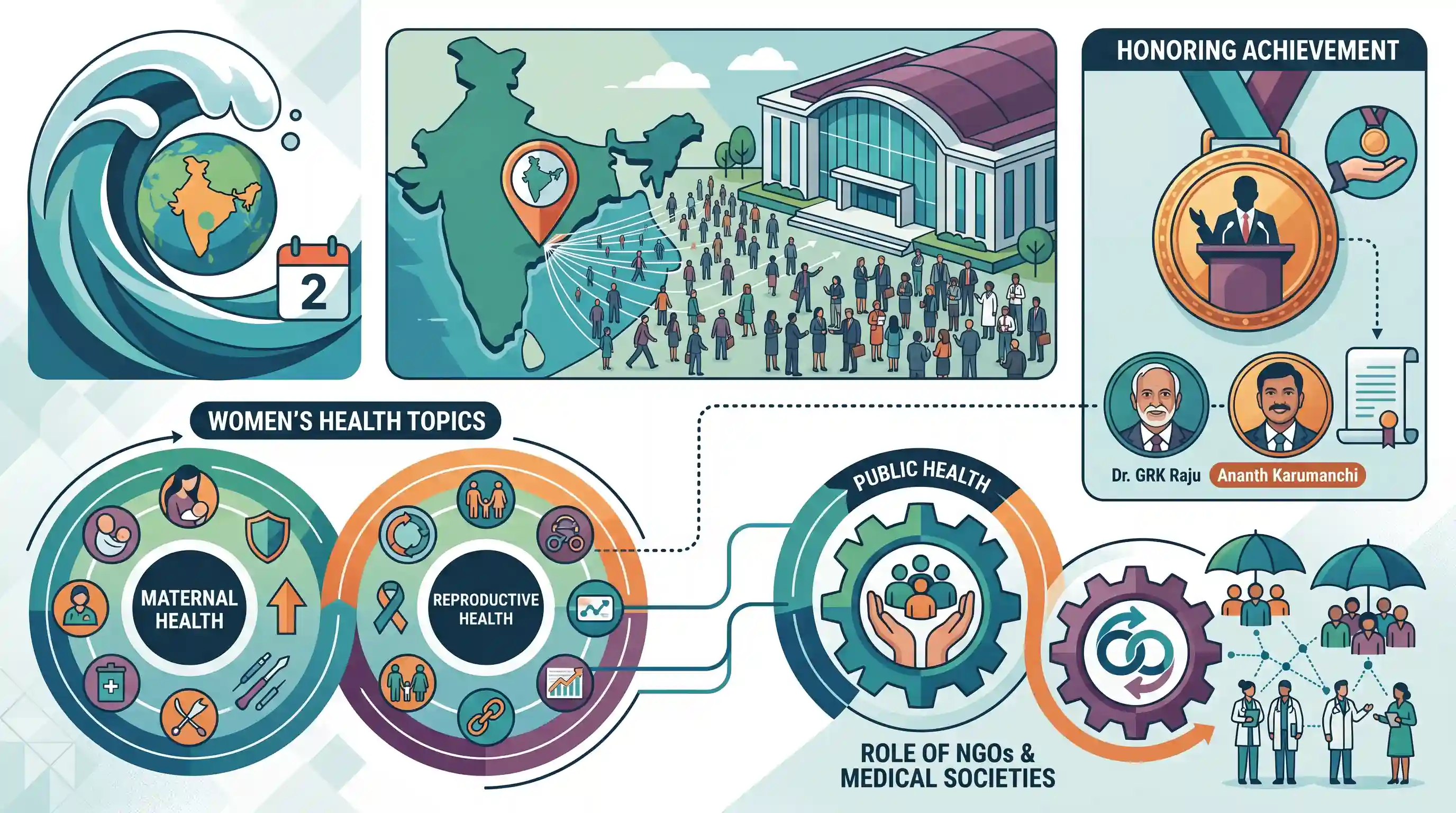
The two-day "Waves-2025" conference, focused on women's health issues, concluded in Visakhapatnam. Organized by the Federation of Obstetrics and Gynaecological Society of India (FOGSI) in collaboration with its local chapter, the event hosted nearly 1,000 delegates from across the country to discuss advancements and challenges in maternal and reproductive health. During the event, Dr. Ananth Karumanchi was honored with the Dr. GRK Raju Oration Medal.
Key Points
- The two-day 'Waves-2025' conference focusing on women's health problems concluded in Visakhapatnam.
- It was organized by the Federation of Obstetrics and Gynaecological Society of India (FOGSI) in association with the local Visakhapatnam society.
- Nearly 1,000 delegates from across India participated in the event to discuss issues pertinent to women's healthcare.
- Dr. Ananth Karumanchi was awarded the Dr. GRK Raju Oration Medal by the former Principal of Andhra Medical College.
Important Terms
Federation of Obstetrics and Gynaecological Society of India (FOGSI)

India's largest professional body for obstetricians and gynecologists, focused on improving women’s health, reducing maternal mortality, and advocating for reproductive rights through education and clinical research.
UPSC context
Relevant for GS Paper II (Health/Social Sector); tests understanding of the role of professional NGOs in public health policy.
Maternal Mortality Ratio (MMR)
The number of maternal deaths per 100,000 live births. It is a primary indicator of a nation's healthcare quality and women's socio-economic status.
UPSC context
Core concept for GS Paper II (Social Justice); critical for analyzing India's progress toward global health standards.
Andhra Medical College (AMC)
Established in 1923, it is one of India's oldest and premier public medical institutions. It serves as a major hub for medical education, research, and tertiary healthcare in Andhra Pradesh.
UPSC context
Contextual for GS Paper II; represents the institutional framework of India’s public health education and historical healthcare infrastructure.
Reproductive Health
A state of complete physical, mental, and social well-being in all matters relating to the reproductive system, including access to safe pregnancy, childbirth, and family planning.
UPSC context
High-yield topic for GS Paper II and Sociology optional; covers challenges like early marriage and maternal nutrition.
Preeclampsia
A pregnancy complication characterized by high blood pressure and signs of damage to organ systems. It remains a leading, yet preventable, cause of maternal morbidity and mortality in India.
UPSC context
Relevant for GS Paper III (Science & Technology/Health); tests knowledge of specific clinical challenges hindering India’s maternal health goals.
Sustainable Development Goal (SDG) 3.1
A United Nations global target to reduce the global Maternal Mortality Ratio to less than 70 per 100,000 live births by the year 2030.
UPSC context
Critical for GS Paper II/III; used to evaluate government schemes like Janani Suraksha Yojana against international benchmarks.
Prelims Trap
"Preeclampsia is a viral infection causing maternal mortality."
Preeclampsia is a pregnancy complication linked to toxic amounts of the sFlt-1 protein inhibiting blood vessel growth, not an infectious disease.
Static Concepts Connected
What is the Maternal Mortality Ratio (MMR) and its related SDG target?
- Definition: The number of maternal deaths during a given time period per 100,000 live births during the same time period.
- SDG Target: SDG 3.1 aims to reduce the global maternal mortality ratio to less than 70 per 100,000 live births by 2030.
- India's Progress: India has witnessed a steep decline in MMR, though interventions remain crucial to overcome regional disparities.
How do professional medical NGOs complement state public healthcare?
- Policy Advocacy: They draft targeted schedules, standardize inclusive care protocols, and advocate for evidence-based maternal policies.
- Capacity Building: They train rural doctors and frontline workers in emergency obstetric care, bridging resource gaps.
- Research & Intervention: They conduct clinical research and provide specialized health interventions for vulnerable, marginalized populations.
Cross-Topic Patterns
Preeclampsia and biomarker research
Identifying the sFlt-1 protein bridges basic biotechnology with maternal health outcomes, reflecting UPSC's growing focus on applied biological sciences in Prelims.
NGOs buffering healthcare marketisation
Professional medical societies act as buffers against extreme healthcare commercialization by setting standardized, inclusive care protocols for vulnerable populations.

Preeclampsia, its protein biomarker (sFlt-1), and MMR SDG targets could merge into a 2026 multi-statement science question.
Linked PYQs · 3
Linked PYQs · 3
- 2020MainsGS2
In order to enhance the prospects of social development, sound and adequate health care policies are needed particularly in the fields of geriatric and maternal health care. Discuss.
- 2024MainsGS2
In a crucial domain like the public healthcare system the Indian State should play a vital role to contain the adverse impact of marketisation of the system. Suggest some measures through which the State can enhance the reach of public healthcare at the grassroots level.
- 2021MainsGS2
Can Civil Society and Non-Governmental Organizations present an alternative model of public service delivery to benefit the common citizen? Discuss the challenges of this alternative model.
