Indus Waters Treaty history and transboundary water diplomacy
Source:Indian Express ↗
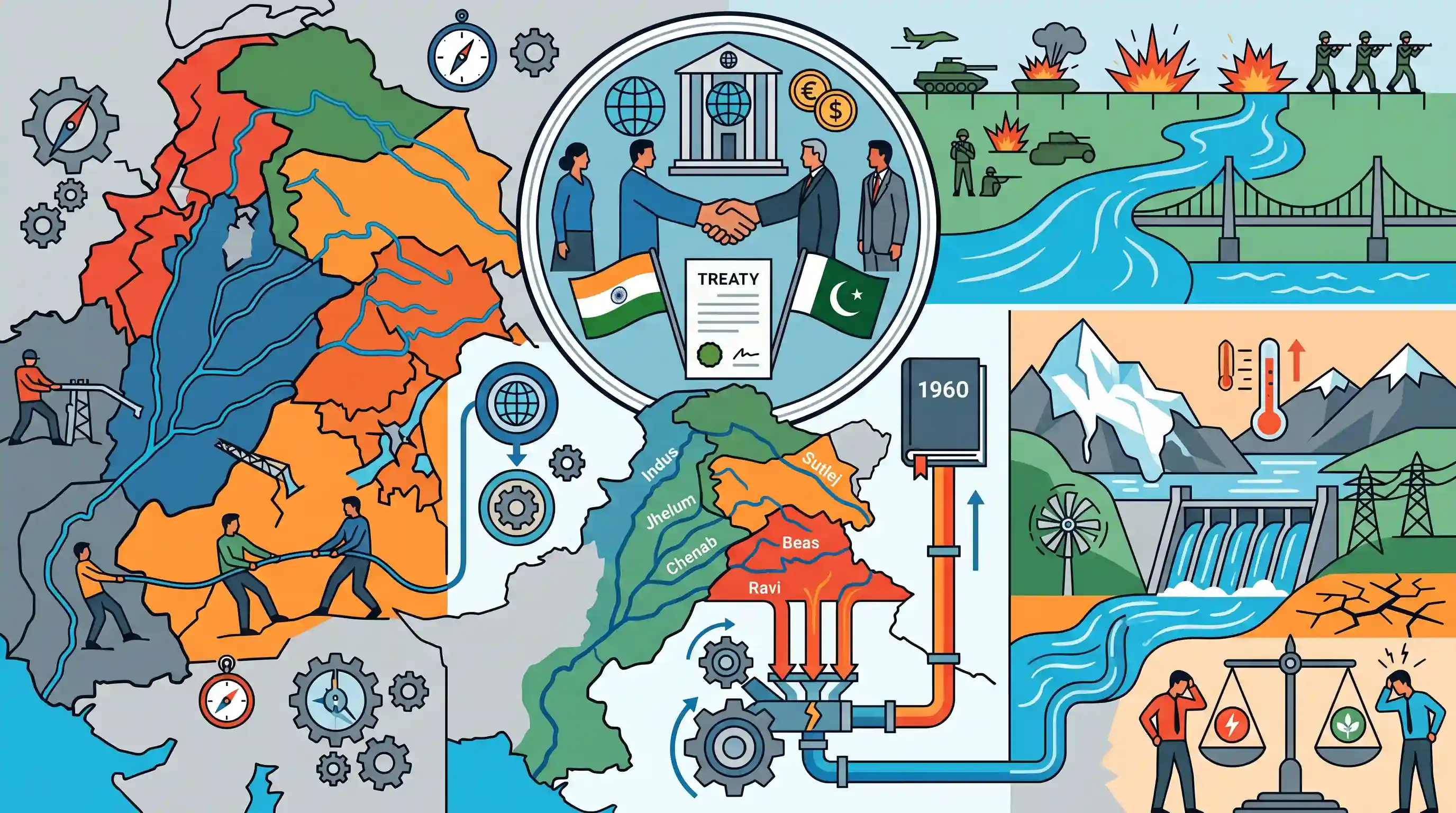
Why It Matters
The Indus Waters Treaty is a staple topic in UPSC examinations, frequently appearing in GS2 (International Relations) and GS1 (Geography). Aspirants must understand its provisions, historical context, and the ongoing hydro-politics between India and Pakistan, especially as contemporary projects and climate challenges prompt calls for its review.
Summary
The article explores the historical context and enduring significance of the Indus Waters Treaty (IWT), signed in 1960 between India and Pakistan. Originating from the chaotic partition that divided the Indus basin's irrigation infrastructure, the early 'water wars' necessitated international intervention. Mediated extensively by the World Bank, the treaty established a clear mechanism for sharing the six rivers of the Indus system, backed by international financial support. The piece underscores the treaty's remarkable resilience in surviving decades of hostile bilateral relations and multiple wars, while also acknowledging that modern pressures—like climate change and hydro-electric projects—continue to strain the agreement's framework today.
Key Points
- The partition of British India divided the Indus basin's unified irrigation system, sparking early bilateral water disputes as headworks remained in India while key canals fell in Pakistan.
- The World Bank played a critical role in mediating the decade-long negotiations, ultimately financing the replacement works necessary for the treaty's success.
- Under the 1960 agreement, waters of the three eastern rivers (Ravi, Beas, Sutlej) were allocated to India, while the three western rivers (Indus, Jhelum, Chenab) were allocated to Pakistan, with India retaining rights for specific non-consumptive uses.
- Despite enduring multiple wars and severe geopolitical tensions between the two nations, the Indus Waters Treaty is widely regarded as one of the most successful transboundary water-sharing agreements in history.
- Contemporary challenges such as climate change, population growth, and disputes over modern Indian hydroelectric projects (like Kishanganga and Ratle) continue to test the treaty's dispute resolution mechanisms.
Important Terms
Permanent Indus Commission (PIC)

A 10-member bilateral body (5 from each country) that manages the Indus Waters Treaty through annual meetings, data exchange, and technical inspections of river projects.
UPSC context
GS Paper II: India and its neighborhood; tests knowledge of institutional mechanisms for bilateral dispute redressal and water diplomacy.
Indus Waters Treaty (IWT)
A 1960 water-sharing agreement between India and Pakistan, brokered by the World Bank, which allocates the six rivers of the Indus system to manage irrigation and power needs.
UPSC context
GS Paper II: Bilateral agreements and international relations; critical for understanding transboundary water management and Indo-Pak conflict history.
World Bank (IBRD)
The primary international financial institution that mediated nine years of negotiations for the IWT and remains a signatory with a procedural role in dispute resolution.
UPSC context
GS Paper II: Role of international organizations in bilateral disputes; tests understanding of multilateral mediation in regional geopolitics.
Eastern Rivers
The Sutlej, Beas, and Ravi rivers, over which India has unrestricted use for irrigation, power, and storage under the Indus Waters Treaty framework.
UPSC context
GS Paper I: Geography of India; important for mapping river systems and understanding regional water resource allocation.
Western Rivers
The Indus, Jhelum, and Chenab rivers, allocated primarily to Pakistan, with India permitted limited non-consumptive uses like 'run-of-the-river' hydroelectric projects.
UPSC context
GS Paper II: India-Pakistan relations; involves technical and legal disputes over hydroelectric projects like Kishenganga and Ratle.
Article IX (Dispute Resolution Mechanism)
A three-tier legal framework under the IWT for resolving conflicts: first via the Commission, second through a Neutral Expert, and third by a Court of Arbitration.
UPSC context
GS Paper II: Dispute redressal mechanisms; tests knowledge of legal procedures in international treaties and recent jurisdictional debates.
Indus Basin
The vast drainage area of the Indus River and its tributaries, covering parts of India, Pakistan, China, and Afghanistan, and home to the world's largest irrigation network.
UPSC context
GS Paper I: Water resources and distribution; relevant for geography and environmental issues like climate change affecting Himalayan glaciers.
Prelims Trap
India is entirely prohibited from building hydroelectric projects on the Western rivers (Indus, Jhelum, Chenab).
India is permitted to build 'run-of-the-river' (non-consumptive) hydroelectric projects on the Western rivers. Tensions over Kishanganga and Ratle are about technical design limits, not an absolute ban.
Static Concepts Connected
How does the Indus Waters Treaty structure its dispute resolution mechanism?
- 'Questions': Resolved bilaterally by the Permanent Indus Commission (PIC), which meets at least once a year.
- 'Differences': Referred to a Neutral Expert appointed by the World Bank, specifically for technical disagreements on dam design.
- 'Disputes': Referred to a 7-member Court of Arbitration for complex legal interpretation and severe treaty breaches.
What is the geographical layout of the disputed Western Rivers?
- Indus: Originates from Bokhar Chu glacier in Tibet; flows between the Ladakh and Zaskar ranges in India.
- Jhelum: Rises at Verinag spring, flows through Wular Lake. Its major tributary hosts the Kishanganga hydroelectric project.
- Chenab: Formed by Chandra and Bhaga rivers in Himachal. It hosts the controversial Ratle, Baglihar, and Salal projects.
Cross-Topic Patterns
Climate change & treaty obsolescence
The 1960 IWT lacks climate provisions. Glacial retreat and altered precipitation patterns in the Himalayas are severely straining rigid historical transboundary water-sharing frameworks.
Run-of-the-river dams vs ecology
India's reliance on run-of-the-river dams to comply with IWT rules links directly to GS3 environmental impact assessments and minimum ecological flow mandates for Himalayan rivers.

Expect a 2026 prelims matching question pairing recent Himalayan run-of-the-river projects (Kishanganga, Ratle, Pakal Dul) with their exact tributaries.
Linked PYQs · 3
Linked PYQs · 3
- 2012MainsGS2
The situation today is far different to that prevalent fifty years back when the Indus Water Treaty was signed." Highlight the complexity of the current challenges on both sides of the border in this regard. Do you think that a review of the Treaty is in India's best interests?
- 2021PrelimsGS1
With reference to the Indus river system, of the following four rivers, three of them pour into one of them which joins the Indus direct. Among the following, which one is such river that joins the Indus direct?
- 2009PrelimsGS1
The Dul Hasti Power Station is based on which one of the following rivers?
