Governance deficit and water challenges in peri-urban zones
Source:The Hindu ↗
Why It Matters
The issue of peri-urban water governance sits precisely at the intersection of urbanization, local governance, and resource management. It directly applies to UPSC topics concerning the efficacy of local bodies (Panchayati Raj vs. Municipalities), the environmental impact of haphazard urban expansion, and groundwater depletion. The 2024 Mains question on merging rural and urban local bodies perfectly encapsulates the administrative challenge posed by peri-urban areas.
Summary
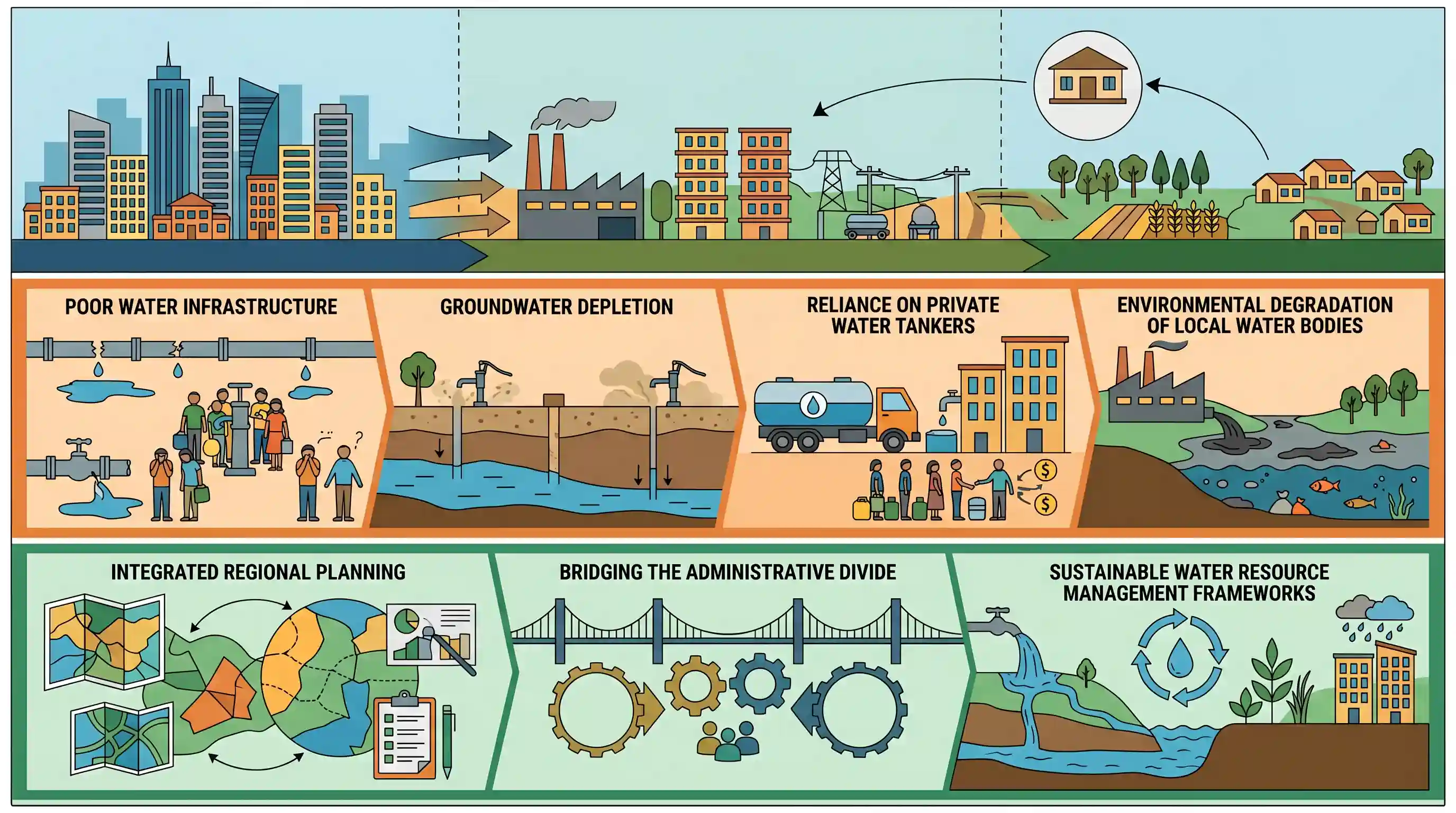
The article examines the mounting challenges of water governance in peri-urban areas—the transitional zones on the fringes of growing cities. These regions suffer from a stark governance deficit, as they often remain under the jurisdiction of rural Panchayats despite experiencing urban levels of population density and resource demand. This mismatch results in poor water infrastructure, unchecked groundwater depletion, reliance on private water tankers, and the environmental degradation of local water bodies. Effective resolution necessitates integrated regional planning, bridging the administrative divide between rural and urban local bodies, and implementing sustainable water resource management frameworks.
Key Points
- Peri-urban areas, located on the fringes of expanding cities, face severe water governance challenges due to a rapid transition from rural to urban land use.
- A significant governance vacuum exists in these areas, as they are typically administered by rural Panchayats which lack the financial resources and technical capacity to manage urban-scale water demands.
- The absence of piped municipal water supply leads to massive unregulated groundwater extraction and a heavy reliance on informal water markets, such as private tankers.
- Unplanned expansion often leads to the encroachment, pollution, and reclamation of traditional water bodies and wetlands in peri-urban zones.
- Addressing these challenges requires integrated spatial planning, capacity building for local institutions, and potentially restructuring local governance to bridge the gap between rural and urban local bodies.
Important Terms
Peri-urban Areas

Transitional zones on city fringes where urban expansion meets rural landscapes, often experiencing rapid population growth and significant governance deficits in infrastructure and resource management.
UPSC context
GS I (Urbanization) and GS III (Environment). Tests awareness of planning gaps and resource management challenges in rapidly expanding cities.
73rd Constitutional Amendment Act
1992 legislation granting constitutional status to rural local bodies (Panchayats), mandating a three-tier system and regular elections to ensure grassroots democracy and rural development.
UPSC context
GS II (Governance). Essential for understanding the devolution of power and the administrative framework governing rural fringes.
74th Constitutional Amendment Act
1992 legislation providing constitutional status to Urban Local Bodies (ULBs), establishing a framework for decentralized urban planning and water supply management in cities and transitional zones.
UPSC context
GS II (Federalism). Key for analyzing the shift from rural to urban governance in densifying peri-urban regions.
Panchayati Raj Institutions (PRIs)
The three-tier system of rural self-government in India. In peri-urban contexts, PRIs often struggle to manage urban-scale water demands due to limited technical and financial capacity.
UPSC context
GS II (Devolution of Powers). Focuses on the challenges of rural administrative bodies managing urban-level resource demands.
Urban Local Bodies (ULBs)
Statutory municipal institutions (Corporations, Councils, or Nagar Panchayats) responsible for essential urban services. Effective peri-urban water governance often requires transitioning authority from rural bodies to ULBs.
UPSC context
GS II (Governance). Critical for questions regarding urban service delivery and the 12th Schedule responsibilities.
Nagar Panchayat
A specific urban local body established under the 74th Amendment to govern 'transitional areas' shifting from rural to urban, intended to bridge the peri-urban governance gap.
UPSC context
GS II (Local Self-Government). Tests understanding of specialized governance units for hybrid rural-urban landscapes.
Devolution of Powers
The statutory transfer of functions, finances, and functionaries from central/state governments to local bodies, often cited as incomplete in managing transitional peri-urban resources.
UPSC context
GS II (Federal Structure). Central to discussions on administrative efficiency and local autonomy in water and land management.
Prelims Trap
Peri-urban areas automatically come under Urban Local Bodies once they meet urban demographic criteria.
Meeting urban demographic criteria only makes a settlement a "Census Town." It legally remains under rural Panchayat administration until the State formally notifies it as a Statutory Town.
Static Concepts Connected
What is the mandate of Metropolitan Planning Committees (MPCs)?
- Constitutional basis: Article 243ZE mandates MPCs for metropolitan areas (10L+ population) to consolidate plans prepared by both Panchayats and Municipalities in the region.
- Composition: At least two-thirds of MPC members must be elected by and from amongst the elected members of Municipalities and Chairpersons of Panchayats.
- Shared resources: They resolve matters of common interest, including spatial planning, water supply sharing, and environmental conservation across the rural-urban continuum.
How is groundwater extraction regulated in India?
- Statutory backing: The Central Ground Water Authority (CGWA) was constituted under the Environment (Protection) Act, 1986—not the Water Act of 1974.
- NOC Exemptions: Individual domestic consumers, rural drinking water supply schemes, and the agricultural sector are generally exempt from obtaining No Objection Certificates (NOCs) for extraction.
Cross-Topic Patterns
Census Towns and Fiscal Federalism
Demographically urban settlements that remain administratively rural miss out on specific Urban Local Body grants from the Finance Commission, crippling their capacity to build piped water infrastructure.
Wetland loss and Urban Flooding
The unchecked reclamation of peri-urban lakes destroys natural hydrological buffers, linking the 73rd/74th CAA governance gap directly to downstream urban flooding disasters in major metros.

Expect a GS2 or GS1 mains question in 2026 connecting Article 243ZE, the 'Census Town' governance vacuum, and water stress.
Linked PYQs · 4
Linked PYQs · 4
- 2024MainsGS2
Analyse the role of local bodies in providing good governance at local level and bring out the pros and cons merging the rural local bodies with the urban local bodies.
- 2021MainsGS1
What are the environmental implications of the reclamation of water bodies into urban land use ? Explain with examples.
- 2018MainsGS1
The ideal solution of depleting ground water resources in India is water harvesting system." How can it be made effective in urban areas?
- 2025MainsGS3
Examine the factors responsible for depleting groundwater in India. What are the steps taken by the government to mitigate such depletion of groundwater?
