Urban Water Security Crisis and Bengaluru Future Challenges
Source:The Hindu ↗
Why It Matters
The Bengaluru water crisis serves as a critical case study for India's broader urban water security challenges. It highlights the intersection of urbanization, climate change, and resource mismanagement, directly aligning with UPSC themes of conservation, urban planning, and environmental impact on public health.
Summary
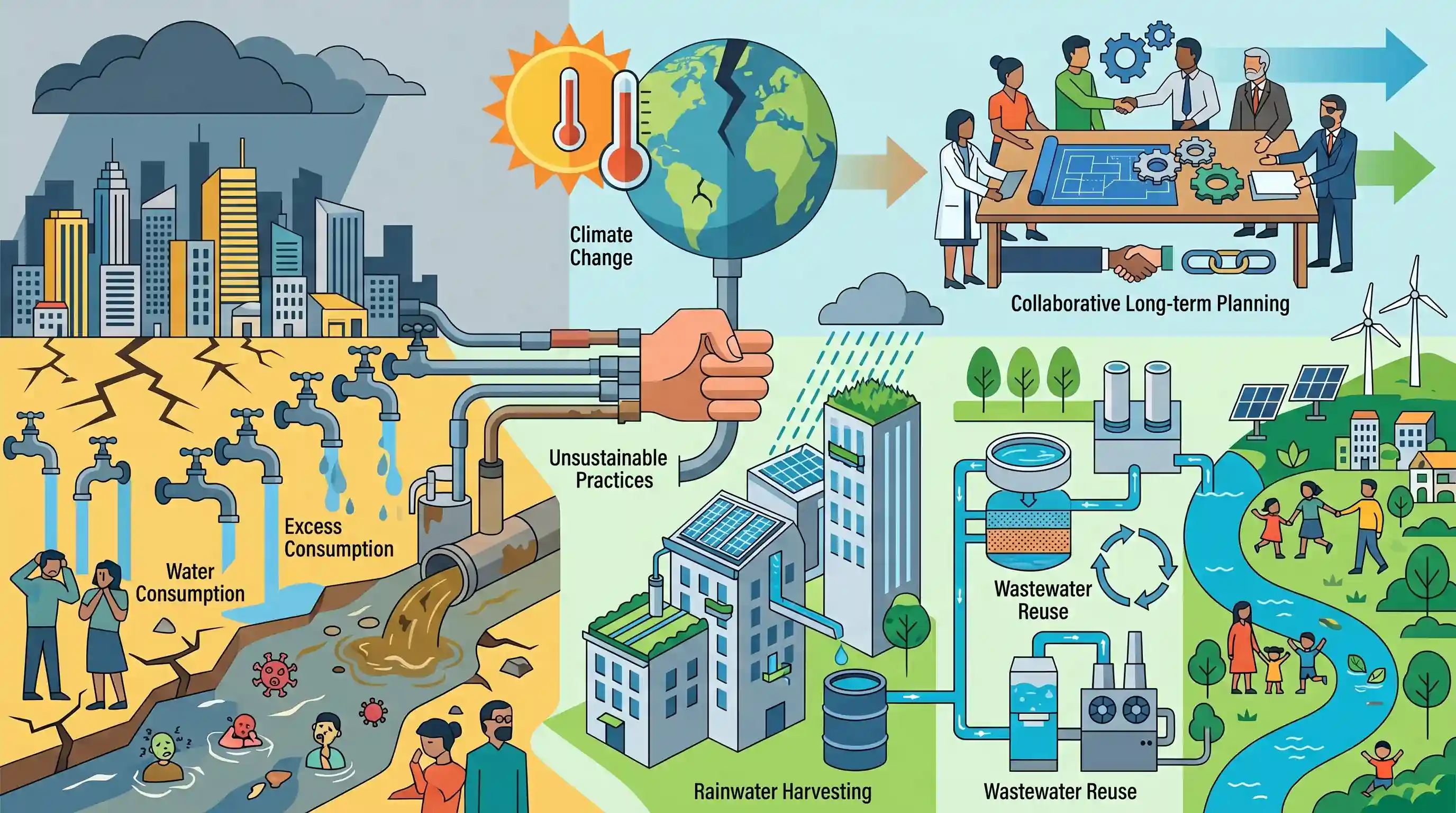
Experts at the WEEHTEC - 2026 conference held at Dr. Manmohan Singh Bengaluru City University raised urgent alarms about Bengaluru's impending water crisis. Driven by unsustainable practices, pollution, and climate change, the city's water situation poses severe public health and security risks. Key recommendations include widespread rainwater harvesting, systematic wastewater reuse, and collaborative long-term planning to secure a sustainable future.
Key Points
- Experts at WEEHTEC-2026 warned that Bengaluru is approaching a critical threshold due to unsustainable water practices.
- Former AICTE chairperson advocated for large-scale rainwater harvesting and systematic wastewater reuse to ensure water security.
- Climate change, pollution, and resource misuse were linked to escalating public health risks in urban areas.
- There is an urgent need for collaborative, long-term, and sustainable water-management solutions for Bengaluru's future.
Important Terms
WEEHTEC - 2026

A premier technical forum (Water-Energy-Environment-Health) focusing on actionable technology and scalable engineering solutions for sustainable urban development and resource management.
UPSC context
GS Paper III (Environment); relevant for studying multi-disciplinary approaches to climate change and urban resource management.
Bengaluru Water Expo - 2026
An annual technical exhibition and conference in Karnataka dedicated to water quality, circular water economy, and innovative technologies for urban water sectors.
UPSC context
GS Paper III (Infrastructure/Water); highlights industry-academia collaboration in solving city-specific environmental crises.
Dr. Manmohan Singh Bengaluru City University (BCU)
A state public university established in 2017, inheriting the legacy of the 160-year-old Central College, focusing on inclusive higher education and social transformation.
UPSC context
GS Paper II (Education/Institutions); illustrates the role of state universities in hosting global sustainability dialogues.
AICTE (All India Council for Technical Education)
The statutory body responsible for planning, formulation, and maintenance of norms and standards in technical education across India.
UPSC context
GS Paper II (Statutory Bodies/Education); crucial for questions on governance and human resource development.
Integrated Urban Water Management (IUWM)
A holistic approach to managing the entire urban water cycle—including water supply, sanitation, and stormwater—to maximize economic and social welfare.
UPSC context
GS Paper I (Urbanization) & GS Paper III (Environment); a key strategy for sustainable cities and SDG 6.
Prelims Trap
"The 'Sponge City' model relies primarily on centralized concrete reservoirs and large-scale drainage pipes to prevent urban flooding."
The Sponge City concept emphasizes decentralized, nature-based solutions (permeable pavements, green roofs, urban wetlands) to absorb rain, not traditional grey/concrete infrastructure.
Static Concepts Connected
What are the core principles of a Circular Water Economy?
- Reduce: Minimizing raw water consumption and curbing physical leakages in urban distribution networks.
- Reuse & Recycle: Treating and utilizing wastewater for non-potable urban applications like industrial cooling, flushing, and landscaping.
- Resource Recovery: Extracting valuable resources, such as energy and nutrients (like phosphorus and nitrogen), from wastewater before final discharge.
Why are Indian megacities facing the dual challenge of water scarcity and urban flooding?
- Impermeable Surfaces: Rampant paving and concretization reduce permeable surface area, preventing groundwater recharge and increasing surface runoff during monsoons.
- Wetland Encroachment: Rapid, unplanned reclamation of traditional urban water bodies (lakes and wetlands) removes natural flood sinks and dry-season recharge zones.
- Climate Change: The increased frequency of short-duration, high-intensity rainfall events overwhelms outdated urban drainage systems.
Cross-Topic Patterns
Urban Wetlands & Disaster Management
The destruction of interconnected urban lake systems directly ties wetland conservation to disaster management. Previous exams have repeatedly linked water body encroachment to urban flooding (e.g., Chennai, Hyderabad, Bengaluru).
Water Scarcity & Public Health Nexus
Severe groundwater depletion concentrates natural contaminants (like fluoride), while intermittent piped supply creates a vacuum that pulls in sewage. This links resource mismanagement directly to public health burdens.

Expect a GS1 or GS3 Mains question linking 'Sponge City' models to mitigating both urban floods and groundwater scarcity in megacities.
Linked PYQs · 4
Linked PYQs · 4
- 2018MainsGS1
The ideal solution of depleting ground water resources in India is water harvesting system." How can it be made effective in urban areas?
- 2023MainsGS1
Why is the world today confronted with a crisis of availability of and access to freshwater resources?
- 2024MainsGS3
The world is facing an acute shortage of clean and safe freshwater. What are the alternative technologies which can solve this crisis? Briefly discuss any three such technologies citing their key merits and demerits.
- 2025MainsGS3
Examine the factors responsible for depleting groundwater in India. What are the steps taken by the government to mitigate such depletion of groundwater?
