Uttar Pradesh groundwater management achievement under UN SDG 6 target
Source:uniindia ↗
Why It Matters
Water conservation, watershed development, and the SDGs are highly recurrent themes in UPPSC Prelims (e.g., past questions on SDG-6 and watershed definitions). Understanding state-specific achievements in these areas is crucial for questions related to UP's environmental and developmental milestones.
Summary
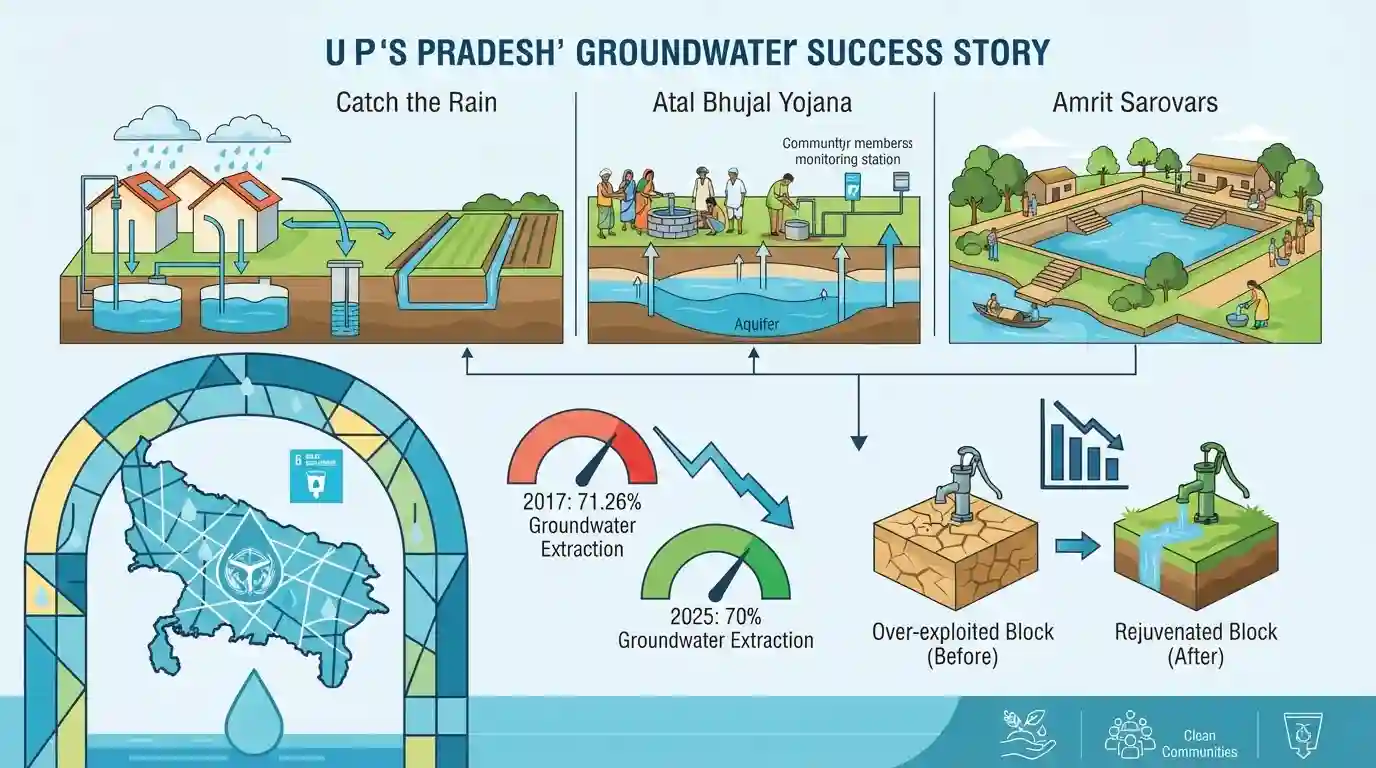
Uttar Pradesh has successfully achieved the United Nations Sustainable Development Goal 6 (SDG-6) benchmark for clean water and sanitation by significantly improving its groundwater management. Through rigorous conservation efforts, including the 'Catch the Rain' campaign, Atal Bhujal Yojana, and the construction of Amrit Sarovars, the state reduced its groundwater extraction rate from 71.26% in 2017 to 70% in 2025. These initiatives have led to a notable increase in annual groundwater recharge and a sharp decline in the number of over-exploited blocks, demonstrating effective regional implementation of global sustainability targets.
Key Points
- Uttar Pradesh has achieved the UN SDG-6 target for clean water and sanitation ahead of the 2030 deadline by reducing its groundwater extraction rate to 70%.
- Through the 'Catch the Rain' campaign, the state constructed 3.39 lakh rainwater harvesting structures and revived 1.34 lakh traditional water bodies.
- The Atal Bhujal Yojana led to improved groundwater levels in 303 out of 550 targeted Gram Panchayats.
- Under the Amrit Sarovar scheme, the Rural Development Department developed 19,974 sarovars to increase water storage capacity.
- Annual groundwater recharge in the state increased from 71.66 BCM in 2017 to 73.39 BCM in 2025.
- The number of over-exploited groundwater blocks in Uttar Pradesh declined from 82 to 44.
Important Terms
Sustainable Development Goal 6 (SDG-6)

A United Nations global benchmark aimed at ensuring the availability and sustainable management of clean water and sanitation for all by 2030.
UPSC context
GS Paper 3 (Environment). Tests awareness of global sustainability targets and India's state-level progress in achieving them.
Jal Shakti Abhiyan: Catch the Rain
A flagship campaign under the Jal Shakti Abhiyan to promote rainwater harvesting, rejuvenate water bodies, and accelerate groundwater recharge through mass public participation.
UPSC context
GS Paper 3 (Water Conservation). Evaluates knowledge of national mass-movement initiatives for disaster resilience and watershed management.
Atal Bhujal Yojana
A World Bank-backed central sector scheme that promotes community-led groundwater management, water budgeting, and demand-side interventions in critically water-stressed states.
UPSC context
GS Paper 2 (Governance) & Paper 3 (Conservation). Tests understanding of participatory resource management and state-centre schemes.
Mission Amrit Sarovar
A national mission launched in 2022 to construct or restore at least 75 high-capacity water bodies (ponds) in every Indian district, improving local groundwater recharge.
UPSC context
GS Paper 3 (Infrastructure/Environment). Important for rural development schemes and local water capacity-building initiatives.
Ministry of Jal Shakti
The nodal Union ministry established in 2019 to comprehensively address India's mounting water challenges, managing everything from drinking water supply to groundwater conservation.
UPSC context
GS Paper 2 (Polity/Governance). Tests institutional awareness regarding the administration and convergence of national water policies.
Prelims Trap
Atal Bhujal Yojana is a pan-India scheme to improve groundwater levels across all districts.
Atal Bhujal Yojana targets only seven specific water-stressed states, not the entire country. Aspirants also often mistake it for a Centrally Sponsored Scheme rather than Central Sector.
Static Concepts Connected
How does the CGWB categorize groundwater assessment units in India?
- Safe: Stage of annual groundwater extraction is strictly less than 70%.
- Semi-critical: Stage of extraction is between 70% and 90%.
- Critical: Stage of extraction is between 90% and 100%.
- Over-exploited: Extraction exceeds 100% of the annual extractable groundwater recharge.
What are the core mechanisms of the Atal Bhujal Yojana?
- Funding model: It is a Central Sector Scheme with an outlay of Rs. 6000 crore, funded 50:50 by the Government of India and the World Bank.
- Target areas: Focuses exclusively on seven water-stressed states: Gujarat, Haryana, Karnataka, Madhya Pradesh, Maharashtra, Rajasthan, and Uttar Pradesh.
- Community focus: Emphasizes decentralized, participatory groundwater management through the preparation of Water Security Plans at the Gram Panchayat level.
Cross-Topic Patterns
Groundwater Depletion & Cropping Patterns
Heavy reliance on MSP for water-guzzling crops like paddy and sugarcane drives groundwater depletion. Shifting procurement policies toward millets directly aligns agricultural economics with SDG-6 conservation goals.
SDG Localization & Federalism
UP's achievement reflects 'SDG Localization'—a NITI Aayog priority where sub-national governments drive global sustainability targets through decentralized, panchayat-led planning and localized scheme implementation.

Expect a 2026 prelims question pairing CGWB groundwater extraction categories (Safe <70%) with Atal Bhujal Yojana's World Bank funding.
Linked PYQs · 4
Linked PYQs · 4
- 2019UPPSC_PRELIMSGS1
Which of the following Sustainable Development Goal (SDG) will target to water availability for all and its permanent management upto 2030 in India?
- 2025UPPSC_PRELIMSGS1
Match List-I (Sustainable Development Goal): (A) Goal 1 (B) Goal 3 (C) Goal 4 (D) Goal 6 List-II (Area of Goal): 1. Clean water and sanitation 2. Quality education 3. End poverty in all its forms 4. Good health and well-being
- 2022UPPSC_PRELIMSGS1
Which one of the following Watershed Development Projects sponsored by the Central Government of India which aims at enabling the rural population to conserve the water ?
- 2023UPPSC_PRELIMSGS1
A geographical unit that collects, stores and release water is called -
