RBI Revises FY27 GDP Growth Forecast Downward
Source:The Hindu ↗
Why It Matters
The RBI's downward revision of the GDP forecast demonstrates the direct vulnerability of India's macroeconomic stability to global geopolitical tensions and supply chain shocks. Understanding how external factors like the Strait of Hormuz crisis influence domestic monetary policy and inflation is crucial for evaluating economic resilience.
Summary
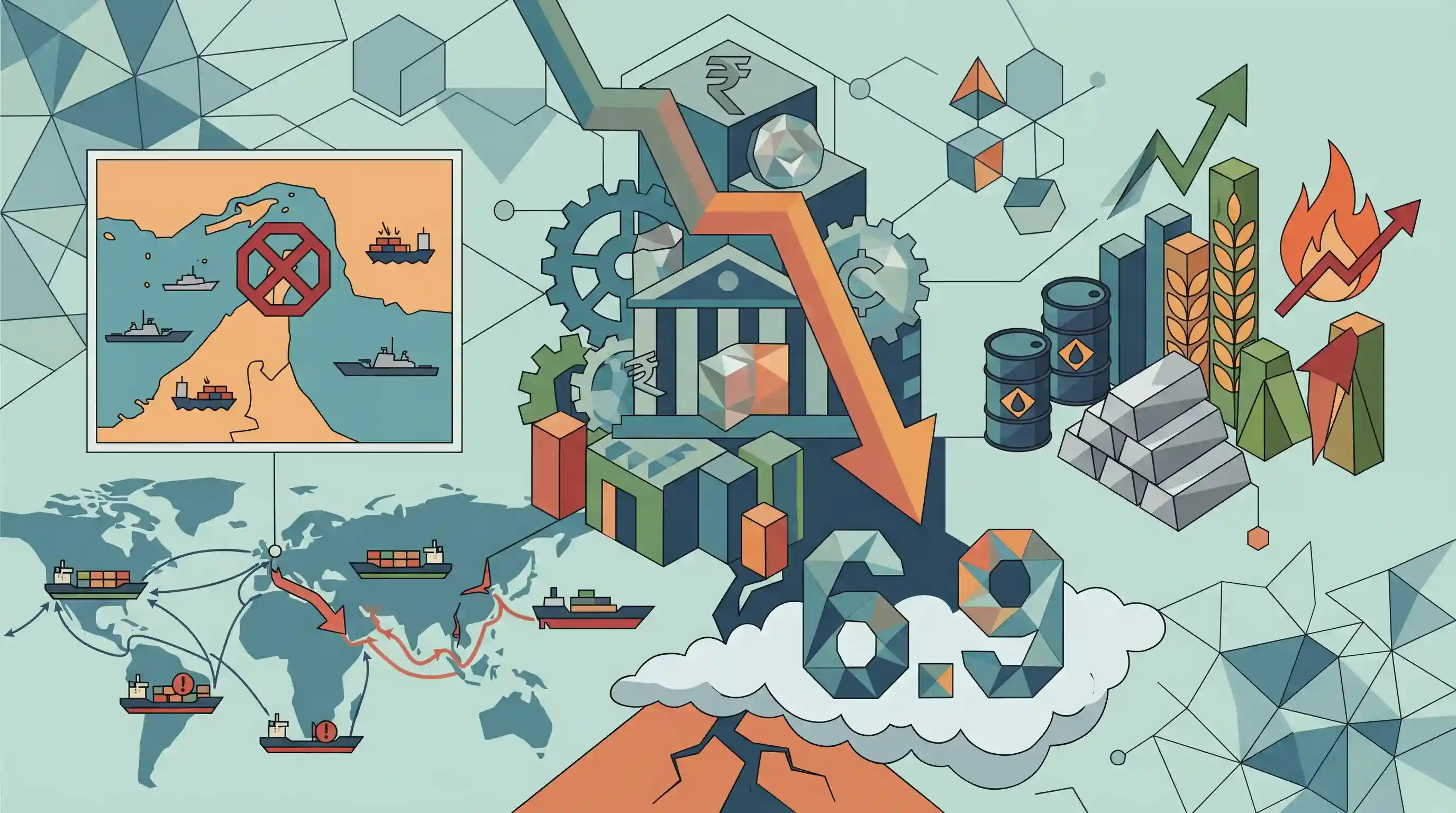
The Reserve Bank of India has revised its GDP growth forecast for India downward to 6.9% for FY27, citing multiple global and domestic headwinds. RBI Governor Sanjay Malhotra emphasized that rising commodity prices, global supply chain disruptions, and the ongoing geopolitical crisis in the Strait of Hormuz present major risks to economic stability and growth prospects.
Key Points
- The Reserve Bank of India has lowered India's GDP growth projection for FY27 to 6.9%, compared to the estimated 7.6% in FY26.
- RBI Governor Sanjay Malhotra identified rising commodity prices and supply chain disruptions as significant headwinds to economic growth.
- The ongoing geopolitical crisis in the Strait of Hormuz was highlighted as a key risk affecting global supply chains and energy security.
Important Terms
Reserve Bank of India (RBI)

India’s central bank, established in 1935, responsible for regulating the country's monetary policy, banking system, and currency to ensure economic stability and financial growth.
UPSC context
GS Paper III (Economy). Essential for understanding central banking functions, monetary stability, and the regulatory framework of India's financial system.
Monetary Policy Committee (MPC)
A six-member statutory body chaired by the RBI Governor that fixes the benchmark interest rate (repo rate) to maintain price stability while supporting economic growth.
UPSC context
GS Paper III (Economy). Tests knowledge of interest rate setting, the inflation-targeting framework, and central bank accountability.
Gross Domestic Product (GDP)
The total market value of all final goods and services produced within a country's borders, serving as the primary indicator of economic size and growth.
UPSC context
GS Paper III (Economy). Fundamental for measuring economic development, per capita income, and sectoral contributions to the Indian economy.
Strait of Hormuz
A critical maritime chokepoint between Iran and Oman through which approximately one-fifth of the world’s traded oil and LNG passes, vital for global energy trade.
UPSC context
GS Paper I (Geography) & II (IR). Key for mapping maritime routes, West Asian geopolitics, and India's energy security vulnerabilities.
Energy Security
The uninterrupted availability of energy sources at an affordable price, which is vulnerable to geopolitical disruptions in maritime corridors like the Strait of Hormuz.
UPSC context
GS Paper III (Infrastructure). Addresses India’s dependency on oil imports, fiscal impact of price shocks, and strategic petroleum reserves.
Flexible Inflation Targeting (FIT)
A framework requiring the RBI to maintain retail inflation within a 2-6% target range, focusing on price stability as a precondition for sustainable growth.
UPSC context
GS Paper III (Economy). Tests understanding of price stability mechanisms, Consumer Price Index (CPI) relevance, and central bank mandates.
Prelims Trap
Repo rate hikes are the primary mechanism to control imported inflation caused by global supply shocks.
The repo rate primarily curbs demand-pull inflation by contracting domestic money supply. It cannot resolve supply-side logistics bottlenecks or global commodity shocks.
Static Concepts Connected
What are the key geographical features of the Strait of Hormuz?
- Water bodies linked: It connects the Persian Gulf to the Gulf of Oman and subsequently the Arabian Sea.
- Bordering nations: It is bounded by Iran to the north and the exclave of Oman and the UAE to the south.
- Economic significance: It is a highly strategic maritime chokepoint handling a massive share of the world's seaborne crude oil transit.
How does imported inflation restrict the Monetary Policy Committee (MPC)?
- Supply-side nature: It is driven by external supply-side shocks (e.g., costly crude oil) rather than excess domestic consumer demand.
- Policy limitation: Traditional monetary tools like raising the repo rate are designed to curb domestic demand, rendering them largely ineffective against external supply disruptions.
- Growth trade-off: Aggressive rate hikes to control imported inflation risk stifling domestic credit growth, forcing the RBI into a difficult growth-inflation trade-off.
Cross-Topic Patterns
Imported Inflation + Energy Security
Supply shocks in Hormuz highlight the limitations of RBI's monetary tools, emphasizing India's reliance on Strategic Petroleum Reserves to buffer imported inflation and safeguard GDP growth.
Maritime Chokepoints + CAD Widening
Geopolitical bottlenecks in the Middle East directly depress domestic GDP by inflating logistics costs, depreciating the Rupee, and expanding India's Current Account Deficit.

Expect a 2026 question linking RBI's inflation-targeting limits with Middle East maritime chokepoints and rupee depreciation.
Linked PYQs · 3
Linked PYQs · 3
- 2022PrelimsGS1
With reference to the Indian economy, consider the following statements: 1. If the inflation is too high, Reserve Bank of India (RBI) is likely to buy government securities. 2. If the rupee is rapidly depreciating, RBI is likely to sell dollars in the market. 3. If interest rates in the USA or European Union were to fall, that is likely to induce RBI to buy dollars. Which of the statements given above are correct?
- 2022PrelimsGS1
In India, which one of the following is responsible for maintaining price stability by controlling inflation?
- 2024PrelimsGS1
Consider the following statements : Statement-I : Sumed pipeline is a strategic route for Persian Gulf oil and natural gas shipments to Europe. Statement-II : Sumed pipeline connects the Red Sea with the Mediterranean Sea. Which one of the following is correct in respect of the above statements?
