Israel strikes Iran Assembly of Experts amid succession crisis
Source:Indian Express ↗
Why It Matters
The Israel-Iran conflict dictates the geopolitical stability of West Asia. For India, this matters immensely due to its dependence on Middle Eastern oil, the presence of a large Indian diaspora, and strategic investments like the Chabahar Port and INSTC.
Summary
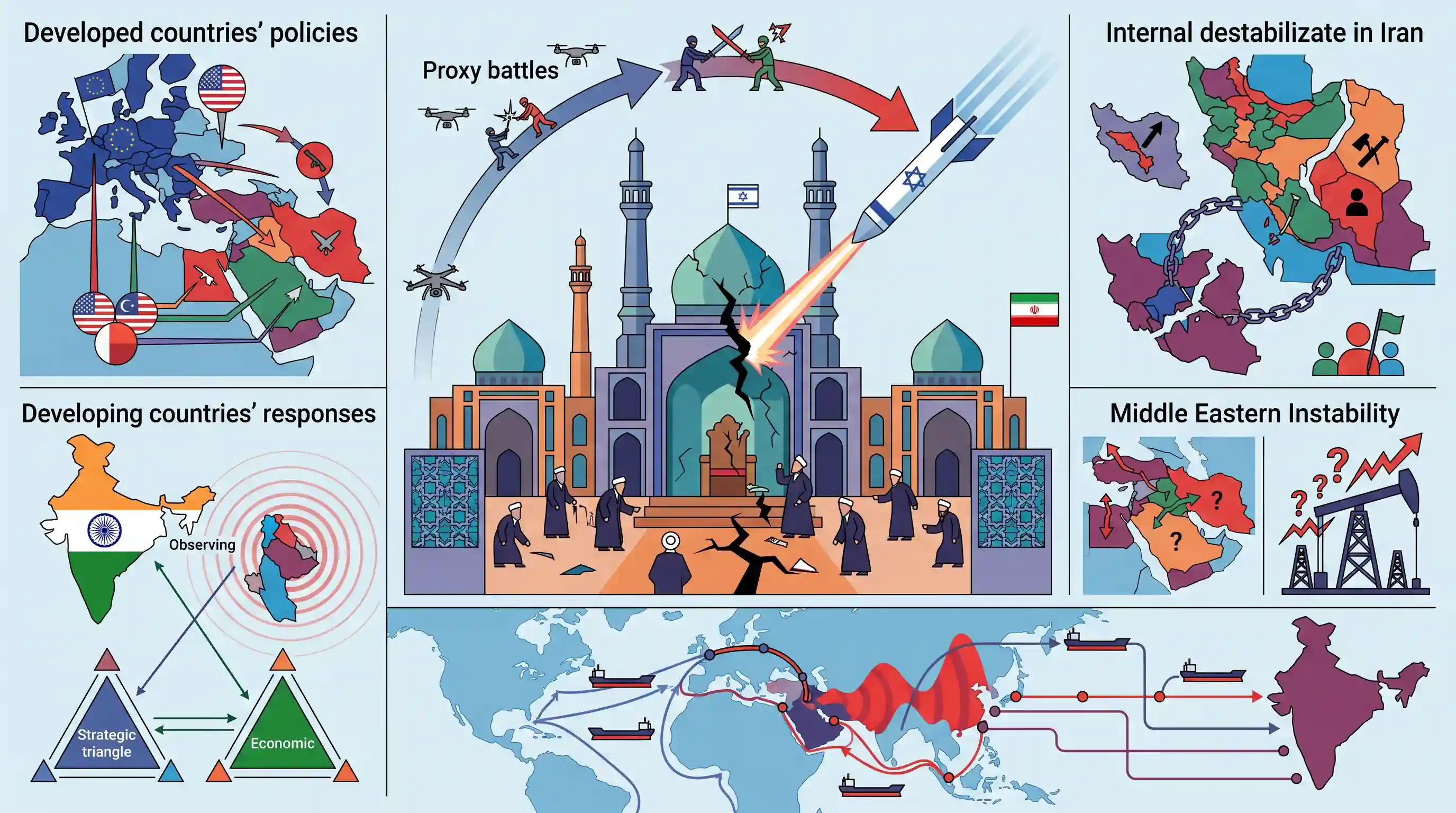
Israel has reportedly executed a strike against the Assembly of Experts in the holy city of Qom, Iran, marking a dramatic escalation in the ongoing Israel-Iran conflict. The Assembly of Experts is the paramount clerical body tasked with appointing the next Supreme Leader of Iran. By targeting this specific institution, Israel appears to be making a calculated geopolitical move to disrupt Iran's political continuity and foment internal instability during a vulnerable succession period. This unprecedented direct attack on Iran's religious and political nerve center underscores a shift from regional proxy warfare to direct internal destabilization, raising severe concerns for broader Middle Eastern stability and global energy security.
Key Points
- The Assembly of Experts is a crucial 88-member deliberative body of Islamic theologians in Iran, responsible for electing and overseeing the Supreme Leader.
- Qom is the primary theological center of Iran; a strike here is a highly symbolic and direct attack on the country\'s politico-religious establishment.
- The timing of the strike appears calculated to exploit a looming succession crisis, aiming to destabilize Iran during a critical leadership transition.
- This event marks a significant escalation in the Israel-Iran conflict, shifting from proxy warfare and military targets to direct strikes on Iran\'s core political institutions.
- Such instability in the Middle East directly threatens global energy security and impacts India\'s strategic balancing between Israel and Arab/Iranian partners.
Important Terms
Assembly of Experts

Iran's 88-member clerical body empowered to appoint, oversee, and dismiss the Supreme Leader. Members are elected every eight years but vetted by the Guardian Council to ensure ideological alignment.
UPSC context
GS Paper II (International Relations). Tests understanding of West Asian political structures and their impact on regional stability and India's interests.
Supreme Leader (Rahbar)
The ultimate political and religious authority in Iran’s theocratic system. They serve as Head of State, Commander-in-Chief, and hold final say over major foreign and domestic policy decisions.
UPSC context
GS Paper II. Relevant for studying theocratic governance models and bilateral dynamics between India and Iran.
Qom
Iran's second holiest city and a global center for Shiite theological scholarship. It serves as the ideological heart of the Islamic Republic and a key site for clerical power.
UPSC context
GS Paper II. Highlights the intersection of religion and politics in West Asian geopolitics and its impact on regional security.
Velayat-e Faqih
The doctrine of “Guardianship of the Islamic Jurist,” which forms the constitutional basis of Iran’s government. It grants a leading cleric supreme authority over the state.
UPSC context
GS Paper II. Tests knowledge of foreign political systems and ideological drivers of Iranian foreign policy affecting Indian interests.
Axis of Resistance
A strategic coalition led by Iran, comprising regional governments and non-state actors (e.g., Hezbollah, Hamas, Houthis) aimed at countering Western and Israeli influence in the Middle East.
UPSC context
GS Paper II. Crucial for analyzing regional proxy conflicts, maritime security, and India's "Link West" policy.
Guardian Council
A 12-member body of clerics and jurists that vets candidates for public office and ensures legislation conforms to Islamic law and the Iranian constitution.
UPSC context
GS Paper II. Pertains to the institutional architecture of foreign states and the vetting processes that shape Iranian leadership transitions.
Prelims Trap
"The Assembly of Experts acts as Iran's parliament and drafts regular civic legislation."
Aspirants often confuse it with the Majlis (Parliament). The Assembly of Experts is strictly a clerical body whose primary constitutional mandate is electing and overseeing the Supreme Leader.
Static Concepts Connected
How does the Iranian political power structure function at the top level?
- Supreme Leader: The highest political, religious, and military authority, holding ultimate command over the armed forces, IRGC, and foreign policy.
- Assembly of Experts: An 88-member deliberative body of Islamic theologians that appoints, supervises, and can theoretically dismiss the Supreme Leader.
- President: The head of government, directly elected by the public, but subordinate to the Supreme Leader on major state matters.
What defines India's 'De-hyphenation' policy in West Asia?
- Independent Relations: Pursuing parallel, independent strategic ties with rival nations, ensuring relations with one do not dictate terms with another.
- Issue-Based Alignment: Engaging Israel for high-tech defense and agriculture, while partnering with Iran for Chabahar port and Arab states for energy.
- Strategic Autonomy: Moving away from zero-sum diplomacy to maximize national interest across a complex, multipolar West Asian geopolitical landscape.
Cross-Topic Patterns
Iran instability + INSTC viability
Internal destabilization in Iran directly threatens the operational security of Chabahar Port and the INSTC, jeopardizing India's strategic bypass of Pakistan to reach Central Asia and Russia.
Gulf escalation + Imported Inflation
Direct strikes escalate risks of disruptions in the strategic Strait of Hormuz, threatening India's oil imports, potentially widening the Current Account Deficit, and exacerbating imported inflation.

Iran's unique political bodies (Assembly of Experts) and internal geography (Qom) are highly probable pairing targets for 2026 Prelims.
Linked PYQs · 5
Linked PYQs · 5
- 2018MainsGS2
“India’s relations with Israel have, of late, acquired a depth and diversity, which cannot be rolled back.” Discuss.
- 2025MainsGS2
"Energy security constitutes the dominant kingpin of India's foreign policy, and is linked with India's overarching influence in Middle Eastern countries.” How would you integrate energy security with India's foreign policy trajectories in the coming years?
- 2015PrelimsGS1
The area known as 'Golan Heights' sometimes appears in the news in the context of the events related to
- 2012MainsGS2
How have the US sanctions against Iran affected India's bilateral relations with Iran?
- 2018MainsGS2
In what ways would the ongoing US-Iran Nuclear Pact Controversy affect the national interest of India? How should India respond to this situation?
