AI Impact Summit and Technology Governance Execution Challenges
Source:The Hindu ↗
Why It Matters
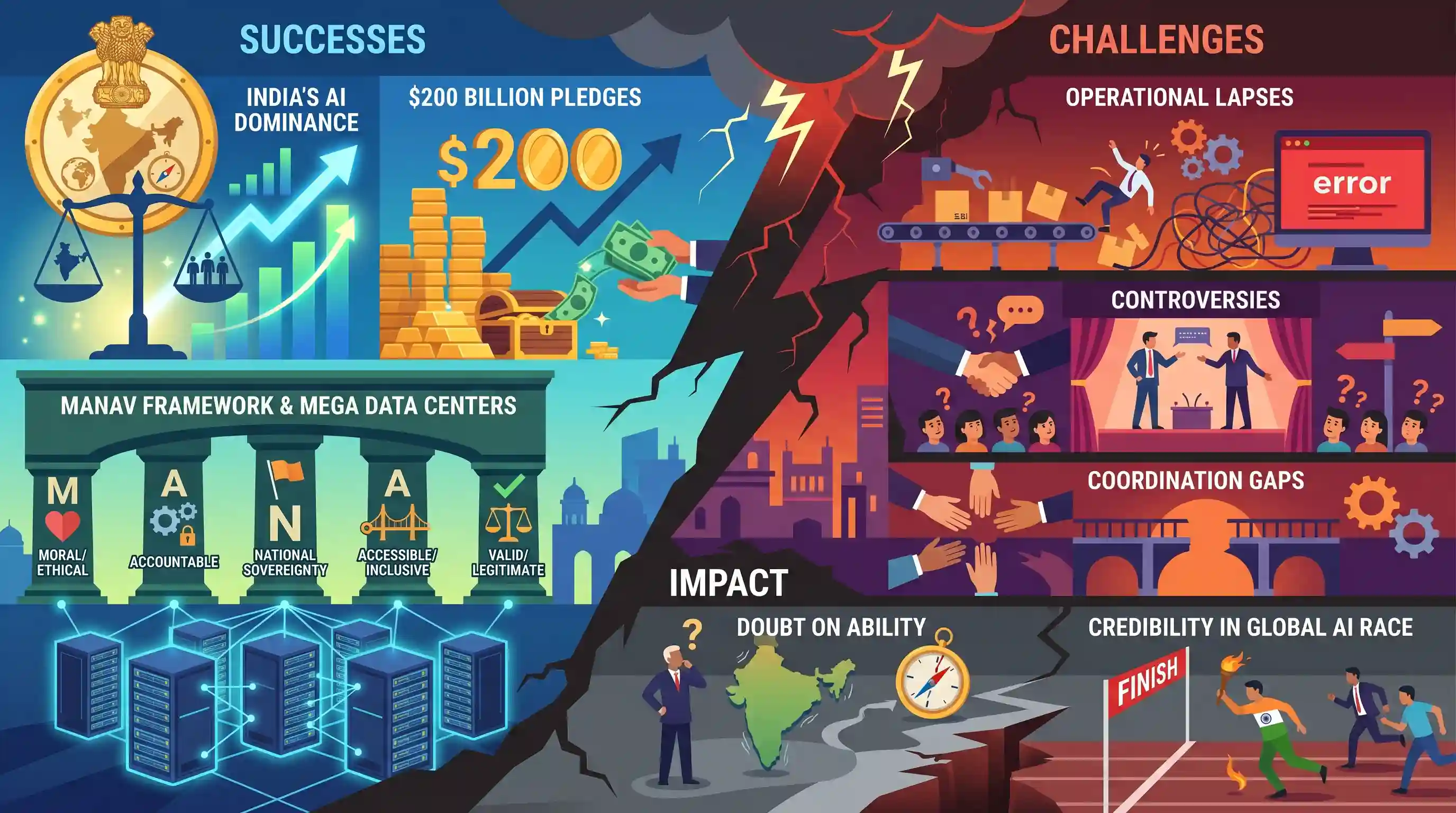
This event illustrates the duality of India's technological push: high ambition and investment (MANAV framework, $200B pledges) coupled with persistent bureaucratic and execution challenges. It serves as a prime case study for GS3 (Science & Tech, AI applications) and GS2 (e-Governance, implementation bottlenecks) on whether the state capacity matches its technological aspirations.
Summary
The AI Impact Summit 2026 aimed to assert India's dominance in the global artificial intelligence landscape, garnering over $200 billion in pledges and introducing the ambitious MANAV framework along with mega data center investments. However, the event's successes were overshadowed by significant operational lapses, controversies, and coordination gaps. These execution issues have cast doubt on the government's ability to effectively deliver on its long-term technological vision and maintain its credibility in the fast-paced global AI race.
Key Points
- The AI Impact Summit 2026 positioned India as a central player in the global AI race, securing over $200 billion in pledges.
- Key announcements included the introduction of the MANAV framework and substantial investments toward mega data centers, signaling strong national intent and scale.
- Despite these achievements, the summit suffered from operational lapses, controversies, and coordination gaps.
- These setbacks have raised serious questions about the effective delivery and long-term credibility of India's ambitious AI and tech governance vision.
Important Terms
MANAV Framework

A human-centric AI governance charter introduced by India, emphasizing five pillars: Moral and Ethical systems, Accountable governance, National sovereignty, Accessible/Inclusive AI, and Valid/Legitimate systems.
UPSC context
GS Paper 3: Science & Technology (AI ethics); GS Paper 2: Governance (Policy frameworks). Tests understanding of India's indigenous AI doctrine.
AI Impact Summit 2026
The first global AI summit hosted in the Global South (New Delhi, 2026), focusing on transitioning from theoretical AI safety to practical socio-economic impact across sectors.
UPSC context
GS Paper 2: International Relations (Global South leadership); GS Paper 3: IT and Economy. Relevant for India's role in global tech diplomacy.
MeitY (Ministry of Electronics and Information Technology)
The Union Ministry responsible for India's digital strategy, implementing the IndiaAI Mission and managing the regulatory framework for electronics, IT, and emerging technologies like AI.
UPSC context
GS Paper 2: Government Policies and Interventions. Nodal agency for e-governance and the digital economy.
IndiaAI Mission
A comprehensive national initiative (outlay ₹10,300+ cr) aimed at establishing a robust AI ecosystem through computing capacity, high-quality datasets, and ethical governance standards.
UPSC context
GS Paper 3: Science & Tech (Indigenization); Economy (Strategic investment). Core component of India's goal for technological sovereignty.
Pax Silica
A US-led strategic initiative (joined by India in 2026) focused on securing AI supply chains and silicon production to reduce global reliance on non-allied mineral and tech dependencies.
UPSC context
GS Paper 2: International Relations (Strategic alliances); GS Paper 3: Science & Tech (Semiconductors). Tests knowledge of global tech-geopolitics.
Prelims Trap
The MANAV framework is a legally binding global AI treaty adopted by the United Nations.
MANAV is India's domestic, foundational doctrine for human-centric AI and sovereign data protection, not an international treaty or UN-backed legally binding regulation.
Static Concepts Connected
What is Sovereign AI and why does India prioritize it?
- Definition: Developing domestic AI capabilities using local infrastructure, data, and foundational models tailored to indigenous linguistic and cultural contexts.
- Data Security: Prevents critical national data from being hosted on foreign servers, mitigating surveillance and strategic vulnerabilities.
- Economic Independence: Reduces reliance on western tech monopolies for core digital public infrastructure and strategic technological needs.
What is the environmental cost of the global Data Centre expansion?
- Energy Intensity: AI and cloud computing data centers require massive, uninterrupted base-load electricity, heavily straining local power grids.
- Water Footprint: Tremendous amounts of freshwater are consumed for cooling hardware and server farms, exacerbating local water scarcity issues.
- Carbon Emissions: Without a rapid shift to renewables, the scale-up of mega data centers severely undermines national net-zero emission targets.
Cross-Topic Patterns
AI data centers vs. Panchamrit climate targets
The massive power required for the $200B data center pledge directly challenges India’s COP26 Panchamrit commitment to reduce carbon intensity, bridging Science & Tech with Environment.
DPI as a geopolitical and diplomatic tool
India uses domestic tech frameworks to export Digital Public Infrastructure (DPI) to the Global South. Execution lapses domestically undermine this crucial foreign policy and soft-power tool.

Expect a multi-statement Prelims question contrasting India's MANAV AI framework with the EU AI Act, focusing on sovereignty vs regulation.
Linked PYQs · 3
Linked PYQs · 3
- 2023MainsGS3
Introduce the concept of Artificial Intelligence (AI). How does Al help clinical diagnosis? Do you perceive any threat to privacy of the individual in the use of Al in healthcare?
- 2023MainsGS3
What is the status of digitalization in the Indian economy? Examine the problems faced in this regard and suggest improvements.
- 2023MainsGS2
e-governance, as a critical tool of governance, has ushered in effectiveness, transparency and accountability in governments. What inadequacies hamper the enhancement of these features ?
