West Asia conflict impact on Indian fertilizer and energy supply
Source:The Hindu ↗
Why It Matters
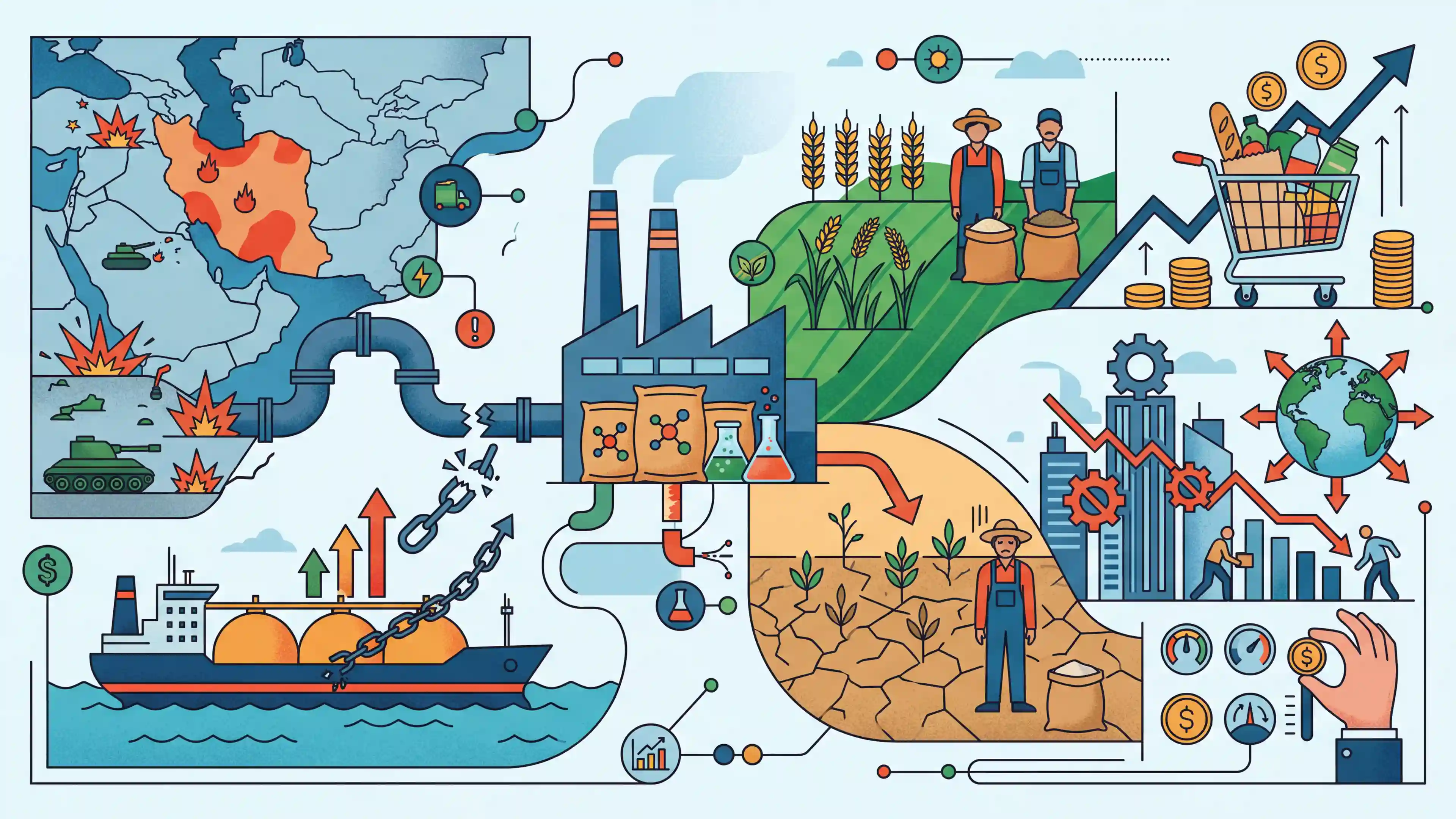
It connects geopolitics with domestic economic realities, demonstrating the complex supply chains (Energy -> Fertilizer -> Agriculture -> Inflation) that UPSC frequently tests across GS2 (International Relations) and GS3 (Economy, Agriculture, Energy Security).
Summary
The article analyzes the economic repercussions of an escalating conflict in West Asia, particularly involving Iran, on India's economy. The primary transmission channel for this shock is through the disruption of Liquefied Natural Gas (LNG) supplies, which India heavily imports from the region. LNG is a critical feedstock for producing ammonia and urea fertilizers. A spike in LNG prices or supply constraints would directly lead to higher fertilizer costs or shortages, severely impacting India's agricultural output. This sequence of events poses a major risk to food security and threatens to exacerbate persistent food inflation, ultimately slowing down India's broader economic growth trajectory due to reduced purchasing power and potential monetary tightening.
Key Points
- Geopolitical tensions in West Asia, particularly involving Iran, threaten global and Indian energy supply chains.
- India is highly dependent on LNG imports from the Middle East to meet its domestic natural gas requirements.
- Natural gas (LNG) serves as a critical primary feedstock (ammonia) for the production of essential agricultural fertilizers like urea.
- Disruptions or price spikes in LNG imports can cause fertilizer shortages or subsidy burdens, threatening crop yields and agricultural stability.
- A consequent decline in agricultural output could trigger severe food inflation, dampening overall economic growth in India.
Important Terms
Liquefied Natural Gas (LNG)

Natural gas cooled to liquid form for transport. It is the primary feedstock for India's urea production; India imports ~50% of its requirements, mostly from West Asia.
UPSC context
GS Paper III (Energy/Infrastructure). Tests energy security and industrial feedstock dependencies.
Urea
A nitrogen-rich chemical fertilizer vital for crop yields. India is a major consumer, relying on domestic production (using LNG feedstock) and imports (primarily from West Asia).
UPSC context
GS Paper III (Agriculture). Tests knowledge of agricultural inputs and food security.
Food Inflation
A persistent rise in food prices, often triggered in India by supply-side shocks like high fuel costs, fertilizer shortages, or weather anomalies.
UPSC context
GS Paper III (Economy). Tests understanding of inflation dynamics and macroeconomic stability.
Strait of Hormuz
A critical maritime chokepoint between Iran and Oman. It handles roughly 20% of global oil and a significant portion of India's LNG imports.
UPSC context
GS Paper I (Geography)/GS II (IR). Tests strategic chokepoints and geopolitical risks.
Monetary Tightening
A central bank action (raising Repo Rates) to reduce money supply and curb high inflation, often used when prices exceed the 4% (+/-2%) target.
UPSC context
GS Paper III (Economy). Tests RBI's role in price stability and monetary policy.
Fertilizer Subsidy
Financial aid from the government to keep fertilizer prices low for farmers. Rising global LNG prices increase this fiscal burden on the Union Budget.
UPSC context
GS Paper III (Agriculture/Economy). Tests knowledge of fiscal policy and agricultural subsidies.
Reserve Bank of India (RBI)
India's central bank responsible for regulating the banking system, managing monetary policy, and maintaining price stability through inflation targeting.
UPSC context
GS Paper III (Economy). Tests institutional frameworks for economic and monetary management.
Prelims Trap
Urea prices are deregulated and governed by the Nutrient Based Subsidy (NBS) scheme.
Urea is the only chemical fertilizer with a statutorily controlled MRP. Non-urea fertilizers (DAP/MOP) fall under the NBS scheme, where subsidy is fixed but MRP is market-determined.
Static Concepts Connected
How are chemical fertilizers priced and subsidized in India?
- Urea MRP: Statutorily controlled by the government. The Centre pays the difference between production/import cost and the fixed MRP to manufacturers.
- NBS Scheme: Applies to non-urea fertilizers (P&K). The government provides a fixed subsidy per kg of nutrient; retail prices are market-linked.
- Feedstock Dependency: Natural gas (LNG) is the primary feedstock for urea, making global gas prices a direct determinant of India's subsidy bill.
How do external supply shocks cause domestic inflation?
- Imported Inflation: Spikes in global prices of critical inputs, like LNG, directly inflate domestic manufacturing and production costs.
- Cost-Push Inflation: Higher fertilizer costs or shortages reduce agricultural yields, driving up food prices independent of consumer demand.
- Fiscal Spillover: If the government absorbs imported costs via expanded subsidies, the fiscal deficit widens, indirectly fueling broader inflationary pressures.
Cross-Topic Patterns
Geopolitical Chokepoints & Crop Yields
West Asian chokepoints like the Strait of Hormuz directly dictate India's food security by controlling transit routes for critical LNG used in domestic Urea production.
Nano Urea as Strategic Buffer
India's push for Liquid Nano Urea isn't just about soil health; it's a macroeconomic shield against imported inflation and global natural gas price volatility.

Expect a multi-statement Prelims question linking Strait of Hormuz transit, LNG feedstock for Urea, and the NBS scheme vs Urea MRP.
Linked PYQs · 4
Linked PYQs · 4
- 2025MainsGS2
"Energy security constitutes the dominant kingpin of India's foreign policy, and is linked with India's overarching influence in Middle Eastern countries.” How would you integrate energy security with India's foreign policy trajectories in the coming years?
- 2017MainsGS2
The question of India's Energy Security constitutes the most important part of India's economic progress. Analyze India's energy policy cooperation with West Asian countries.
- 2020PrelimsGS1
With reference to chemical fertilizers in India, consider the following statements : 1. At present, the retail price of chemical fertilizers is market-driven and not administered by the Government. 2. Ammonia, which is an input of urea, is produced from natural gas. 3. Sulphur, which is a raw material for phosphoric acid fertilizer, is a by-product of oil refineries. Which of the statements given above is/are correct?
- 2024MainsGS3
What are the causes of persistent high food inflation in India? Comment on the effectiveness of the monetary policy of the RBI to control this type of inflation.
