Wastewater Surveillance Network Expansion for Disease Prevention
Source:Indian Express ↗
Why It Matters
Disease surveillance is a critical component of public healthcare systems. For UPSC aspirants, understanding environmental surveillance highlights modern, technology-driven approaches to governance, disaster management (epidemics), and the 'One Health' concept.
Summary
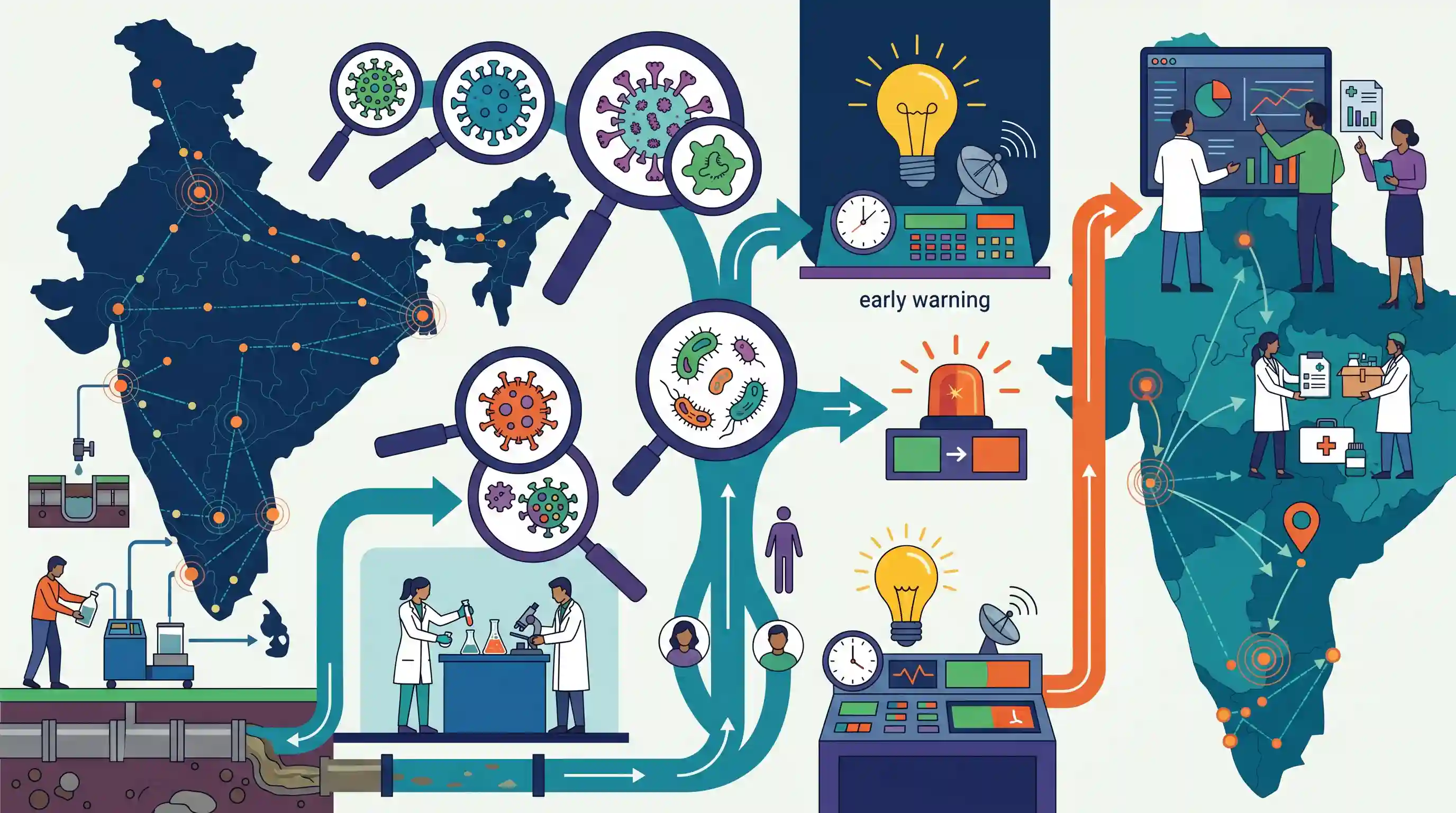
India is expanding its wastewater surveillance program to 50 cities as a proactive measure to prevent disease outbreaks. By testing community sewage for traces of pathogens, public health officials can detect the presence of infectious diseases—including asymptomatic and pre-symptomatic cases—well before clinical symptoms are reported. This non-invasive and cost-effective early warning system helps in monitoring viruses like SARS-CoV-2 and Polio, as well as antimicrobial resistance (AMR). The expansion of this network will significantly bolster India's epidemiological surveillance, enabling timely localized interventions and better resource management to preempt potential epidemics.
Key Points
- Wastewater (environmental) surveillance involves testing community sewage for traces of pathogens to monitor the spread of infectious diseases.
- The system acts as a crucial early-warning mechanism, capable of detecting pathogens (like SARS-CoV-2, Poliovirus, and AMR genes) days or weeks before clinical cases spike.
- India is expanding its wastewater surveillance network to 50 cities to strengthen public health monitoring and epidemic preparedness.
- This method is highly cost-effective and non-invasive, capturing data from asymptomatic and pre-symptomatic individuals who might not undergo clinical testing.
- The expansion will aid in localized public health interventions, optimal resource allocation, and preventing large-scale disease outbreaks.
Important Terms
Wastewater-Based Epidemiology (WBE)

A public health tool that analyzes genetic material in sewage to monitor disease trends and detect outbreaks at a population level before clinical cases appear.
UPSC context
Relevant for GS Paper III (S&T) and GS Paper II (Health); tests knowledge of non-invasive diagnostic technologies.
Indian Council of Medical Research (ICMR)
India’s apex body for biomedical research, responsible for formulating and coordinating health research. It is leading the expansion of wastewater surveillance to 50 cities.
UPSC context
Crucial for GS Paper II (Statutory/Institutional bodies) and health governance topics.
One Health Initiative
An integrated approach that recognizes the interconnectedness of human, animal, and environmental health to better manage zoonotic diseases and global health security.
UPSC context
High priority for GS Paper II (Health) and GS Paper III (Environment/Pandemic Preparedness).
Antimicrobial Resistance (AMR)
The phenomenon where bacteria, viruses, and fungi evolve to resist medications, making infections harder to treat. Wastewater surveillance tracks these resistance genes in communities.
UPSC context
A critical GS Paper III (Science/Health) topic regarding global health threats and scientific challenges.
National Centre for Disease Control (NCDC)
India's premier agency for outbreak investigation and disease surveillance, operating under the Ministry of Health and Family Welfare to manage infectious disease threats.
UPSC context
Relevant for GS Paper II (Governmental institutional frameworks for disease control).
Integrated Disease Surveillance Programme (IDSP)
A decentralized, laboratory-based surveillance program in India that tracks disease outbreaks. Wastewater surveillance complements this by providing early, community-wide warning signals.
UPSC context
Important for GS Paper II (Social Justice/Health) regarding public health infrastructure.
Prelims Trap
Wastewater surveillance tracks and identifies specific infected individuals to mandate clinical quarantine.
WBE only provides aggregate, community-level epidemiological data. It is non-invasive and cannot identify, track, or isolate specific individuals.
Static Concepts Connected
What are the core components of the 'One Health' approach?
- Interconnected framework: Recognizes the interconnectedness of human, animal, and environmental health ecosystems.
- Zoonotic Focus: Prioritizes the prevention of zoonotic spillover events, Antimicrobial Resistance (AMR), and food-borne pathogens.
- Integrated Surveillance: Relies heavily on environmental monitoring (like wastewater testing) alongside clinical data for early warning systems.
How does Antimicrobial Resistance (AMR) spread through environmental channels?
- Drug Residues: Active antibiotics from human excreta, hospital waste, and livestock runoff enter untreated water bodies.
- Gene Transfer: Sewage effluents act as hotspots where bacteria freely exchange resistance traits via Horizontal Gene Transfer.
- Environmental Detection: Testing urban wastewater reveals the silent, community-level burden of these resistant pathogens without individual clinical testing.
Cross-Topic Patterns
Polio's legacy in modern disease surveillance
Environmental surveillance was successfully pioneered in India’s polio eradication drive to detect wild poliovirus. Its expansion to COVID-19 and AMR shows crucial technological adaptation in public health.
AMR + Urban Sanitation Infrastructure
Untreated urban sewage accelerates AMR gene transfer. Integrating wastewater surveillance with the Swachh Bharat Mission and India's AMR National Action Plan connects health to civic infrastructure.

Expect a 2026 prelims statement testing Wastewater-Based Epidemiology (WBE) as a non-invasive tool capable of tracking asymptomatic AMR.
Linked PYQs · 3
Linked PYQs · 3
- 2024MainsGS2
In a crucial domain like the public healthcare system the Indian State should play a vital role to contain the adverse impact of marketisation of the system. Suggest some measures through which the State can enhance the reach of public healthcare at the grassroots level.
- 2022MainsGS3
The increase in life expectancy in the country has led to newer health challenges in the community. What are those challenges and what steps need to be taken to meet them?
- 2023PrelimsGS1
'Wolbachia method' is sometimes talked about with reference to which one of the following?
