US Officials Express Optimism in Bilateral Trade Talks with China
Source:The Hindu ↗
Why It Matters
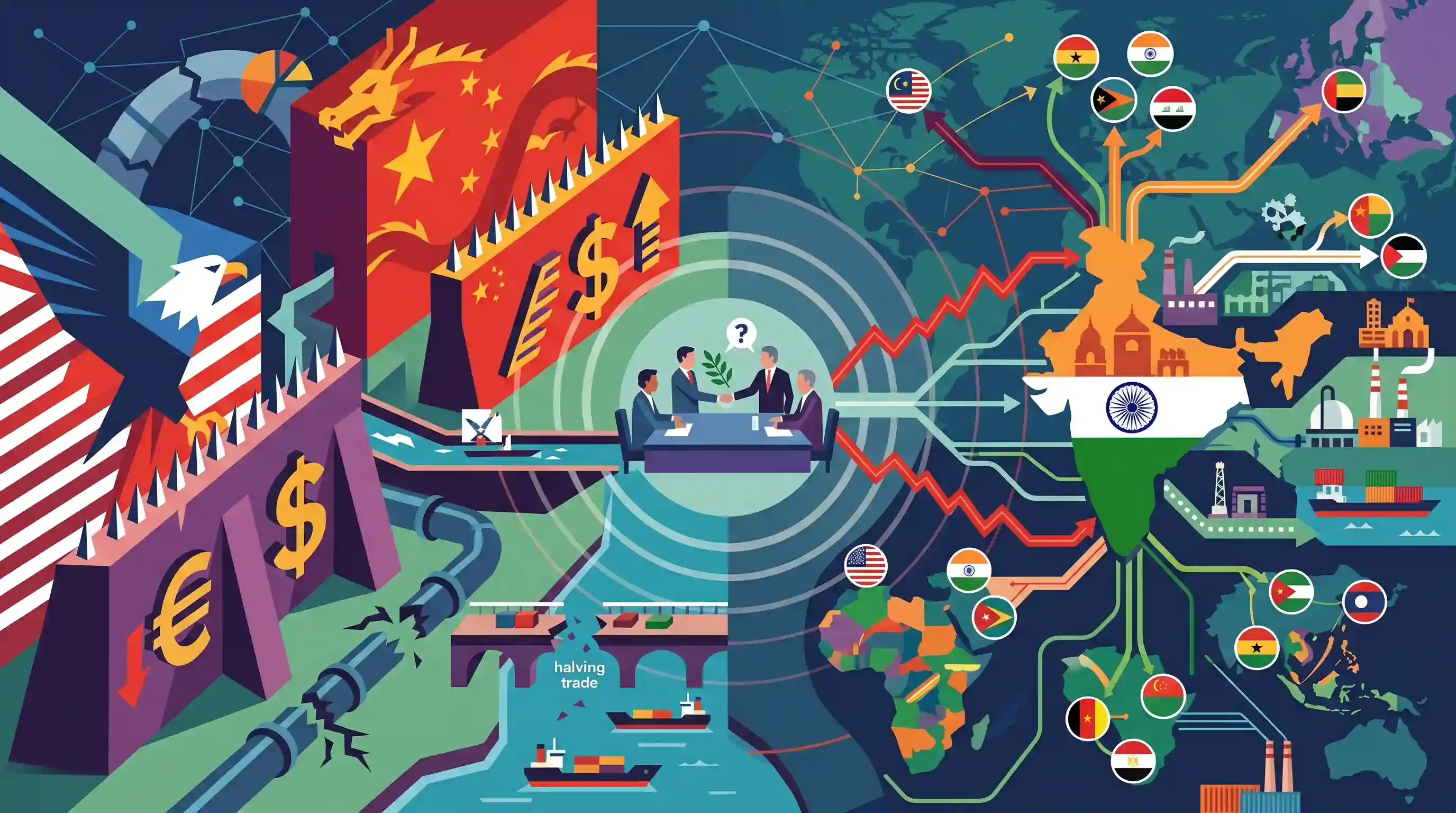
The escalation and subsequent negotiation of U.S.-China trade tariffs profoundly impact global supply chains, economic stability, and geopolitical alignments, forcing nations like India to navigate a fragmented international trade environment.
Summary
Top U.S. and Chinese officials are holding talks in Geneva to de-escalate a rapidly intensifying trade war triggered by steep U.S. tariffs. While the U.S. has imposed cumulative duties of up to 245% on some Chinese goods and China retaliated with 125% tariffs, officials remain optimistic about easing tensions. However, experts caution that a return to normal trade relations is unlikely, and bilateral trade could still halve under reduced but sustained tariffs.
Key Points
- High-level trade negotiations between the U.S. and China have commenced in Geneva to de-escalate tensions stemming from a renewed trade war.
- U.S. President Donald Trump recently enacted aggressive tariffs on Chinese goods (up to 245% cumulative), triggering 125% retaliatory tariffs from Beijing.
- U.S. officials express optimism for a resolution but clarify that the immediate focus is on mutual de-escalation rather than finalizing a comprehensive trade agreement.
- Economists characterize the high tariffs as a "lose-lose proposition," warning that even a moderated tariff rate of 70-80% could potentially halve bilateral trade.
Important Terms
Protectionism

An economic policy of restricting imports from other countries through methods such as tariffs on imported goods, import quotas, and a variety of other government regulations.
UPSC context
GS II/III: Relates to the shift from globalization to economic nationalism and its impact on India’s export-led growth and domestic manufacturing.
Trade War
An economic conflict resulting from extreme protectionism in which states raise or create tariffs or other trade barriers against each other in response to trade barriers created by the other party.
UPSC context
GS II/III: Tests understanding of geopolitical tensions, supply chain disruptions, and the strategic opportunities or challenges presented to the Indian economy.
Tariffs
Taxes or duties imposed by a government on imported goods. They aim to protect domestic industries by making foreign products more expensive and to generate state revenue.
UPSC context
GS III: Essential for understanding trade policy, fiscal measures, and their influence on inflation, competitiveness, and international trade agreements.
Peterson Institute for International Economics (PIIE)
An independent, non-partisan American research organization focused on international economic policy. It provides expert analysis on trade, globalization, and the impact of tariffs on the global economy.
UPSC context
GS III: Economy; tests awareness of influential global think tanks that provide data-driven insights into trade dynamics and policy consequences.
United Nations
An international organization of 193 member states. In trade disputes, its agencies and diplomatic facilities (like those in Geneva) serve as neutral venues for bilateral de-escalation and mediation.
UPSC context
GS II: International Relations. Tests knowledge of international institutions and their role in facilitating diplomacy between global powers.
Bilateral Trade
The exchange of goods and services between two nations. Such relations are governed by treaties and are currently central to the US-China economic de-escalation efforts.
UPSC context
GS II: Bilateral groupings and agreements. Tests understanding of how two-way trade shifts affect global stability and India’s interests.
Citigroup
A major global investment bank and financial services corporation. Its analysts provide market-moving economic forecasts regarding the effects of international trade tensions on global markets and investment.
UPSC context
GS III: Economy. Relevant for understanding how global financial institutions assess geopolitical risks and influence global capital flows.
Prelims Trap
The US-China tariff dispute is being mediated through the WTO's dispute settlement mechanism.
Though the talks are happening in Geneva (WTO HQ), these are bilateral negotiations bypassing the WTO, highlighting the paralysis of its multilateral dispute settlement mechanism.
Static Concepts Connected
What are the three main trade remedy measures under WTO rules?
- Anti-dumping Duty: Imposed when foreign companies export goods at a price lower than their normal home market value, protecting domestic industries from predatory pricing.
- Countervailing Duty: Tariffs levied by an importing country to neutralize the negative effects of subsidies provided by foreign governments to their exporters.
- Safeguard Duty: A temporary tariff applied when a sudden, unforeseen surge of imported goods threatens to seriously injure a domestic industry.
Why is the World Trade Organization (WTO) dispute settlement mechanism currently paralyzed?
- Appellate Body Blockade: The WTO's apex dispute resolution forum has been non-functional since 2019 because the United States has systematically blocked the appointment of new judges.
- MPIA Alternative: In response to the paralysis, several members established the Multi-Party Interim Appeal Arbitration Arrangement to hear appeals outside the blocked, traditional system.
Cross-Topic Patterns
Supply Chain Resilience & China Plus One
The trade war accelerates the relocation of global value chains. India's PLI schemes and manufacturing push directly capitalize on this geopolitical shift in sectors like electronics and APIs.
Excess Capacity & Indian Trade Remedies
Denied US market access, China often redirects surplus manufacturing (e.g., steel, solar modules) to developing markets, forcing India to frequently deploy Anti-Dumping Duties to protect domestic industry.

Expect a 2026 Mains question linking the US-China trade war to India's 'China Plus One' opportunities and Chinese product-dumping risks.
Linked PYQs · 4
Linked PYQs · 4
- 2025MainsGS2
"With the waning of globalization, post-Cold War world is becoming a site of sovereign nationalism.” Elucidate.
- 2021MainsGS2
“The USA is facing an existential threat in the form of a China, that is much more challenging than the erstwhile Soviet Union.” Explain.
- 2025MainsGS3
What are the challenges before the Indian economy when the world is moving away from free trade and multilateralism to protectionism and bilateralism? How can these challenges be met?
- 2024MainsGS2
‘The West is fostering India as an alternative to reduce dependence on China's supply chain and as a strategic ally to counter China's political and economic dominance.’ Explain this statement with examples.
