NATO Expansion and Strategic Implications for India
Source:The Hindu ↗
Why It Matters
The evolution of NATO into a 'Global NATO' and its entry into the Indo-Pacific directly affect India's strategic autonomy and its balance between Western powers, Russia, and China. This is a recurring theme in UPSC GS2 (IR) regarding the implications of global security alliances on India's interests.
Summary
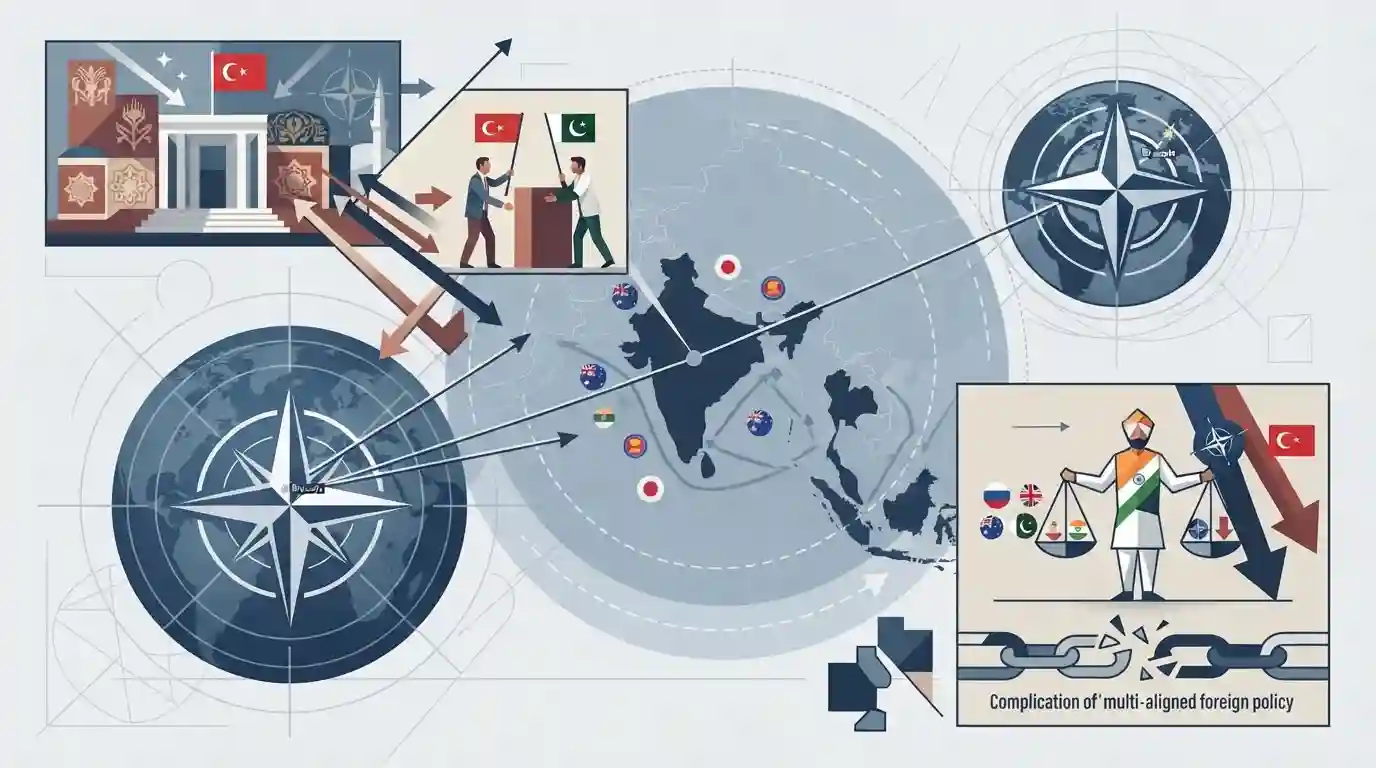
The article analyzes the strategic implications of NATO's Ankara Summit for India. It highlights how NATO's expanding global footprint, especially its increasing focus on the Indo-Pacific, challenges India's strategic autonomy. Additionally, Turkey's elevated role within the alliance could embolden its regional ambitions, which often conflict with India's interests due to Ankara's close ties with Pakistan. The summit signals potential pressure on New Delhi to align more closely with Western security architectures, complicating its multi-aligned foreign policy and its vision of a multipolar, inclusive Indo-Pacific order.
Key Points
- NATO's Ankara Summit highlights the alliance's growing ambitions beyond the Euro-Atlantic, particularly its increasing focus on the Indo-Pacific region.
- Turkey's elevated stature as the summit host may embolden its regional ambitions, posing diplomatic challenges for India given Ankara's historically close ties with Pakistan.
- NATO's expanding global footprint and potential partnerships in Asia could militarize the region, conflicting with India's vision of an inclusive, ASEAN-centric Indo-Pacific.
- A more unified and assertive NATO could increase pressure on New Delhi to align with Western security frameworks, thereby testing India's policy of multi-alignment and strategic autonomy.
Important Terms
North Atlantic Treaty Organization (NATO)

A political and military alliance established in 1949 by the Washington Treaty to collectively defend member states, primarily in Europe and North America, against aggression.
UPSC context
GS Paper II (Bilateral/regional groupings); tests understanding of Western security structures and their geopolitical footprint in the Indo-Pacific.
Strategic Autonomy
A country's ability to pursue its national interest and make independent foreign policy decisions without being constrained by external powers or military alliance obligations.
UPSC context
GS Paper II (Indian Foreign Policy); tests India's sovereign policy choices amidst shifting global power dynamics and external pressures.
Multi-alignment
A pragmatic foreign policy strategy of engaging simultaneously with multiple, competing global powers through issue-based coalitions to maximize a country's national interests.
UPSC context
GS Paper II (Indian Foreign Policy); tests India's diplomatic evolution from Cold War non-alignment to flexible, parallel global partnerships.
Indo-Pacific
A vast biogeographic and geopolitical region spanning the Indian and Pacific Oceans, including critical maritime trade routes and major global powers.
UPSC context
GS Paper II (Bilateral & Global Groupings); tests India's strategic vision for maritime security and counterbalancing regional hegemony.
Multipolarity
An international system where power is distributed among three or more major states, preventing any single nation from establishing global hegemony or unipolar dominance.
UPSC context
GS Paper II (International Relations); tests understanding of the shifting global balance of power and emerging non-Western poles.
Association of Southeast Asian Nations (ASEAN)
A regional intergovernmental organization comprising ten Southeast Asian nations established in 1967 to promote economic growth, social progress, and regional political stability.
UPSC context
GS Paper II (Regional Groupings); tests India's Act East Policy and the organization’s geographic centrality in Indo-Pacific geopolitics.
Prelims Trap
India aims to secure a formal observer status or strategic partnership with NATO to bolster Indo-Pacific maritime security.
India actively rejects formal military alliances and the 'Asian NATO' concept, prioritizing strategic autonomy and ASEAN-led inclusive frameworks instead.
Static Concepts Connected
What distinguishes India's 'Strategic Autonomy' from the historical doctrine of 'Non-Alignment'?
- Structural context: Non-alignment was a Cold War doctrine of neutrality between two superpowers, whereas strategic autonomy is a pragmatic, multi-aligned pursuit of national interest.
- Partnership approach: India actively engages in issue-based alignments with rival configurations, such as participating in both the Quad and BRICS/SCO.
What is the Montreux Convention of 1936 and why is it critical to Turkey's strategic leverage?
- Straits regulation: It governs the transit of commercial and naval vessels through the Bosporus and Dardanelles straits, linking the Black Sea to the Mediterranean.
- Turkey's control: It grants Turkey sovereign authority to restrict the passage of naval warships during times of conflict, giving Ankara massive geopolitical leverage.
Cross-Topic Patterns
Turkey-Pakistan defense axis
Ankara's elevated NATO stature could translate into deeper military transfers to Islamabad and louder anti-India rhetoric on Kashmir at multilateral forums like the UN.
NATO pivot vs ASEAN Centrality
An expanding Euro-Atlantic alliance footprint in Asia risks militarizing the Indo-Pacific, directly undermining India’s advocacy for an inclusive, ASEAN-led security architecture.

NATO's Indo-Pacific pivot and Turkey's rise will test India's ability to balance Western security ties with its strategic autonomy in 2026.
Linked PYQs · 3
Linked PYQs · 3
- 2023MainsGS2
‘The expansion and strengthening of NATO and a stronger US-Europe strategic partnership works well for India.’ What is your opinion about this statement ? Give reasons and examples to support your answer.
- 2020MainsGS2
What is the significance of Indo-US defence deals over Indo-Russian defence deals? Discuss with reference to stability in the Indo-Pacific region.
- 2021MainsGS2
The newly tri-nation partnership AUKUS is aimed at countering China's ambitions in the Indo-Pacific region. Is it going to supersede the existing partnerships in the region? Discuss the strength and impact of AUKUS in the present scenario.
