UNEP report highlights severe risks of temperature overshoot
Source:The Hindu ↗
কেন এটি গুরুত্বপূর্ণ
Global warming targets and reports by bodies like the UNEP form a core component of the UPSC syllabus under GS3 (Environment and Climate Change), often featuring in both Prelims and Mains questions regarding international climate architecture, commitments, and overshoot risks.
সারসংক্ষেপ
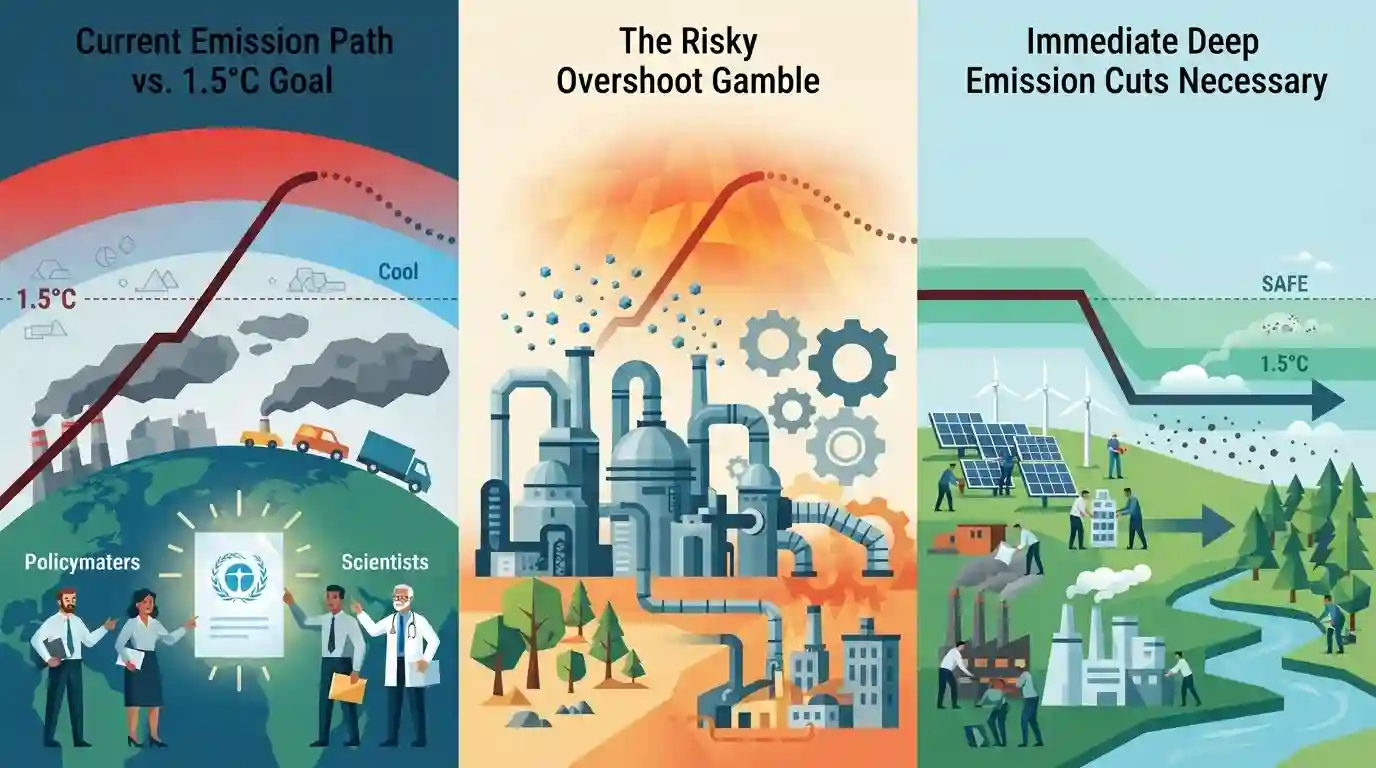
The editorial analyzes a United Nations Environment Programme (UNEP) report focusing on the concept of 'limiting overshoot' in global warming. It underscores that allowing global temperatures to temporarily exceed the 1.5°C target and later trying to bring them down using unproven carbon removal technologies is an extremely hazardous gamble. The piece emphasizes the necessity of immediate, deep emission cuts to avoid catastrophic tipping points and irreversible climate damages.
মূল বিষয়
- The UNEP report highlights the severe risks of temperature overshoot, where global warming temporarily exceeds the 1.5°C threshold before attempting to come down.
- Overshoot poses irreversible ecological risks, including mass coral bleaching, ice-sheet collapse, and triggering feedback loops that amplify global warming.
- Relying on future carbon dioxide removal (CDR) technologies to reverse overshoot is risky, expensive, and unproven at scale.
- Immediate and deep greenhouse gas emission cuts are critical to minimize the need for and duration of any temperature overshoot.
গুরুত্বপূর্ণ শব্দ
Paris Agreement

A legally binding international treaty adopted in 2015 at COP21, aiming to limit global warming to well below 2°C, preferably to 1.5°C, compared to pre-industrial levels.
UPSC context
Crucial for UPSC Mains GS Paper III (Environment & Climate Change); tests international commitments, mitigation targets, and global climate governance.
United Nations Environment Programme (UNEP)
The leading global environmental authority that sets the global environmental agenda, promotes coherent implementation of sustainable development, and acts as an authoritative advocate for the environment.
UPSC context
Important for Prelims and Mains (GS Paper III: International bodies, environmental reports, and institutional mandates).
প্রিলিমস ফাঁদ
A temporary temperature overshoot above 1.5°C carries negligible long-term ecological risks as long as carbon dioxide removal technologies are deployed later.
Aspirants often assume that temporarily exceeding 1.5°C is fully reversible with future CDR, ignoring UNEP warnings about irreversible tipping points and feedback loops.
সংযুক্ত স্থির ধারণা
What are the key mechanisms and principles of the UN Framework Convention on Climate Change (UNFCCC)?
- Core Objective: Establishes the ultimate objective of stabilizing greenhouse gas concentrations to prevent dangerous anthropogenic interference with the climate system.
- CBDR-RC Principle: Operates on the principle that developed countries bear historical responsibility and must take the lead in emission reductions.
- Treaty Framework: Governs international climate architecture, including the Kyoto Protocol and the legally binding Paris Agreement targets.
আন্তঃবিষয় প্যাটার্ন
UNEP Reports and India's Climate Diplomacy
UNEP assessments on emission gaps directly shape India's nationally determined contributions (NDCs) under the Paris Agreement and domestic net-zero pathways.
CDR Technologies and Climate Finance Equity
Proposals for large-scale carbon removal (CDR) intersect with international technology transfer debates and intellectual property rights under UNFCCC.

UNEP overshoot reports + tipping points + CDR feasibility will likely form a multi-statement assertion-reason question in Prelims.
সংযুক্ত PYQ · 2
সংযুক্ত PYQ · 2
- 2022MainsGS3
Discuss global warming and mention its effects on the global climate. Explain the control measures to bring down the level of greenhouse gases which cause global warming, in the light of the Kyoto Protocol, 1997.
- 2016PrelimsGS1
With reference to the Agreement at the UNFCCC Meeting in Paris in 2015, which of the following statements is/are correct? 1. The Agreement was signed by all the member countries of the UN and it will go into effect in 2017. 2. The Agreement aims to limit the greenhouse gas emissions so that the rise in average global temperature by the end of this century does not exceed 2°C or even 1.5°C above pre-industrial levels. 3. Developed countries acknowledged their historical responsibility in global warming and committed to donate $ 1000 billion a year from 2020 to help developing countries to cope with climate change. Select the correct answer using the code given below.
