Climate Warming Limits on Staple Crop Yields and Adaptation
Source:The Hindu ↗
Why It Matters
This study is highly relevant for UPSC Mains as it provides empirical backing for the argument that 'adaptation has its limits'. It shifts the focus towards the necessity of emission mitigation, which is vital for answering questions on food security, changing cropping patterns, and the impacts of climate change on tropical agriculture.
Summary
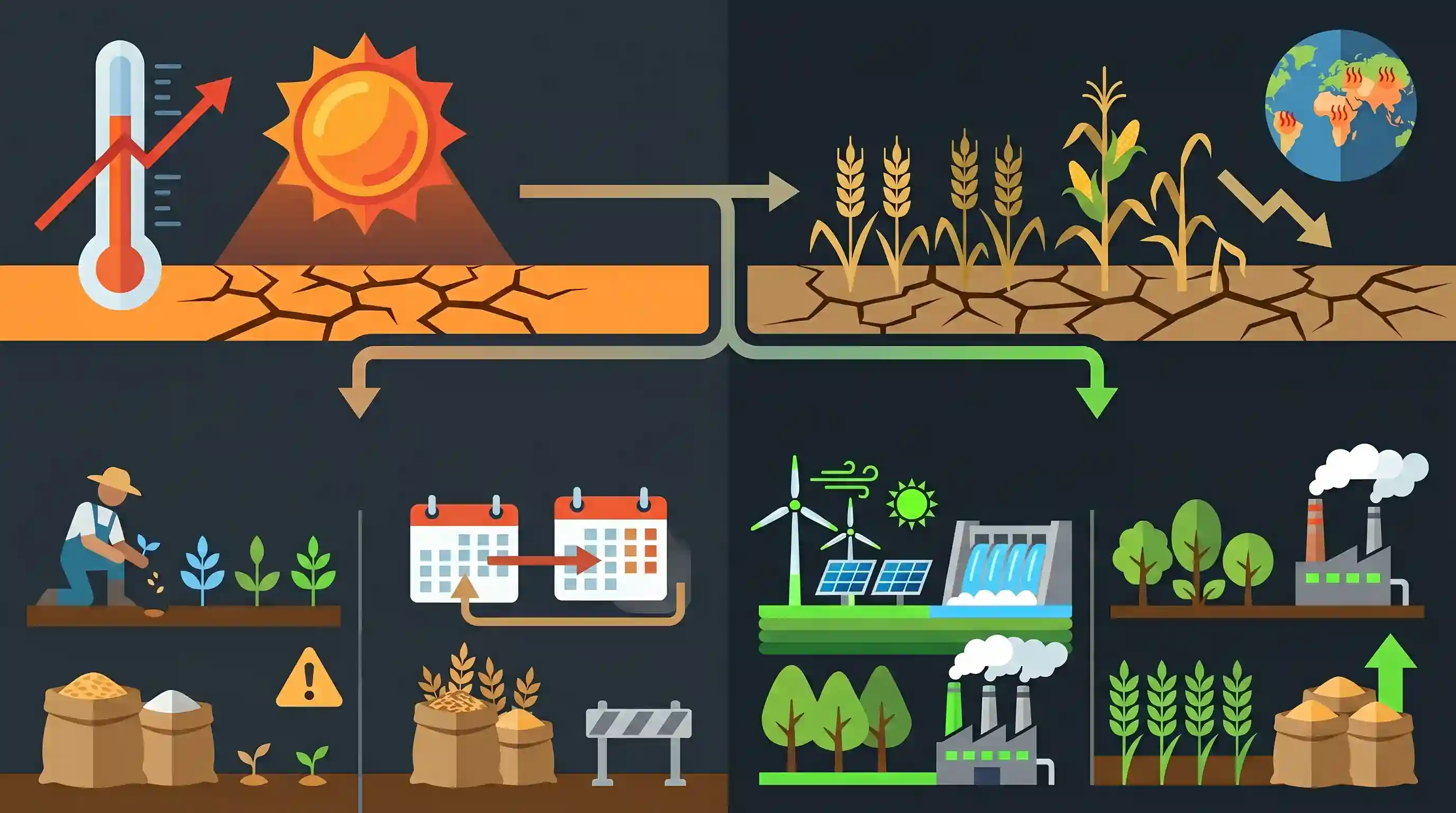
A recent scientific study indicates that global warming will inevitably lead to a decline in the yields of major staple crops, posing a significant risk to global food security. Crucially, the research finds that even after implementing agricultural adaptation measures—such as shifting planting dates or switching to different crop varieties—these yield losses will persist. This highlights the inherent limits of adaptation strategies and underscores the urgent need for stringent emission reductions (mitigation) to prevent severe agricultural and economic consequences.
Key Points
- Global warming is projected to cause significant yield declines in essential staple crops such as wheat, rice, and maize due to thermal stress and altered weather patterns.
- Agricultural adaptation strategies, such as changing sowing dates, adopting heat-tolerant crop varieties, and altering irrigation practices, can partially mitigate these impacts but cannot completely offset the projected yield losses.
- The study highlights the 'limits to adaptation', emphasizing that rising temperatures will outpace the resilience provided by current adaptive agricultural measures.
- The persistent decline in crop yields post-adaptation poses a severe threat to global food security, highlighting the critical necessity of aggressive greenhouse gas mitigation alongside adaptation efforts.
Prelims Trap
Agricultural adaptation measures can completely offset crop yield losses caused by global warming.
UPSC often uses absolute terms. The IPCC and ICAR stress the "limits to adaptation," meaning yields will still decline despite adaptive practices.
Static Concepts Connected
What is 'terminal heat stress' in Indian wheat cultivation?
- Mechanism: Sudden temperature spikes during the critical grain-filling stage (March-April) accelerate crop maturity, severely reducing grain size and overall yield.
- Management: Zero-tillage and early sowing help crops mature before peak heat sets in, while also retaining vital soil moisture.
What are the three pillars of Climate-Smart Agriculture (CSA)?
- Productivity: Sustainably increasing agricultural yields and incomes to ensure baseline food security.
- Adaptation: Building resilience to climate impacts through methods like shifting planting dates or using heat-tolerant seeds.
- Mitigation: Reducing greenhouse gas emissions from farming, such as minimizing methane release from flooded rice paddies.
Cross-Topic Patterns
MSP bias vs climate resilience
The MSP regime overwhelmingly favors water-intensive rice and wheat. This discourages crop diversification into climate-hardy millets, worsening systemic yield vulnerabilities under rising temperatures.
Climate-induced structural inflation
Irreversible declines in staple crop yields risk causing permanent supply-side food inflation, severely complicating the RBI's monetary policy and inflation targeting mandates.

Expect a 2026 Prelims question testing the IPCC's 'limits to adaptation' concept alongside ICAR's NICRA crop-yield projections.
Linked PYQs · 3
Linked PYQs · 3
- 2017MainsGS3
What are the major reasons for declining rice and wheat yield in the cropping system? How crop diversification is helpful to stabilise the yield of the crops in the system?
- 2023MainsGS1
Discuss the consequences of climate change on the food security in tropical countries.
- 2022MainsGS3
Discuss global warming and mention its effects on the global climate. Explain the control measures to bring down the level of greenhouse gases which cause global warming, in the light of the Kyoto Protocol, 1997.
