Pacific Decadal Oscillation and Cyclone Frequency over Indian Coasts
Source:The Hindu ↗
কেন এটি গুরুত্বপূর্ণ
The Pacific Decadal Oscillation (PDO) and ENSO are critical geographical phenomena impacting the Indian monsoon and disaster management. Understanding how long-term oceanic cycles intersect with global warming to influence cyclone frequency is highly relevant for GS Paper 1 (Geography) and GS Paper 3 (Disaster Management).
সারসংক্ষেপ
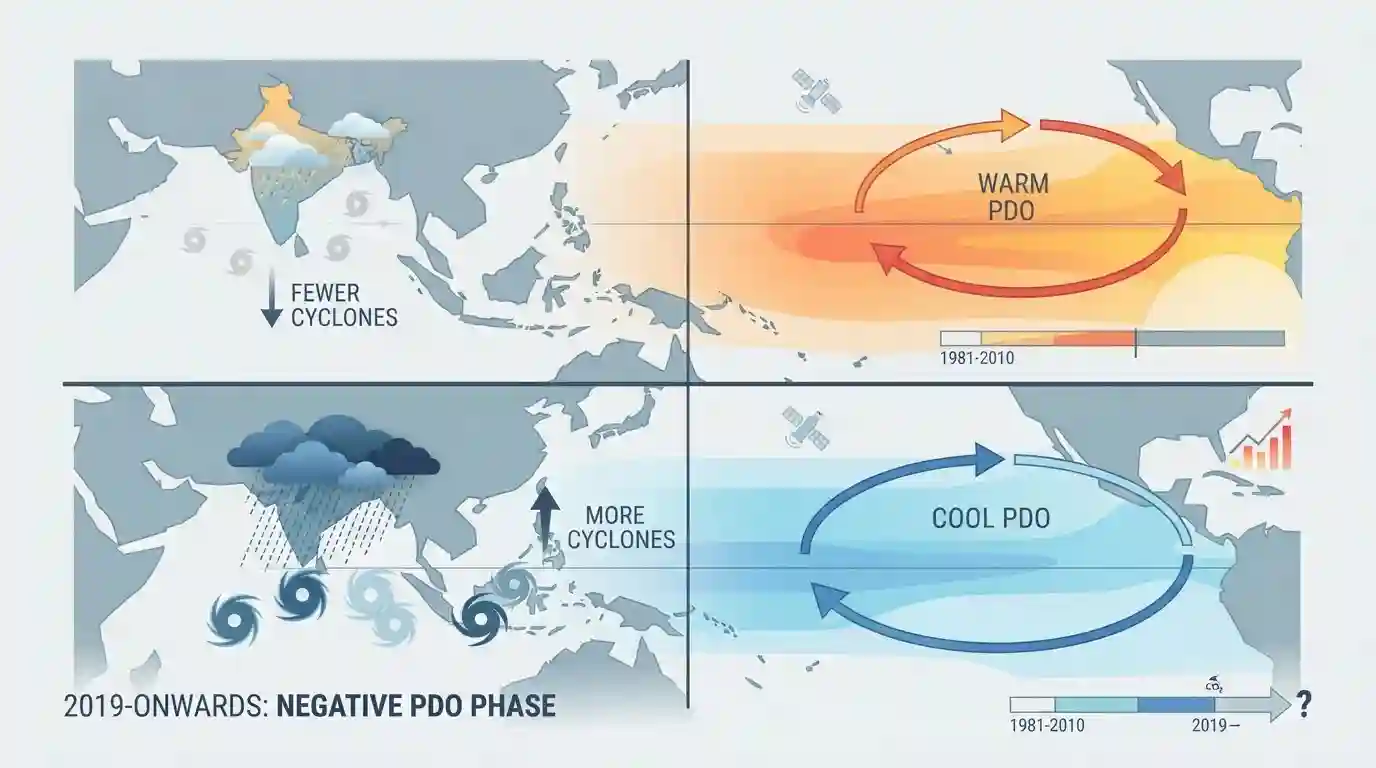
A warming Pacific Ocean, in conjunction with the cyclical Pacific Decadal Oscillation (PDO), is likely to increase the frequency of tropical cyclones originating near the Equator along the Indian coast. Researchers from IISER Pune highlight that while the PDO was in a 'positive' (warmer) phase from 1981 to 2010, resulting in fewer such cyclones, it entered a 'negative' (cooler) phase in 2019. If this negative phase persists, the combination of global warming and the cooler Eastern Pacific could trigger more post-monsoon equatorial cyclones and potentially bring increased rainfall to India.
মূল বিষয়
- A study published in Nature Communications by researchers at IISER Pune reveals that global warming combined with a 'negative' Pacific Decadal Oscillation (PDO) can lead to an increase in cyclones originating near the Equator in India.
- The PDO is a long-term cyclical event repeating every 20-30 years, differing from the annual or biennial El Nino/La Nina ENSO phenomena.
- A 'positive' or 'warmer' PDO corresponds to a warmer Eastern Pacific and cooler Western Pacific, which previously (1981-2010) led to a 43% reduction in equatorial-origin cyclones compared to 1951-1980.
- In 2019, the PDO entered a 'cooler' or 'negative' phase, which often translates to a warmer Western Pacific and cooler Eastern Pacific.
- If the PDO remains in this negative phase, India could witness a rise in tropical cyclones originating near the Equator during the post-monsoon months.
- A negative PDO linked with ENSO generally brings more rainfall to India.
গুরুত্বপূর্ণ শব্দ
Pacific Decadal Oscillation (PDO)

A long-term climate cycle of sea surface temperature fluctuations in the Pacific Ocean that shifts between warm (positive) and cool (negative) phases over 20 to 30 years.
UPSC context
GS Paper I (Physical Geography) and GS III (Environment); tested under climatology, ocean-atmosphere oscillations, and global weather patterns.
El Niño Southern Oscillation (ENSO)
A recurring global ocean-atmospheric climate pattern characterized by alternating warm (El Niño) and cool (La Niña) phases in the tropical Pacific Ocean.
UPSC context
GS Paper I (Physical Geography); critical for understanding monsoon variations, drought cycles, and climate teleconnections.
Equatorial Cyclones
Tropical cyclones originating close to the Equator (within 5° latitude), which are historically rare due to weak Coriolis forces but can significantly impact coastal areas.
UPSC context
GS Paper I (Geography); tests tropical cyclone genesis, atmospheric mechanics, Coriolis force, and disaster management.
Indian Institute of Science Education and Research (IISER), Pune
An autonomous premier public research university established in 2006 by the Indian Ministry of Education, declared an Institute of National Importance to promote basic sciences.
UPSC context
GS Paper III (Science & Technology); tested under institutional frameworks, research achievements, and science policy in India.
Nature Communications
A highly prestigious, peer-reviewed, open-access multidisciplinary scientific journal published by Nature Portfolio, frequently cited for groundbreaking research across the natural sciences.
UPSC context
GS Paper III (Science & Technology); relevant as a key international reference for globally recognized climate change and geophysical research.
প্রিলিমস ফাঁদ
Tropical cyclones cannot form at low latitudes (below 10°N) due to the absolute absence of Coriolis force near the equator.
While Coriolis force is near-zero at the equator, Low-Latitude Cyclones (LLCs) still successfully originate between 5°N and 11°N, representing a major share of North Indian Ocean systems.
সংযুক্ত স্থির ধারণা
How does the Pacific Decadal Oscillation (PDO) differ from ENSO?
- Temporal scale: PDO operates on a 20-to-30-year cycle, unlike ENSO which cycles every 2 to 7 years.
- Spatial domain: PDO is centered in the North Pacific (mid-latitudes), whereas ENSO is primarily a tropical Pacific phenomenon.
- Phase characteristics: Warm/positive phase features cooler SSTs in the Western North Pacific and warmer SSTs in the Eastern Pacific.
What are the physical dynamics of Low-Latitude Cyclones (LLCs)?
- Genesis zone: LLCs originate close to the equator (5°N–11°N) where weak Coriolis force makes cyclogenesis thermodynamically demanding but possible.
- Core features: They are characterized by compact structures, rapid intensification, and unusually long tracks, making them highly destructive.
আন্তঃবিষয় প্যাটার্ন
Ocean Oscillations & Disaster Mitigation
Links multi-decadal ocean cycles to regional preparedness, requiring NDMA to adapt early warning systems for rapid-onset, low-latitude cyclones.
Pacific Teleconnections & Indian Agriculture
Explores how ENSO-PDO phase interactions modulate the Walker Circulation, directly impacting monsoon variability, crop-planning, and food security.

Conceptual questions on PDO vs ENSO mechanisms paired with low-latitude cyclogenesis constraints are highly likely.
সংযুক্ত PYQ · 2
সংযুক্ত PYQ · 2
- 2024MainsGS1
What is sea surface temperature rise? How does it affect the formation of tropical cyclones?
- 2011PrelimsGS1
La Nina is suspected to have caused recent floods in Australia. How is La Nina different from El Nino? 1. La Nina is characterised by unusually cold ocean temperature in equatorial Indian Ocean whereas El Nino is characterised by unusually warm ocean temperature in the equatorial Pacific Ocean. 2. El Nino has adverse effect on south-west monsoon of India, but La Nina has no effect on monsoon climate. Which of the statements given above is/are correct?
