Climate Vulnerability Demands Sustainable Himalayan Planning
Source:The Hindu ↗
ఇది ఎందుకు ముఖ్యం
This article provides critical insights into the intersection of climate vulnerability and unsustainable development in the ecologically sensitive Himalayas, directly addressing GS3 topics on environment, climate change impacts, and disaster management.
సారాంశం
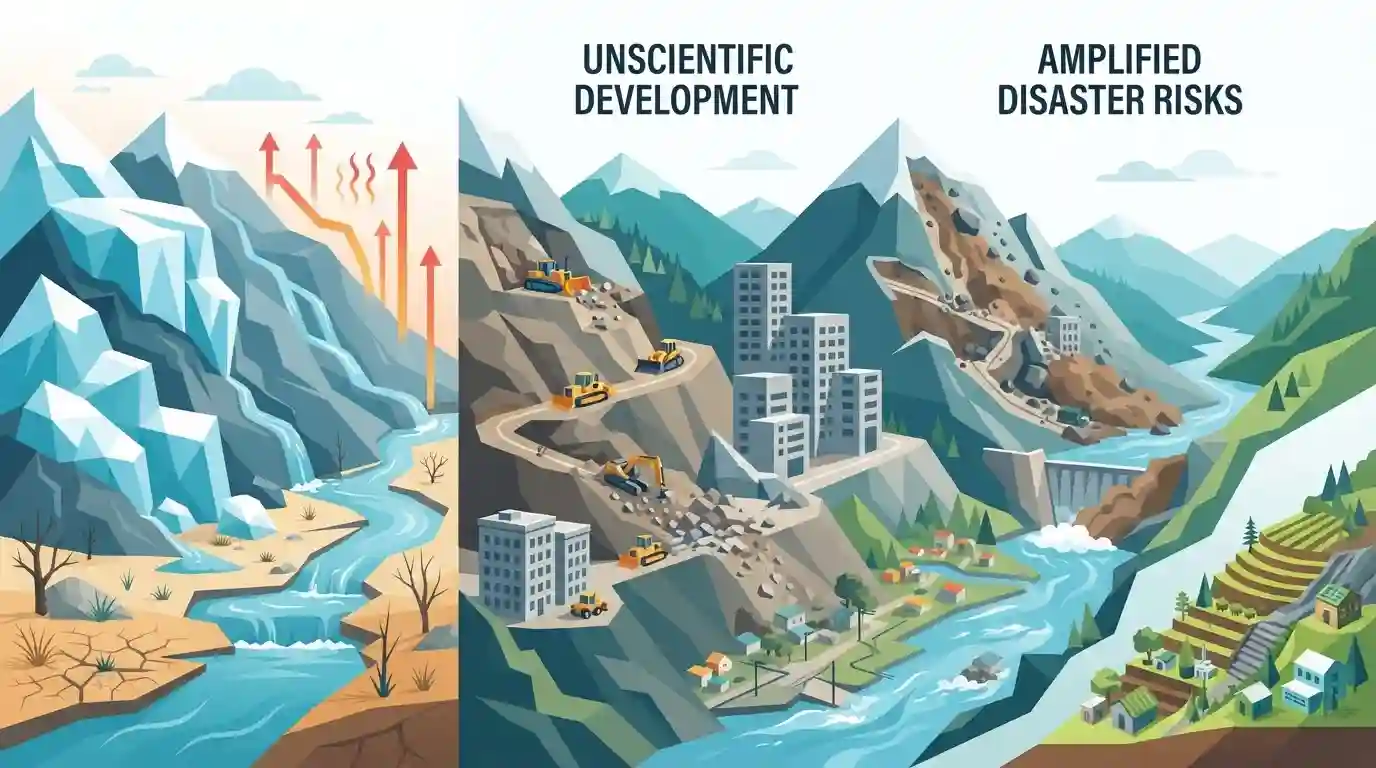
The article discusses the compounding effects of rapid climate change and ecologically damaging infrastructure development in the Himalayan region. It highlights how warming temperatures, melting glaciers, and unscientific construction practices amplify disaster risks like landslides and floods, necessitating a paradigm shift toward sustainable, climate-resilient regional planning.
ముఖ్య అంశాలు
- Rapid warming in the Himalayan region threatens fragile ecosystems, increasing the frequency of extreme weather events, glacial lake outburst floods (GLOFs), and massive landslides.
- Unregulated and heavy infrastructure development (such as massive hydropower projects, widening of roads, and unchecked tourism) exacerbates the vulnerability of the mountain terrain.
- There is an urgent need to shift from conventional growth models to ecologically sensitive and climate-resilient development frameworks tailored for mountain regions.
- Policy measures must incorporate robust environment impact assessments (EIAs), localized disaster management strategies, and community-led adaptation.
ప్రిలిమ్స్ ఉచ్చు
The Himalayas require a complete cessation of all infrastructure projects and tourism activities to prevent landslides and flash floods.
Aspirants often assume young fold mountains cannot be stabilized at all by engineering; however, the policy focus is on unscientific and unregulated construction practices, not a total ban on all infrastructure.
అనుసంధానమైన స్థిర భావనలు
What are the primary causative factors and mitigation frameworks for Glacial Lake Outburst Floods (GLOFs)?
- Trigger Mechanism: Rapid melting of glaciers and permafrost thawing forms unstable moraine-dammed lakes, which can breach due to earthquakes, avalanches, or excessive water accumulation.
- Mitigation Strategy: NDMA guidelines recommend structural measures like artificial siphon systems or drainage channels, and non-structural measures like early warning systems and zoning laws.
- Terrain Vulnerability: Geologically young fold mountains have high seismicity, loose soil strata, and steep slopes, making them inherently prone to mass wasting events.
అంతర-అంశ నమూనాలు
Border Infrastructure vs. Eco-Fragility
Himalayan infrastructure push intersects with border security corridors (like Char Dham), testing strategic necessity against ecological carrying capacity in fragile young fold mountains.
Hydropower vs. Ecological Federalism
Hydropower expansion in eco-sensitive zones triggers local protests and state-level friction over fiscal federalism and environmental compensation funds like CAMPA.

Himalayan disaster vulnerability + GLOFs + EIA norms will likely appear as a multi-statement assertion-reasoning question.
అనుసంధాన PYQలు · 2
అనుసంధాన PYQలు · 2
- 2017MainsGS3
'Climate change' is a global problem. How India will be affected by climate change? How Himalayan and coastal states of India will be affected by climate change?
- 2016MainsGS1
The Himalayas are highly prone to landslides. Discuss the causes and suggest suitable measures of mitigation.
