Accelerated Himalayan Warming Demands Sustainable Development
Source:The Hindu ↗
हे का महत्त्वाचे आहे
The Himalayan region is a sensitive ecological zone whose stability dictates the water security and climate safety of millions of people in South Asia. Analyzing its developmental model is central to GS3 questions on environmental degradation, carrying capacity, and disaster management.
सारांश
The article argues that the accelerated warming of the Himalayan region requires a fundamental paradigm shift in developmental strategies, moving away from ecologically destructive infrastructure projects toward sustainable, climate-resilient practices.
मुख्य मुद्दे
- The Himalayas are warming at a rate significantly higher than the global average, threatening fragile ecosystems and indigenous communities.
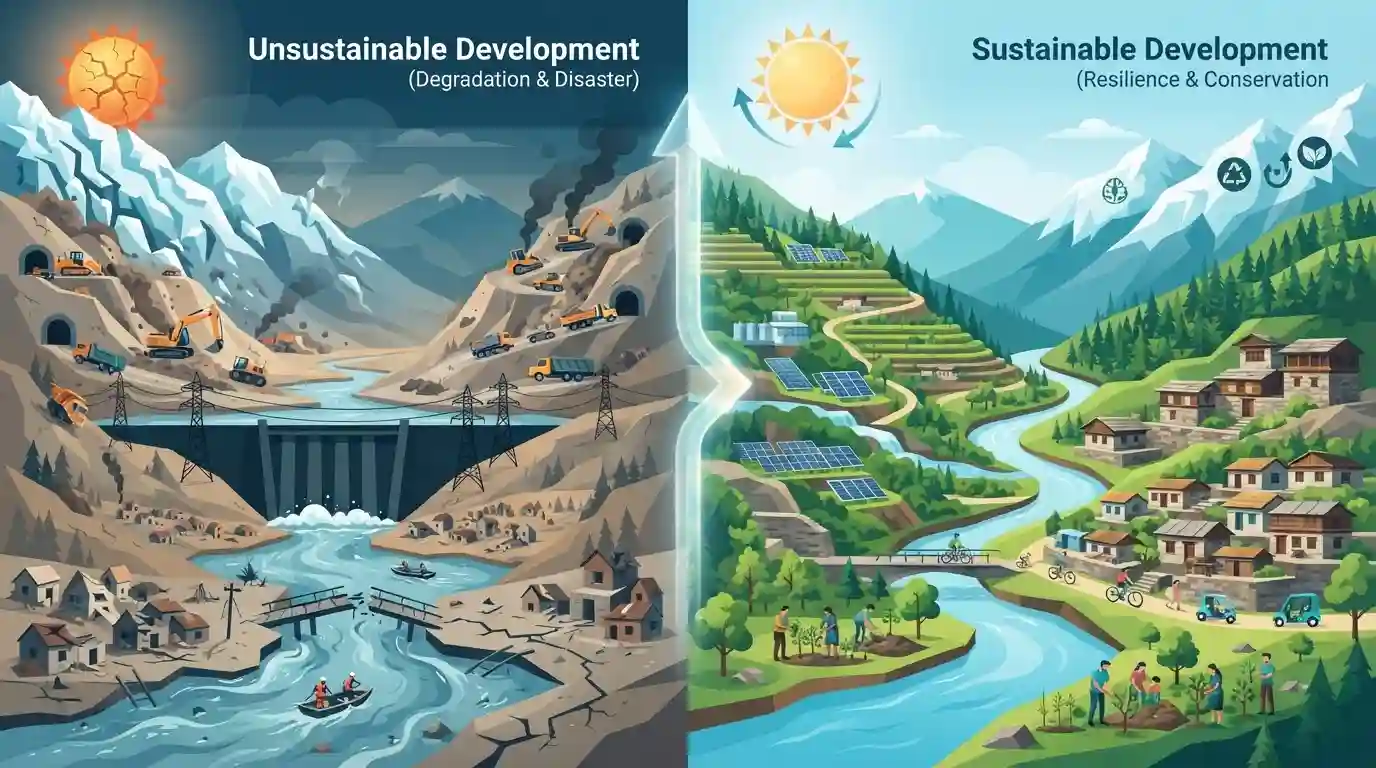
- Unchecked infrastructure development, unscientific road construction, and heavy hydropower projects exacerbate disaster risks like landslides and flash floods.
- There is an urgent need to transition from conventional engineering-heavy paradigms to ecologically sensitive development frameworks in mountain regions.
- Balancing energy and developmental aspirations with ecological carrying capacity is vital for long-term climate resilience in the Himalayan states.
पूर्वपरीक्षा सापळा
Himalayas warm at the same global average rate
Aspirants often assume global average temperature rise applies uniformly across all geographies, missing that high-altitude zones experience amplified warming rates.
संबंधित स्थिर संकल्पना
What are the key ecological vulnerabilities and geomorphological features of the Himalayan mountain ecosystem?
- Tectonic Instability: Young Fold Mountains: Formed by ongoing tectonic convergence, making them structurally fragile, seismically active, and prone to mass movements.
- Accelerated Warming: Elevation Amplification: High-altitude regions warm significantly faster than the global average, accelerating snowmelt and permafrost thawing.
- Ecological Limits: Carrying Capacity: Fragile soils and steep slopes cannot sustain heavy engineering interventions without triggering landslides and flash floods.
आंतर-विषय नमुने
Himalayan Warming & Downstream Water Security
Rapid glacial retreat in the HKH region directly threatens perennial river systems, compounding water stress issues tied to inter-state river disputes and international basin management.
Eco-Development vs. Federal Tribal Governance
Large infrastructure projects in fragile mountain ecosystems spark recurring friction between developmental sovereignty, indigenous land rights, and fifth/sixth schedule governance frameworks.

Himalayan vulnerability + carrying capacity + glacial retreat will likely anchor a multi-statement Prelims/Mains environment question.
संबंधित PYQ · 2
संबंधित PYQ · 2
- 2017MainsGS3
'Climate change' is a global problem. How India will be affected by climate change? How Himalayan and coastal states of India will be affected by climate change?
- 2016MainsGS3
Rehabilitation of human settlements is one of the important environmental impacts which always attracts controversy while planning major projects. Discuss the measures to be adopted to mitigate the impact of the recent incidents of cloudbursts in many places of Uttarakhand.
