Modern warfare compressed to seconds using emerging technology
Source:The Hindu ↗
Why It Matters
Provides current perspectives on evolving maritime threats, the impact of emerging technologies (AI, drones, cyber) on warfare, and the specific role of the Indian Coast Guard in securing the EEZ and countering transnational crimes. Essential for GS-3 Security answers.
Summary
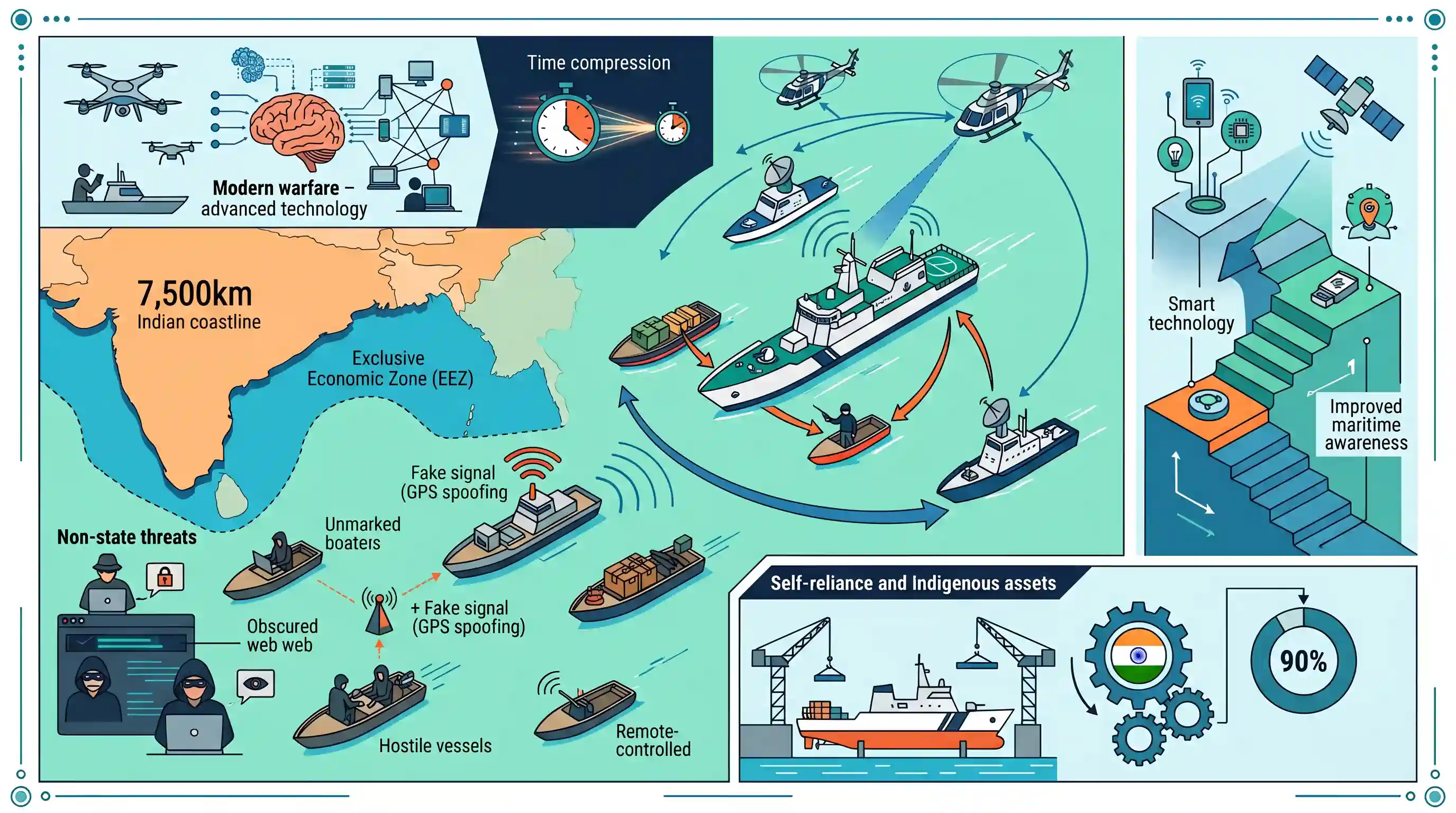
Defence Minister Rajnath Singh, addressing the 42nd Indian Coast Guard (ICG) Commanders' Conference, emphasized that modern warfare is now driven by advanced technology—including cyber capabilities, AI, and drones—compressing conflict durations from months to hours or seconds. He highlighted the complex, multi-dimensional threats facing India's 7,500-km coastline and Exclusive Economic Zone (EEZ), as non-state actors increasingly exploit GPS spoofing, remote-controlled vessels, and the dark web. Outlining the ICG's pivotal role at the nexus of internal and external security, Singh called for a futuristic roadmap integrating AI-enabled surveillance to combat drug trafficking, smuggling, and maritime terrorism. He also praised the ICG's commitment to self-reliance, with nearly 90% of its capital budget dedicated to indigenous assets.
Key Points
- The nature of warfare has shifted from long-duration conventional conflicts to rapid tech-driven engagements measured in 'hours and seconds', heavily reliant on cyber warfare, electronic jamming, drones, and AI.
- Non-state actors and criminal networks are increasingly utilizing sophisticated technologies such as GPS spoofing, remote-controlled boats, encrypted communications, and the dark web.
- India's 7,500-km coastline and remote island territories pose complex security challenges compared to permanent land borders, necessitating automated, AI-enabled surveillance and quick-response capabilities.
- The Indian Coast Guard (ICG) plays a critical intersectional role between internal and external security, focusing on protecting the Exclusive Economic Zone (EEZ), countering illegal fishing, and stopping narcotics and arms trafficking.
- Aligning with self-reliance, nearly 90% of the ICG's capital budget is allocated toward acquiring indigenous maritime assets.
- Geopolitical instability in the neighborhood (such as in Myanmar and Bangladesh) impacts maritime security, particularly in the Bay of Bengal, requiring heightened vigilance.
Important Terms
Indian Coast Guard (ICG)

An armed force under the Ministry of Defence (Coast Guard Act, 1978) responsible for maritime law enforcement, search and rescue, and protecting India's maritime zones and interests.
UPSC context
GS III (Internal Security); tests knowledge of India's maritime security architecture and coastal defense agencies.
Exclusive Economic Zone (EEZ)
A maritime area extending up to 200 nautical miles from the baseline where a coastal state has sovereign rights for resource exploration, exploitation, and environmental management under UNCLOS.
UPSC context
GS I (Geography) & GS III (Security); relevant for resource management and maritime boundary surveillance.
Aatmanirbhar Bharat (Defence)
A national mission to achieve self-reliance in the defense sector by prioritizing indigenous design and manufacturing to reduce import dependency and strengthen strategic autonomy.
UPSC context
GS III (S&T/Economy); tests understanding of indigenization, 'Make in India,' and strategic independence.
GPS Spoofing
A cyberattack that broadcasts counterfeit satellite signals to deceive GPS receivers, causing ships, aircraft, or drones to calculate false positions, time, or speed.
UPSC context
GS III (Cyber Security/S&T); evaluates awareness of emerging technological threats and asymmetric warfare.
Non-state Actors
Groups or individuals not affiliated with any sovereign government—such as terrorists, pirates, or insurgents—who exert influence and create security challenges through illicit or violent actions.
UPSC context
GS III (Internal Security); fundamental for analyzing proxy wars and unconventional security threats.
Dark Web
An encrypted portion of the internet not indexed by search engines, accessible via specialized software (like Tor), often used for anonymous illegal activities, including drug trafficking and terrorism.
UPSC context
GS III (Cyber Security); tests knowledge of digital challenges and anonymous criminal networks in internal security.
Prelims Trap
"The Indian Coast Guard has exclusive jurisdiction over India's territorial waters up to 12 nautical miles."
Under India's 3-tier coastal security architecture, Marine/State Police jurisdiction extends up to 12 NM. The ICG primarily patrols between 12 and 200 NM (the EEZ).
Static Concepts Connected
What is India's 3-tier coastal security architecture?
- Marine Police (Tier 1): Patrols from the shoreline up to 12 Nautical Miles (territorial waters).
- Indian Coast Guard (Tier 2): Jurisdiction ranges from 12 NM up to 200 NM, covering the Exclusive Economic Zone (EEZ).
- Indian Navy (Tier 3): Responsible for overall maritime security, defending the nation in deeper waters beyond 200 NM.
What sovereign rights does India hold in its EEZ under UNCLOS?
- Economic exploitation: Exclusive rights to explore, exploit, conserve, and manage living (fish) and non-living (minerals, oil) resources up to 200 NM.
- Jurisdiction limits: Unlike territorial waters, the EEZ does not grant full sovereignty; foreign vessels still enjoy freedom of navigation and overflight.
Cross-Topic Patterns
Defence Indigenization & Capital Budgets
The ICG dedicating 90% of its capital budget to domestic assets ties directly to GS-3 Indigenization of Technology, linking coastal security with the MoD's Positive Indigenization Lists.
Asymmetric Warfare via Dual-Use Tech
The weaponization of GPS spoofing and remote-controlled vessels by non-state actors bridges GS-3 Science & Tech (navigational satellite vulnerabilities) with Internal Security threats.

Expect a GS-3 Mains question on integrating emerging tech (AI, drone swarms) to overhaul India's 3-tier coastal security architecture.
Linked PYQs · 5
Linked PYQs · 5
- 2025MainsGS3
Why is maritime security vital to protect India's sea trade? Discuss maritime and coastal security challenges and the way forward.
- 2022MainsGS3
What are the maritime security challenges in India ? Discuss the organisational, technical and procedural initiatives taken to improve the maritime security.
- 2021MainsGS3
Keeping in view India's internal security, analyse the impact of cross-border cyber attacks. Also discuss defensive measures against these sophisticated attacks.
- 2024MainsGS3
Explain how narco-terrorism has emerged as a serious threat across the country. Suggest suitable measures to counter narco-terrorism.
- 2018MainsGS3
India's proximity to two of the world's biggest illicit opium-growing states has enhanced her internal security concerns. Explain the linkages between drug trafficking and other illicit activities such as gunrunning, money laundering and human trafficking. What counter-measures should be taken to prevent the same?
