Autonomous Warfare Integration and Indigenization in India
Source:Indian Express ↗
Why It Matters
It provides crucial insights into the changing nature of modern warfare, which is a key area for UPSC GS-3 (Science and Technology & Security). Understanding the strategic necessity of autonomous weapons and India's push for indigenisation is essential for answering questions on border security, defense technology, and AI applications.
Summary
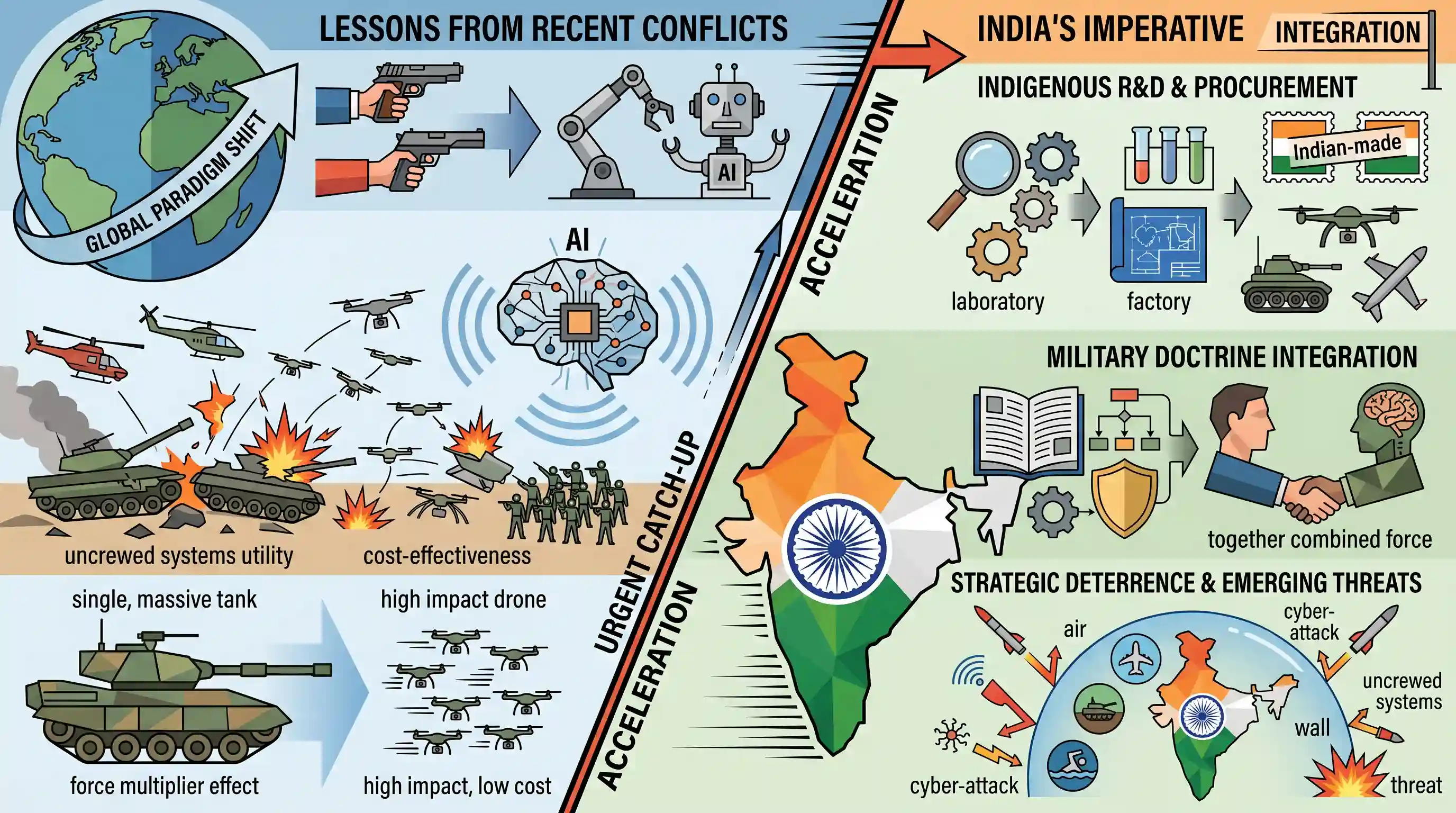
The article discusses the global paradigm shift towards autonomous warfare, driven by rapid advancements in Artificial Intelligence, drones, and Unmanned Aerial Vehicles (UAVs). Citing lessons from recent conflicts, it highlights the growing utility and cost-effectiveness of uncrewed systems on the modern battlefield. The author argues that India must urgently catch up by accelerating its indigenous research, development, and procurement of AI-driven autonomous weapons and integrating them into its military doctrines to maintain strategic deterrence and effectively counter emerging security threats.
Key Points
- The character of warfare is undergoing a rapid transformation with the integration of Artificial Intelligence, autonomous systems, and Unmanned Aerial Vehicles (UAVs).
- Recent global conflicts have demonstrated the cost-effectiveness and tactical advantages of drone swarms and uncrewed platforms over traditional manned weapon systems.
- India needs to aggressively pursue the indigenisation of defence technology, specifically focusing on robotics, AI, and autonomous weapons, to deter technologically advanced adversaries.
- The Indian armed forces must update their military doctrines and procurement strategies to seamlessly integrate autonomous warfare capabilities into their operational framework.
Important Terms
Atmanirbhar Bharat (Defence)

A 2020 national campaign aiming for self-reliance in defense, reducing import dependency through domestic manufacturing and R&D-focused initiatives like Positive Indigenisation Lists.
UPSC context
GS3/Internal Security; tests strategies for self-reliance and the economic impact of reducing high defense imports.
Lethal Autonomous Weapons Systems (LAWS)
Military systems (often called 'killer robots') capable of selecting and engaging targets without human intervention, utilizing AI and sensors for autonomous lethal force.
UPSC context
GS3/Science & Tech; critical for discussing ethical dilemmas, AI in warfare, and international humanitarian law.
iDEX (Innovations for Defence Excellence)
A Ministry of Defence initiative launched in 2018 to foster innovation by engaging startups, MSMEs, and academia in developing high-tech military solutions.
UPSC context
GS3/Indigenisation; tests knowledge of public-private partnerships and the startup ecosystem within the defense sector.
Indigenisation of Technology
The capability to design, develop, and produce defense equipment within India, ensuring supply chain security and technological sovereignty.
UPSC context
GS3/S&T; a core syllabus topic regarding 'developing new technology' and domestic R&D milestones.
DRDO (Defence Research and Development Organisation)
India's premier military R&D organization under the Ministry of Defence, responsible for developing indigenous weapon systems, missiles, and autonomous platforms like UAVs.
UPSC context
GS3/S&T; fundamental to questions on India's defense research architecture and major technology missions.
Positive Indigenisation List
Government-issued schedules of military hardware and components that are barred from import, mandating their procurement from the domestic Indian industry.
UPSC context
GS3/Internal Security; tests understanding of specific policy instruments used to boost domestic defense manufacturing.
Strategic Autonomy
The ability of a nation to pursue its foreign policy and security interests independently, without over-reliance on foreign powers for military hardware.
UPSC context
GS2/International Relations; central to debates on India's global positioning and defense procurement diplomacy.
Prelims Trap
Lethal Autonomous Weapons Systems (LAWS) are completely banned globally under the UN Convention on Certain Conventional Weapons (CCW).
No international treaty currently mandates a blanket ban on LAWS. The UN CCW has established a Group of Governmental Experts, but a legally binding prohibition does not yet exist.
Static Concepts Connected
What is the Innovations for Defence Excellence (iDEX) initiative?
- Objective: Fosters innovation and tech development in Defence and Aerospace by engaging MSMEs, start-ups, individual innovators, and R&D institutes.
- Nodal Agency: Funded and managed by the Defence Innovation Organization (DIO), a not-for-profit company formed under the Ministry of Defence.
- Grants & Linkage: Provides grants and support, acting as a bridge connecting civilian deep-tech innovators directly with the Indian Armed Forces' procurement needs.
How are Unmanned Aerial Vehicles (UAVs) classified under India's Drone Rules?
- Nano & Micro: Nano (up to 250 grams) and Micro (250g to 2kg) drones. Nano drones are largely exempt from stringent licensing and type-certificate requirements.
- Small & Medium: Small (2kg to 25kg) and Medium (25kg to 150kg). These require specific permits, unique identification numbers, and remote pilot licenses.
- Large: Large drones (greater than 150kg), typically reserved for heavy commercial or military applications, requiring extensive regulatory compliance and clearances.
Cross-Topic Patterns
Autonomous tech & Border Security Challenges
Cross-border drone drops in Punjab and J&K connect autonomous tech directly to GS3 internal security, specifically linking state-sponsored proxy war with narco-terrorism and arms smuggling.
Ethics of Lethal Autonomous Weapons (LAWS)
The delegation of 'kill decisions' to AI systems links defence technology directly to GS4 (Ethics in International Relations) and debates over human accountability and the laws of armed conflict.

Expect a multi-statement question combining iDEX's mandate with the roles of DAIC/DAIPA in integrating AI into India's defence systems.
Linked PYQs · 4
Linked PYQs · 4
- 2023MainsGS3
The use of unmanned aerial vehicles (UAVs) by our adversaries across the borders to ferry arms/ammunitions, drugs, etc., is a serious threat to the internal security. Comment on the measures being taken to tackle this threat.
- 2025PrelimsGS1
With reference to Unmanned Aerial Vehicles (UAVs), consider the following statements : I. All types of UAVs can do vertical landing. II. All types of UAVs can do automated hovering. III. All types of UAVs can use battery only as a source of power supply. How many of the statements given above are correct?
- 2015MainsGS3
What are the areas of prohibitive labour that can be sustainably managed by robots ? Discuss the initiatives that can propel research in premier research institutes for substantive and gainful innovation.
- 2023MainsGS3
Introduce the concept of Artificial Intelligence (AI). How does Al help clinical diagnosis? Do you perceive any threat to privacy of the individual in the use of Al in healthcare?
