Geopolitical Conflicts and Macroeconomic Vulnerabilities for India
Source:Indian Express ↗
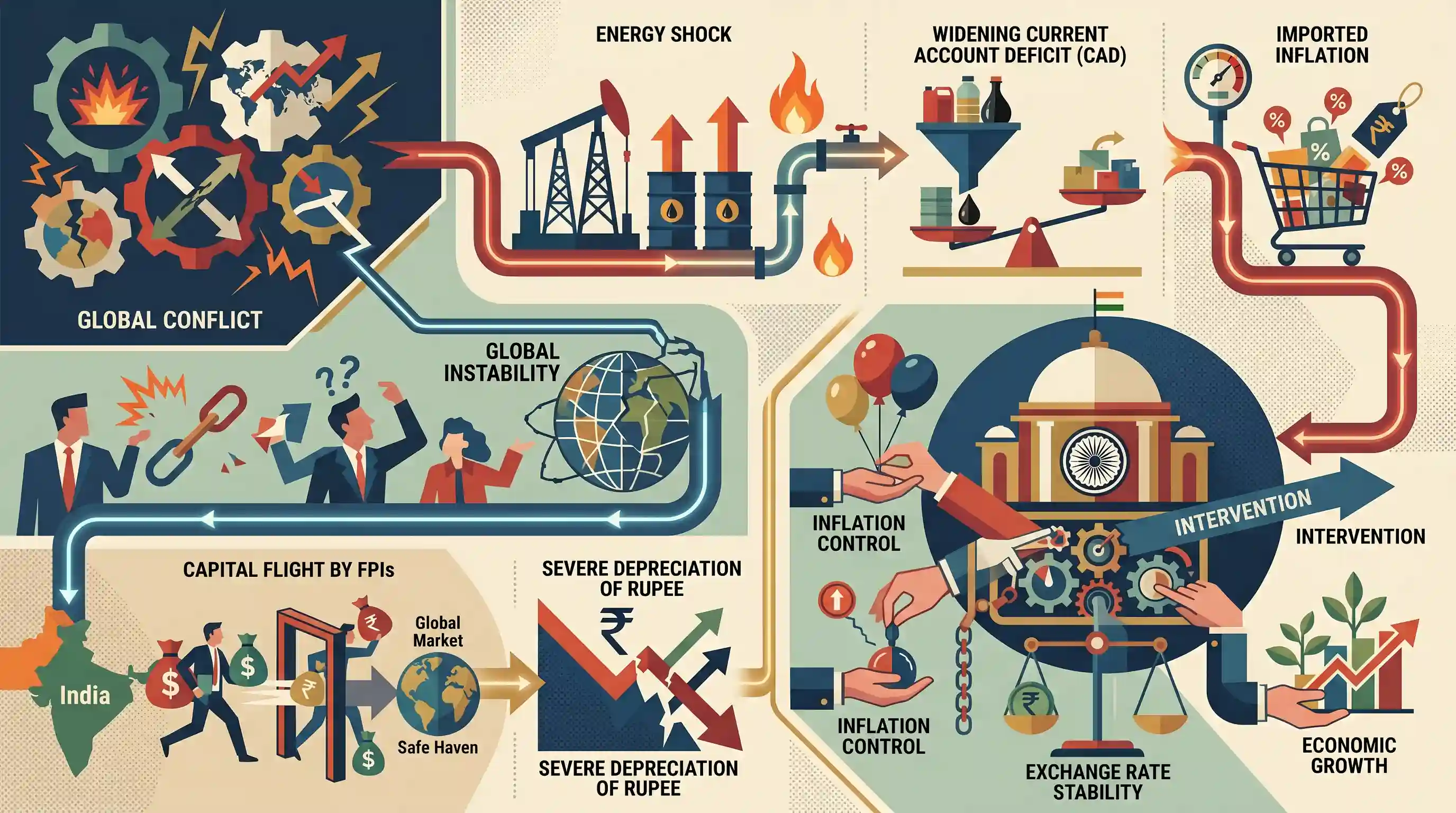
Why It Matters
Understanding the impact of external geopolitical shocks on the Indian economy is crucial for answering questions related to macroeconomic stability, the vulnerabilities of the external sector, and the RBI's monetary policy responses.
Summary
The article explains the transmission channels through which global wars and geopolitical conflicts impact the Indian economy, often leading to severe economic downturns. It highlights how external shocks manifest domestically through skyrocketing crude oil prices, which cause imported inflation and widen the Current Account Deficit. Additionally, global instability prompts capital flight by Foreign Portfolio Investors, leading to severe depreciation of the Indian Rupee. This forces the Reserve Bank of India (RBI) to intervene, complicating its mandate to balance inflation control, exchange rate stability, and economic growth.
Key Points
- Global conflicts and wars disrupt international supply chains and cause spikes in crude oil prices, heavily impacting India due to its high dependence on oil imports.
- A surge in international oil prices translates into 'imported inflation' for India, driving up transportation and production costs across the domestic economy.
- Geopolitical uncertainty triggers a flight to safety among global investors, resulting in massive Foreign Portfolio Investment (FPI) outflows from emerging markets like India.
- Capital flight and an inflated import bill cause rapid depreciation of the Indian Rupee and widen the Current Account Deficit (CAD), putting pressure on forex reserves.
- The Reserve Bank of India (RBI) faces a complex macroeconomic challenge, having to intervene in forex markets to stabilize the Rupee while simultaneously managing domestic inflation and protecting economic growth.
Important Terms
Current Account Deficit (CAD)

The shortfall occurring when a country's total imports of goods, services, and transfers exceed its total exports, necessitating foreign borrowing or asset sales.
UPSC context
GS Paper 3 (Economy). Essential for understanding Balance of Payments (BoP) stability and trade-driven currency pressure.
Imported Inflation
General price rise in a domestic economy caused by increased costs of imported essentials (e.g., oil) or a depreciating currency making foreign goods more expensive.
UPSC context
GS Paper 3 (Economy). Tests knowledge of external cost-push factors affecting domestic price stability.
Foreign Portfolio Investors (FPI)
Foreign entities investing in a country's financial assets like stocks and bonds without seeking management control; characterized by high liquidity and volatility.
UPSC context
GS Paper 3 (Economy). Critical for analyzing "hot money" flows and their impact on market volatility.
Currency Depreciation
The fall in value of a domestic currency against foreign benchmarks (e.g., USD) due to market forces like trade deficits or global interest rate hikes.
UPSC context
GS Paper 3 (Economy). Key for evaluating export competitiveness and external debt servicing costs.
Monetary Policy Committee (MPC)
A six-member statutory body led by the RBI Governor that determines the policy repo rate to maintain price stability within a defined target.
UPSC context
GS Paper 3 (Economy). Fundamental institutional framework for inflation targeting and monetary transmission.
Forex Reserves
Assets held by the RBI in foreign currencies, gold, and SDRs to manage exchange rate volatility and provide a cushion against external economic shocks.
UPSC context
GS Paper 3 (Economy). Measures the central bank's capacity to defend the currency during global crises.
Capital Flight
Rapid outflow of capital from a country due to geopolitical risks, interest rate differentials, or economic instability, often leading to currency crises.
UPSC context
GS Paper 3 (Economy). Crucial for understanding macroeconomic vulnerability and the risk of financial contagion.
Prelims Trap
Rupee depreciation automatically reduces the Current Account Deficit by boosting exports.
India's import basket is dominated by highly inelastic goods like crude oil. Depreciation initially inflates the import bill, often worsening the CAD before exports can respond (J-curve effect).
Static Concepts Connected
How does the RBI intervene to arrest Rupee depreciation?
- Spot Market Sales: RBI sells US dollars from its forex reserves in the spot market to increase dollar supply and stabilize the Rupee.
- Sterilization: RBI uses Open Market Operations (OMOs) to inject or absorb Rupee liquidity that gets altered by its aggressive forex interventions.
- Interest Rate Defense: RBI may hike the repo rate to prevent capital flight and maintain an attractive yield differential for foreign investors.
What are the primary channels of Imported Inflation?
- Commodity Price Shocks: Direct transmission of high global prices for inelastic and essential imports like crude oil, fertilizers, and edible oils.
- Currency Depreciation: A weaker Rupee makes even stable-priced global commodities more expensive in domestic currency terms, directly raising the import bill.
- Supply & Freight Disruption: Geopolitical conflicts inflate international shipping, insurance, and logistics costs, which are passed on to domestic consumers.
Cross-Topic Patterns
Macroeconomic Trilemma (Impossible Trinity)
Links current RBI interventions to the Mundell-Fleming 'Impossible Trinity' model, showing the difficulty of simultaneously managing exchange rates, free capital movement, and independent monetary policy.
Energy Security & Green Transition
Recurrent crude oil shocks and widening CAD act as a major push-factor for GS3 topics like the National Green Hydrogen Mission, EV adoption, and building Strategic Petroleum Reserves.

Expect a 2026 Prelims sequence question tracing the causal chain: FPI flight → Rupee depreciation → imported inflation → RBI sterilization.
Linked PYQs · 5
Linked PYQs · 5
- 2022PrelimsGS1
With reference to the Indian economy, consider the following statements: 1. If the inflation is too high, Reserve Bank of India (RBI) is likely to buy government securities. 2. If the rupee is rapidly depreciating, RBI is likely to sell dollars in the market. 3. If interest rates in the USA or European Union were to fall, that is likely to induce RBI to buy dollars. Which of the statements given above are correct?
- 2019PrelimsGS1
Which one of the following is not the most likely measure the Government/RBI takes to stop the slide of Indian rupee?
- 2019PrelimsGS1
In the context of India, which of the following factors is/are contributor/contributors to reducing the risk of a currency crisis? 1. The foreign currency earnings of India's IT sector 2. Increasing the government expenditure 3. Remittances from Indians abroad Select the correct answer using the code given below.
- 2018MainsGS3
How would the recent phenomena of protectionism and currency manipulations in world trade affect macroeconomic stability of India?
- 2024MainsGS3
What are the causes of persistent high food inflation in India? Comment on the effectiveness of the monetary policy of the RBI to control this type of inflation.
