Geopolitical Conflicts and Macroeconomic Stability in India
Source:Indian Express ↗
Why It Matters
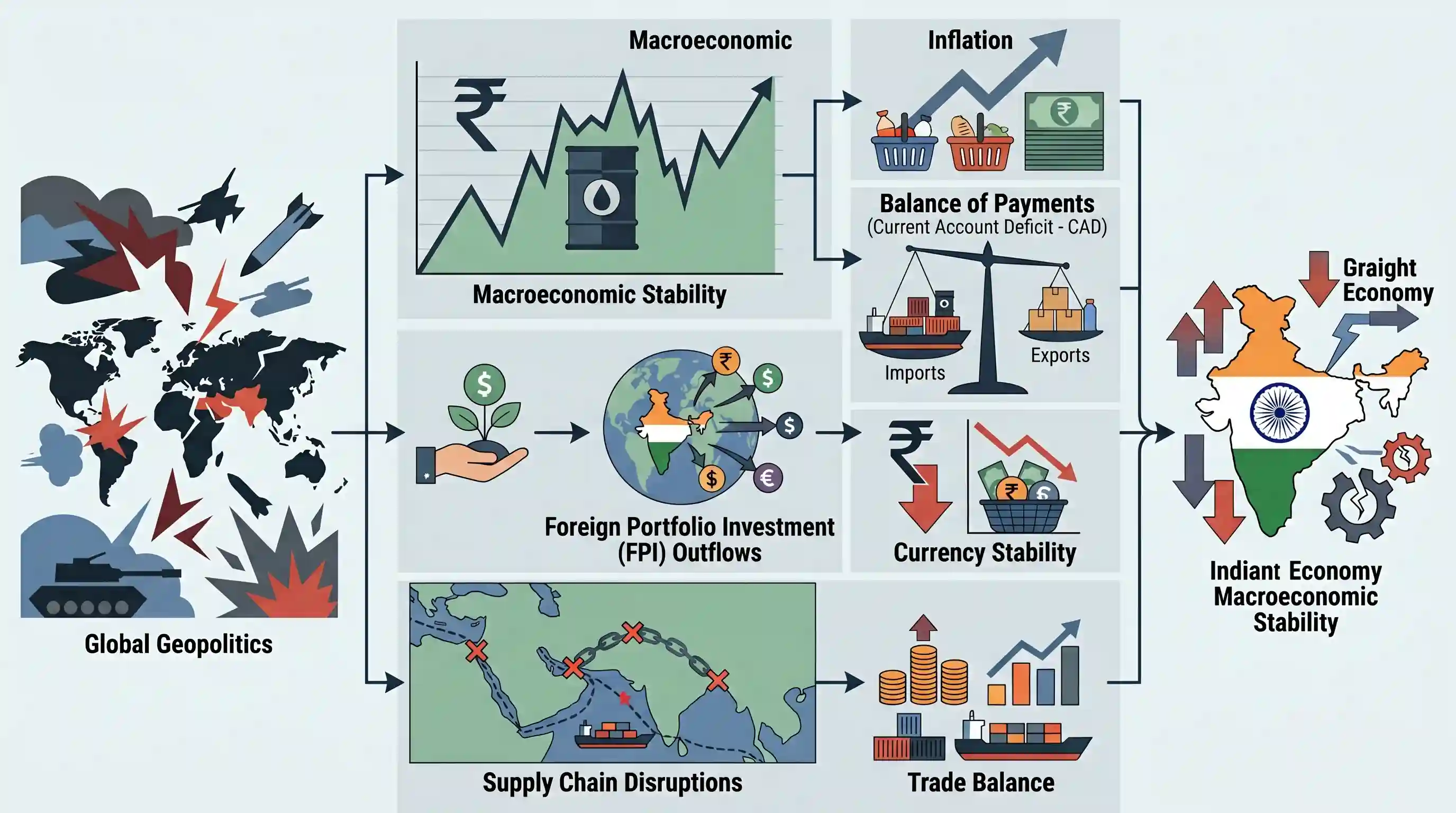
Understanding how external shocks (wars, supply chain disruptions) transmit into the domestic economy is critical for UPSC aspirants, especially for GS3 Economy and GS2 International Relations. It highlights the interplay between geopolitics, energy security, inflation, and currency valuation.
Summary
An analysis of how global geopolitical conflicts impact the Indian economy through multiple transmission channels. The primary concern is volatile crude oil prices, which directly widen India's Current Account Deficit (CAD) and fuel domestic inflation. Furthermore, global uncertainty triggers Foreign Portfolio Investment (FPI) outflows, depreciating the Rupee. Supply chain disruptions through vital maritime choke points also increase freight costs, affecting India's trade balance and overall macroeconomic stability.
Key Points
- India imports over 80% of its crude oil, making its Current Account Deficit (CAD) highly vulnerable to global oil price spikes triggered by geopolitical conflicts.
- Higher global energy prices cascade into domestic inflation by raising fuel, transportation, and manufacturing costs across the economy.
- Global uncertainty prompts capital flight as Foreign Portfolio Investors (FPIs) move to safe-haven assets, leading to the depreciation of the Indian Rupee.
- Supply chain disruptions along critical maritime routes increase freight costs, dampening India's export competitiveness and causing logistical delays.
Important Terms
Current Account Deficit (CAD)

A measurement of a country's trade where the value of the goods and services it imports exceeds the value of those it exports.
UPSC context
GS Paper III (Economy). Tests understanding of external sector vulnerabilities and Balance of Payments (BoP) stability.
Foreign Portfolio Investment (FPI)
Investment by non-residents in financial assets like stocks and bonds without seeking direct control or management of the businesses.
UPSC context
GS Paper III (Economy). Critical for questions on capital market volatility, exchange rate fluctuations, and 'hot money' risks.
Maritime Chokepoints
Narrow, strategically significant sea passages—such as the Strait of Hormuz—through which high volumes of global trade and energy supplies move.
UPSC context
GS Paper II & III. Vital for analyzing trade route vulnerabilities and India's strategic interests in the Indian Ocean Region.
Energy Security
The uninterrupted availability of energy sources at an affordable price, involving long-term investment and short-term resilience to supply shocks.
UPSC context
GS Paper III (Energy). Focuses on India's crude dependence, strategic petroleum reserves, and diversification strategies.
Inflation
A sustained increase in the general price level of goods and services, which reduces the purchasing power of the national currency.
UPSC context
GS Paper III (Economy). Tests knowledge of RBI's inflation-targeting mandate and the impact of global cost-push factors.
Reserve Bank of India (RBI)
India's central bank responsible for issuing currency, formulating monetary policy, and managing foreign exchange reserves to ensure financial stability.
UPSC context
GS Paper III (Economy). Key for questions on monetary tools, liquidity management, and currency stabilization.
Stagflation
An economic condition characterized by stagnant growth, high unemployment, and high inflation occurring simultaneously, often triggered by supply-side shocks.
UPSC context
GS Paper III (Economy). A conceptual term testing understanding of policy dilemmas during complex global supply disruptions.
Macroeconomic Stability
A condition where an economy maintains low inflation, sustainable deficits, and steady growth, enabling it to absorb external shocks effectively.
UPSC context
GS Paper III (Economy). Evaluates a country's overall economic health and the impact of geopolitical transmission channels.
Prelims Trap
Currency depreciation always reduces the Current Account Deficit by boosting export competitiveness.
India's imports (like crude oil) are highly inelastic. While depreciation theoretically makes exports cheaper, it heavily inflates the massive energy import bill, often widening the CAD.
Static Concepts Connected
What are the components of the Current Account in India's Balance of Payments?
- Trade in Goods: Records visible exports and imports of physical goods like crude oil, machinery, and agricultural products.
- Trade in Services: Records net invisible exports/imports, primarily dominated by software services, travel, and transportation.
- Transfer Payments: Includes inward remittances from the Indian diaspora, grants, and gifts which do not involve any corresponding economic return.
- Factor Income: Net income from compensation of employees and investment income (dividends, interest, and profits) from abroad.
What are the primary drivers of 'Imported Inflation' in India?
- Currency Depreciation: A weaker Rupee makes purchasing the same volume of foreign goods (like oil and electronics) more expensive in domestic currency terms.
- Global Commodity Shocks: Spikes in international prices of inelastic imports such as crude oil, fertilizers, and edible oils directly raise domestic input costs.
- Rising Freight Costs: Geopolitical disruptions at maritime choke points increase shipping times and insurance premiums, cascading into higher retail prices.
Cross-Topic Patterns
Choke points mapping & energy security
Disruptions in Bab-el-Mandeb or Hormuz link global geography to macroeconomy. UPSC frequently tests Middle East map locations alongside their economic implications for India's energy security.
FPI flight & exchange rate management
Global uncertainties causing FPI outflows connect directly to RBI's sterilization efforts and forex reserve management, testing the interplay between NEER, REER, and domestic liquidity.

Expect a multi-statement Prelims question linking global crude shocks, FPI flight, and RBI's forex interventions via REER in 2026.
Linked PYQs · 4
Linked PYQs · 4
- 2025MainsGS2
"Energy security constitutes the dominant kingpin of India's foreign policy, and is linked with India's overarching influence in Middle Eastern countries.” How would you integrate energy security with India's foreign policy trajectories in the coming years?
- 2022PrelimsGS1
With reference to the Indian economy, consider the following statements: 1. An increase in Nominal Effective Exchange Rate (NEER) indicates the appreciation of rupee. 2. An increase in the Real Effective Exchange Rate (REER) indicates an improvement in trade competitiveness. 3. An increasing trend in domestic inflation relative to inflation in other countries is likely to cause an increasing divergence between NEER and REER. Which of the above statements are correct?
- 2018MainsGS3
How would the recent phenomena of protectionism and currency manipulations in world trade affect macroeconomic stability of India?
- 2011PrelimsGS1
Both Foreign Direct Investment (FDI) and Foreign Institutional Investor (FII) are related to investment in a country. Which one of the following statements best represents an important difference between the two?
