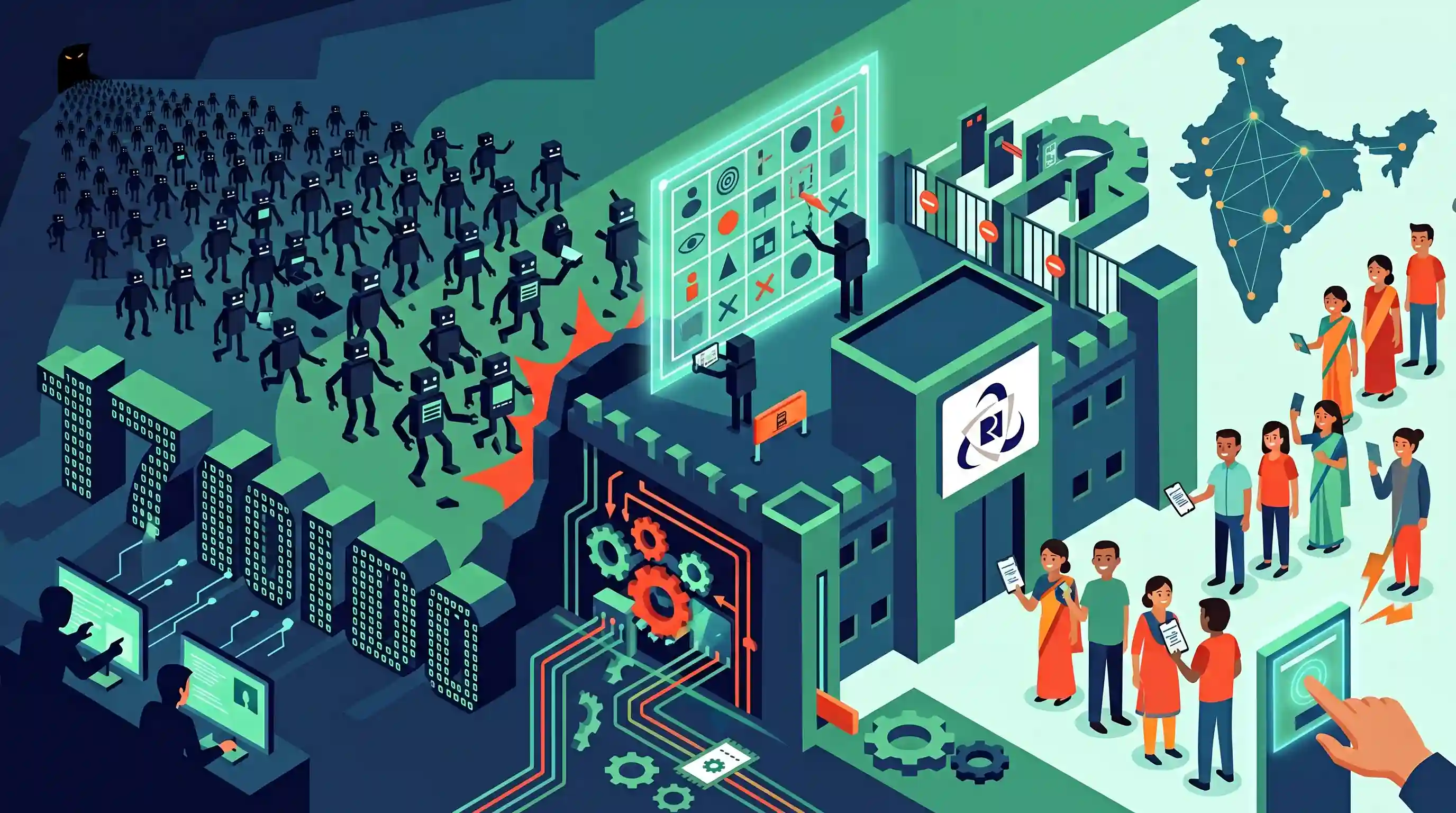
Railways deploys cybersecurity measures to block tatkal bots
Source:Indian Express ↗
Why It Matters
It demonstrates the immense scale of automated cyber attacks against critical Indian e-governance platforms and highlights the continuous technological arms race required to ensure equitable and secure public service delivery to citizens.
Summary
The Indian Railway Catering and Tourism Corporation (IRCTC) successfully blocks a staggering 17 billion bot attacks every month aimed at exploiting the Tatkal ticket booking system. These automated scripts are deployed by malicious actors to bypass security measures and hoard tickets meant for genuine passengers, revealing an ongoing 'invisible war' in cyberspace. To protect the platform, IRCTC has implemented stringent anti-bot measures, including advanced CAPTCHAs, booking limits, and backend infrastructure upgrades. This massive scale of automated attacks illustrates the critical cybersecurity challenges and the need for resilience in India's digital public infrastructure and e-governance service delivery.
Key Points
- IRCTC neutralizes approximately 17 billion automated bot attacks per month targeting the high-demand Tatkal ticket booking window.
- Malicious actors use sophisticated scripts and botnets to bypass queuing mechanisms and hoard tickets, denying access to legitimate passengers.
- To counter these threats, the Railways continually deploys security upgrades such as advanced CAPTCHA, session timeouts, and booking limits per IP/user to filter non-human traffic.
- The massive scale of these attacks highlights the immense cybersecurity challenges faced by India's digital public infrastructure (DPI) and e-governance services.
- Ensuring equitable and transparent access to public services necessitates robust, dynamic cyber-defense mechanisms against automated exploitation.
Important Terms
Indian Railway Catering and Tourism Corporation (IRCTC)

A Mini Ratna PSU under the Ministry of Railways managing online ticketing, catering, and tourism. It operates one of India's largest e-commerce platforms for public transport.
UPSC context
GS Paper II/III: Public service delivery, digital infrastructure, and governance of public sector undertakings (PSUs).
Tatkal Scheme
An emergency rail ticket booking system allowing passengers to reserve seats 24 hours before train departure for an additional charge, often targeted by automated hoarding scripts.
UPSC context
GS Paper III: Infrastructure and Transport. Tests understanding of efficiency and fair access in essential public services.
Bot Attacks
Automated software scripts used to perform tasks at high speeds, such as mass-booking tickets, which can overwhelm servers and bypass standard human interaction protocols.
UPSC context
GS Paper III: Cyber Security. Essential for analyzing threats to critical information infrastructure and digital public services.
Digital Public Infrastructure (DPI)
Foundational digital platforms (like Aadhaar, UPI, or IRCTC’s booking system) that enable governments and businesses to provide essential, scalable, and interoperable services to citizens.
UPSC context
GS Paper III: Economy/S&T. A core pillar of India’s digital transformation and G20 development agenda.
Aadhaar-based Authentication
A security verification process using unique 12-digit IDs to confirm user identity, preventing duplicate accounts and automated bot registrations on digital platforms.
UPSC context
GS Paper II: E-Governance. Critical for discussions on curbing leakages, ensuring transparency, and protecting digital identities.
CAPTCHA
A security test ("Completely Automated Public Turing test to tell Computers and Humans Apart") designed to distinguish human users from bots to prevent automated abuse.
UPSC context
GS Paper III: Cyber Security. Relevant for technical safeguards used to protect national-scale digital interfaces from exploitation.
Prelims Trap
"CERT-In is the designated nodal agency for protecting Critical Information Infrastructure like railway networks."
Under Section 70A of the IT Act, NCIIPC (under NTRO) protects Critical Information Infrastructure (Transport, Power). CERT-In (under MeitY) handles general cyber incidents.
Static Concepts Connected
How do the roles of CERT-In and NCIIPC differ?
- CERT-In (Incident Response): Acts as the national agency for responding to computer security incidents as and when they occur, issuing alerts and advisories (under IT Act Sec 70B).
- NCIIPC (CII Protection): Acts as the nodal agency specifically mandated to protect Critical Information Infrastructure (CII) like power, transport, and telecom (under IT Act Sec 70A).
- Parent Ministries: CERT-In operates under the Ministry of Electronics and IT (MeitY), whereas NCIIPC operates under the National Technical Research Organisation (NTRO) in the PMO.
What are Botnets and how do they function?
- Definition: A network of hijacked, malware-infected devices (zombies) connected to the internet, remotely controlled by a hacker (botmaster) without the owners' knowledge.
- Mechanism: They are deployed to execute massive automated tasks simultaneously, such as overwhelming servers (DDoS attacks), scraping data, or hoarding limited online resources like tickets.
- Evasion capability: They exploit the massive scale of infected IoT devices, making it difficult for traditional IP-blocking security systems to distinguish between legitimate human users and malicious scripts.
Cross-Topic Patterns
DPI diplomacy + Cyber resilience
As India globalizes its Digital Public Infrastructure (UPI, ONDC), proving systemic resilience against bot-driven DDoS attacks is crucial for digital diplomacy and maintaining trust in the India Stack.
Digital hoarding + Unfair Trade
Bot-driven ticket hoarding (scalping) links cyber vulnerabilities directly to the Consumer Protection Act, highlighting how technology can be used to perpetuate unfair trade practices and artificial scarcity.

Expect a Prelims pairing question matching cyber agencies (NCIIPC, CERT-In, I4C) with their specific mandates and parent ministries.
Linked PYQs · 4
Linked PYQs · 4
- 2020MainsGS3
Discuss different types of cyber crimes and measures required to be taken to fight the menace.
- 2017MainsGS3
Discuss the potential threats of Cyber attack and the security framework to prevent it.
- 2024MainsGS2
e-governance is not just about the routine application of digital technology in service delivery process. It is as much about multifarious interactions for ensuring transparency and accountability. In this context evaluate the role of the 'Interactive Service Model' of e-governance.
- 2023MainsGS2
e-governance, as a critical tool of governance, has ushered in effectiveness, transparency and accountability in governments. What inadequacies hamper the enhancement of these features ?
