Legislative Reforms Create Apprehensions Among Religious Minorities
Source:Indian Express ↗
Why It Matters
The article provides a powerful case study for Mains answers on secularism, communal harmony, and the grassroots impact of government legislation concerning minority institutions (like the Waqf Amendment Bill). It illustrates how macro-level policies affect micro-level social dynamics.
Summary
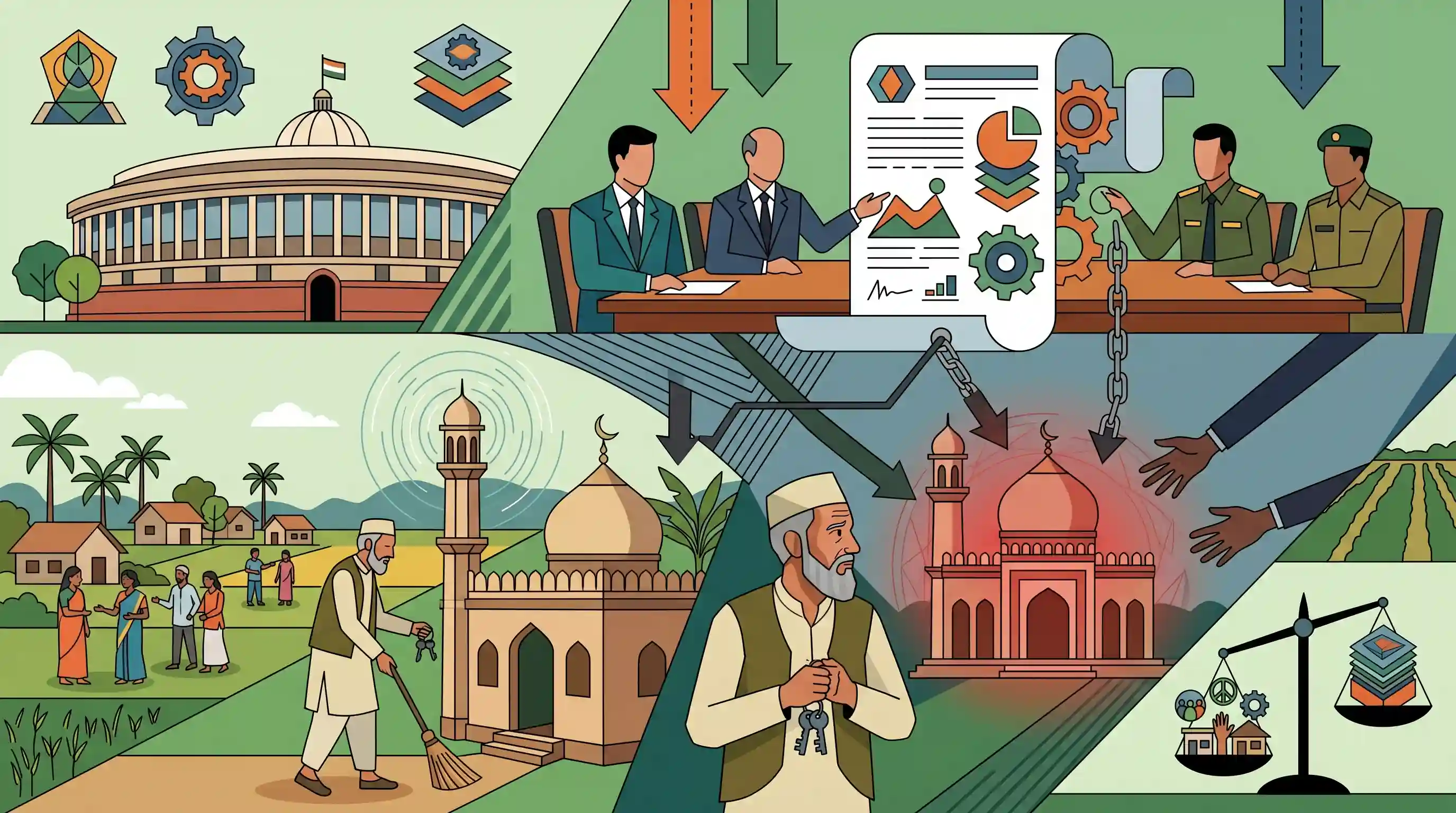
In Bihar’s Sarbahdi village (Nalanda), a lone Muslim resident is maintaining the local mosque and keeping the tradition of the azaan alive. The proposed Waqf (Amendment) Bill, which seeks to alter the administration of Waqf properties across India, has added a new layer of urgency to his presence. Fearing that the mosque and its associated Waqf lands could be lost or mismanaged under the new legal framework if left unattended, the caretaker feels compelled to stay put. The story serves as a poignant intersection of grassroots communal harmony, pluralism, and the tangible anxieties that national legislative changes regarding religious endowments cause among minority communities.
Key Points
- A lone Muslim resident in Sarbahdi village, Nalanda, has taken on the responsibility of maintaining the local mosque and continuing the tradition of the daily azaan.
- The introduction of the Waqf (Amendment) Bill has created anxiety regarding the future security and administration of Waqf properties, particularly in areas with a minimal Muslim population.
- The proposed legislative changes have strengthened the caretaker's resolve to remain in the village to protect the mosque and its associated lands from potential loss or mismanagement.
- The narrative reflects broader themes of grassroots communal harmony, pluralism, and how national policies affecting religious endowments impact minority communities on the ground.
Important Terms
Waqf

A permanent dedication of movable or immovable property for religious, pious, or charitable purposes recognized by Muslim law; once dedicated, ownership is considered to reside with the Almighty.
UPSC context
GS Paper I (Society/Secularism) and Paper II (Governance); tests understanding of religious endowments and minority property rights.
Waqf Board
A statutory body established under the Waqf Act, 1995, responsible for the management, administration, and protection of Waqf properties within a specific state or territory.
UPSC context
GS Paper II (Statutory Bodies); relevant for questions on institutional governance of religious minorities and administrative efficiency.
Waqf (Amendment) Bill, 2024
Proposed legislation (introduced in 2024) seeking to reform Waqf management by including non-Muslim members, increasing government oversight via District Collectors, and mandating digital registration.
UPSC context
GS Paper II (Government Policies/Interventions); tests analysis of federalism, minority autonomy, and administrative centralization.
Mutawalli
The manager or trustee of a Waqf property responsible for ensuring that its revenue and use align with the original religious or charitable intent.
UPSC context
GS Paper II (Governance); relevant for understanding grassroots administration of minority religious institutions.
Waqf by User
A legal concept recognizing property as Waqf based on long-term uninterrupted usage for religious or charitable purposes, even without a formal written deed (waqfnama).
UPSC context
GS Paper II (Polity/Legal Provisions); critical for discussions on property disputes and the potential impact of legislative changes.
Central Waqf Council
A statutory body under the Ministry of Minority Affairs that advises the Central Government and State Waqf Boards on the administration of Waqf properties.
UPSC context
GS Paper II (Statutory/Advisory Bodies); tests knowledge of the hierarchical structure of minority religious administration in India.
Prelims Trap
The Waqf Amendment Act 2025 strengthens the 'Waqf by user' doctrine to protect undocumented rural mosques.
The 2025 Act actually abolishes 'Waqf by user', mandating digital registration and shifting the authority to determine Waqf status from Tribunals to District Collectors.
Static Concepts Connected
What constitutional protections cover property owned by religious denominations?
- Article 26(c) & (d): Guarantees religious denominations the right to own, acquire, and administer movable and immovable property "in accordance with law."
- State Regulation: The State can regulate the administration of property through secular laws, but cannot wholly strip the denomination of its fundamental right to administer it.
- Exceptions: Unlike Article 25, rights under Article 26 are only subject to public order, morality, and health, not "other provisions of this Part."
What is the doctrine of "Waqf by user" in Indian jurisprudence?
- Historical Use: A legal principle where property is recognized as Waqf based on long-standing, continuous use for religious purposes (e.g., a graveyard), even without a formal dedication deed.
- 2025 Amendment Impact: The Waqf (Amendment) Act 2025 abolished this doctrine to curb arbitrary land claims, mandating a formal Waqfnama (deed) and registration on a central portal.
Cross-Topic Patterns
Waqf Reforms + Art 26 + Admin Overreach
The SC stay on granting District Collectors unilateral power over Waqf land disputes highlights the tension between statutory executive reforms and constitutional Article 26 rights.
Everyday Pluralism + GS-1 Indian Society
A lone Muslim maintaining a mosque in a multi-faith village serves as an excellent case study for GS-1 mains answers on grassroots pluralism and the Indian model of secularism.

Prelims 2026 will likely test the abolition of the 'Waqf by user' doctrine alongside Article 26 property administration rights.
Linked PYQs · 3
Linked PYQs · 3
- 2022MainsGS1
Are tolerance, assimilation and pluralism the key elements in the making of an Indian form of secularism? Justify your answer.
- 2018MainsGS1
How the Indian concept of secularism is different from the western model of secularism? Discuss.
- 2024MainsGS2
Public charitable trusts have the potential to make India's development more inclusive as they relate to certain vital public issues. Comment.
