Waqf Amendment Bill Supreme Court Challenge and Fundamental Rights
Source:Indian Express ↗
Why It Matters
The issue tests the constitutional balance between state regulation of institutional property (Waqf) and the fundamental rights of minorities to manage their religious and charitable endowments, generating critical questions on secularism and Article 300A.
Summary
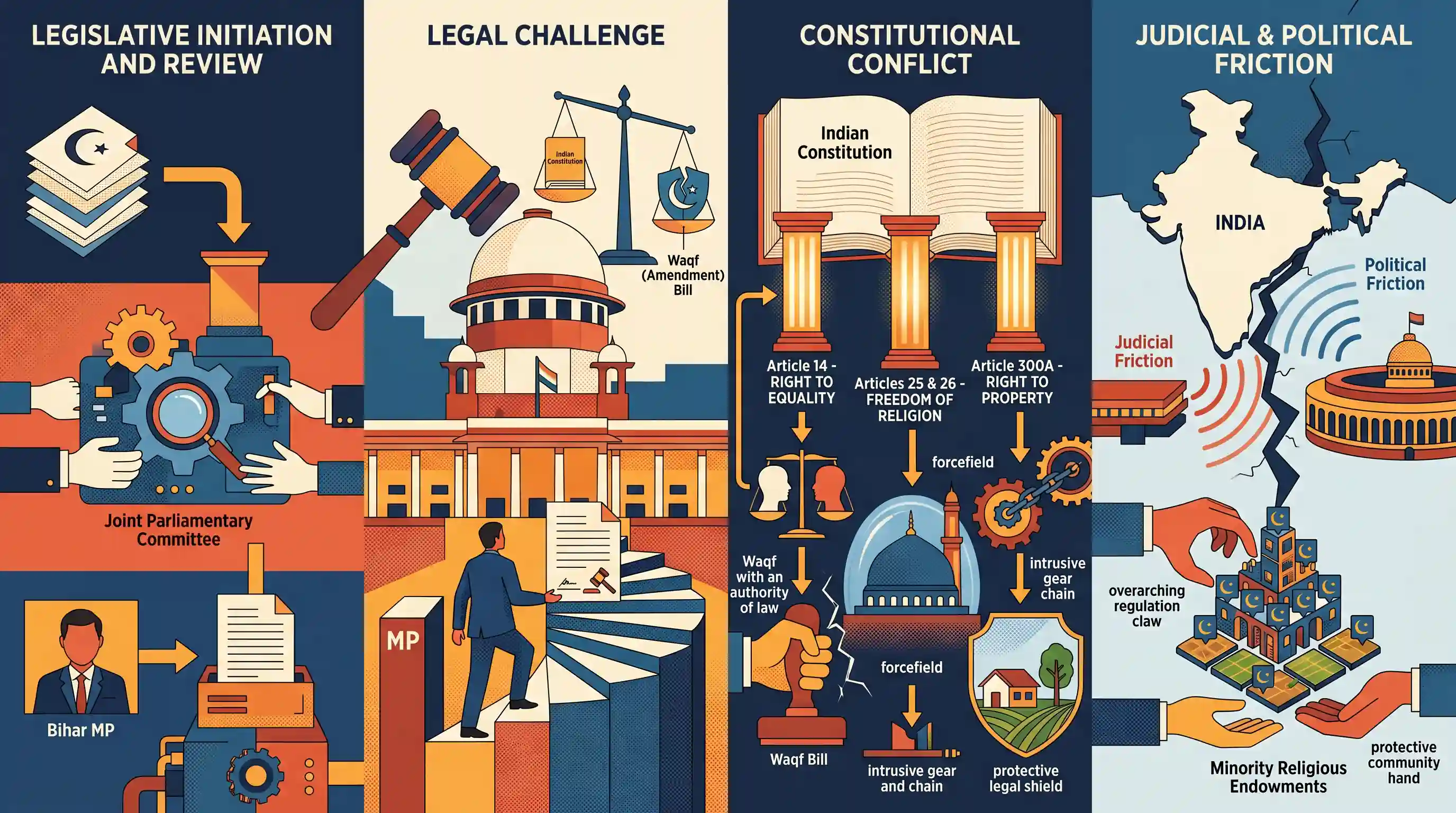
A veteran Congress Member of Parliament from Bihar, Mohammad Jawed, has filed a plea in the Supreme Court challenging the Waqf (Amendment) Bill. The petition asserts that the Bill violates core constitutional protections, specifically targeting the right to equality (Article 14), freedom of religion (Articles 25 and 26), and the legal right to property (Article 300A). The move represents a pre-emptive legal challenge while the controversial legislation is still undergoing review by a Joint Parliamentary Committee, highlighting escalating political and judicial friction over state regulation of minority religious endowments.
Key Points
- Congress MP Mohammad Jawed from Bihar has approached the Supreme Court challenging the constitutional validity of the Waqf (Amendment) Bill.
- The petition argues that the proposed amendments violate fundamental rights including Article 14 (Right to Equality) and Articles 25 and 26 (Freedom to manage religious affairs).
- The challenge also invokes Article 300A (Right to Property), asserting that the Bill imposes arbitrary state control over Waqf properties.
- The legal challenge comes even as the contentious Bill is currently being scrutinized by a Joint Parliamentary Committee (JPC) due to widespread opposition.
Important Terms
Waqf (Amendment) Bill, 2024

Proposed legislation to reform Muslim endowment management by including non-Muslim members in boards, empowering District Collectors in land disputes, and abolishing the "Waqf by user" doctrine.
UPSC context
GS Paper II: Governance and Polity; tests understanding of legislative reforms, minority rights, and state-religion dynamics.
Waqf Act, 1995
The primary legal framework in India for administering Muslim religious and charitable endowments, establishing State Waqf Boards and the Central Waqf Council as supervisory bodies.
UPSC context
GS Paper II: Statutory Bodies; tests knowledge of the legal and administrative structures governing religious properties.
Article 26 (Freedom to Manage Religious Affairs)
A Fundamental Right granting religious denominations the autonomy to establish institutions, manage their own religious affairs, and own or administer property in accordance with law.
UPSC context
GS Paper II: Fundamental Rights; tests the balance between denominational autonomy and the state's power to regulate secular activities.
Article 300A (Right to Property)
A constitutional right mandating that no person shall be deprived of their property except by "authority of law," protecting against arbitrary state seizure or reclassification of land.
UPSC context
GS Paper II: Constitution; tests understanding of the legal safeguards for property and the limits of executive power.
Joint Parliamentary Committee (JPC)
An ad-hoc legislative body comprising members from both Lok Sabha and Rajya Sabha, formed to provide in-depth bipartisan scrutiny of complex or controversial Bills.
UPSC context
GS Paper II: Parliament; tests knowledge of parliamentary procedures and the committee system's role in executive accountability.
Waqf by User
A legal doctrine recognizing property long-used for religious purposes as Waqf, even without formal documentation; its proposed removal is a core point of constitutional friction.
UPSC context
GS Paper II: Judiciary/Polity; tests knowledge of legal doctrines, land title disputes, and judicial precedents related to religious practice.
Prelims Trap
Under Article 26, religious denominations have an absolute fundamental right to administer their property without State interference.
Article 26(d) grants the right to administer religious property, but explicitly states it must be 'in accordance with law,' permitting state regulation of secular/financial administration.
Static Concepts Connected
What are the powers and composition of a Joint Parliamentary Committee (JPC)?
- Ad-hoc nature: Formed via a motion adopted by one House and agreed to by the other; dissolves after submitting its final report.
- Composition: Typically consists of members from both the Lok Sabha and Rajya Sabha in a 2:1 ratio.
- Evidentiary powers: Can summon experts, stakeholders, and demand official documents to thoroughly scrutinize contentious bills.
How does the Indian Constitution protect the property of religious endowments?
- Article 26: Grants denominations the right to own and administer movable and immovable property, but strictly 'in accordance with law'.
- Article 300A: Ensures no entity or person is deprived of property except by authority of law, post the 44th Amendment.
- Secular regulation: The state can legally intervene in the financial, economic, or secular administration of religious institutions without violating essential religious freedoms.
Cross-Topic Patterns
Indian secularism and property regulation
The Waqf debate directly parallels controversies surrounding Hindu Religious and Charitable Endowments (HRCE) Acts, highlighting India's principled distance model where the state regulates the secular administration of faith.
Separation of powers and premature judicial review
Petitions challenging bills still under JPC review test the boundaries of judicial intervention in ongoing legislative proceedings before a statute is officially enacted.

A 2026 prelims multi-statement question will likely interlink Article 26, Article 300A, and JPC composition via the Waqf controversy.
Linked PYQs · 4
Linked PYQs · 4
- 2024MainsGS2
Discuss India as a secular state and compare with the secular principles of the US constitution.
- 2021PrelimsGS1
What is the position of the Right to Property in India?
- 2005PrelimsGS1
Consider the following statements: 1. Article 301 pertains to the Right to Property. 2. Right to Property is a legal right but not a fundamental right. 3. Article 300 A was inserted in the Constitution of India by the Congress Government at the Center by the 44th Constitutional Amendment. Which of the above statements are true?
- 2024MainsGS2
Public charitable trusts have the potential to make India's development more inclusive as they relate to certain vital public issues. Comment.
