Goa nightclub fire exposes urban governance and fire safety failures
Source:The Hindu ↗
Why It Matters
The article provides a powerful real-world case study on the failure of local governance, regulatory enforcement, and bureaucratic accountability. It is highly relevant for GS2 (Governance/Local Bodies), GS3 (Urban Disaster Management), and GS4 (Ethics case studies on public safety, corruption, and administrative negligence).
Summary
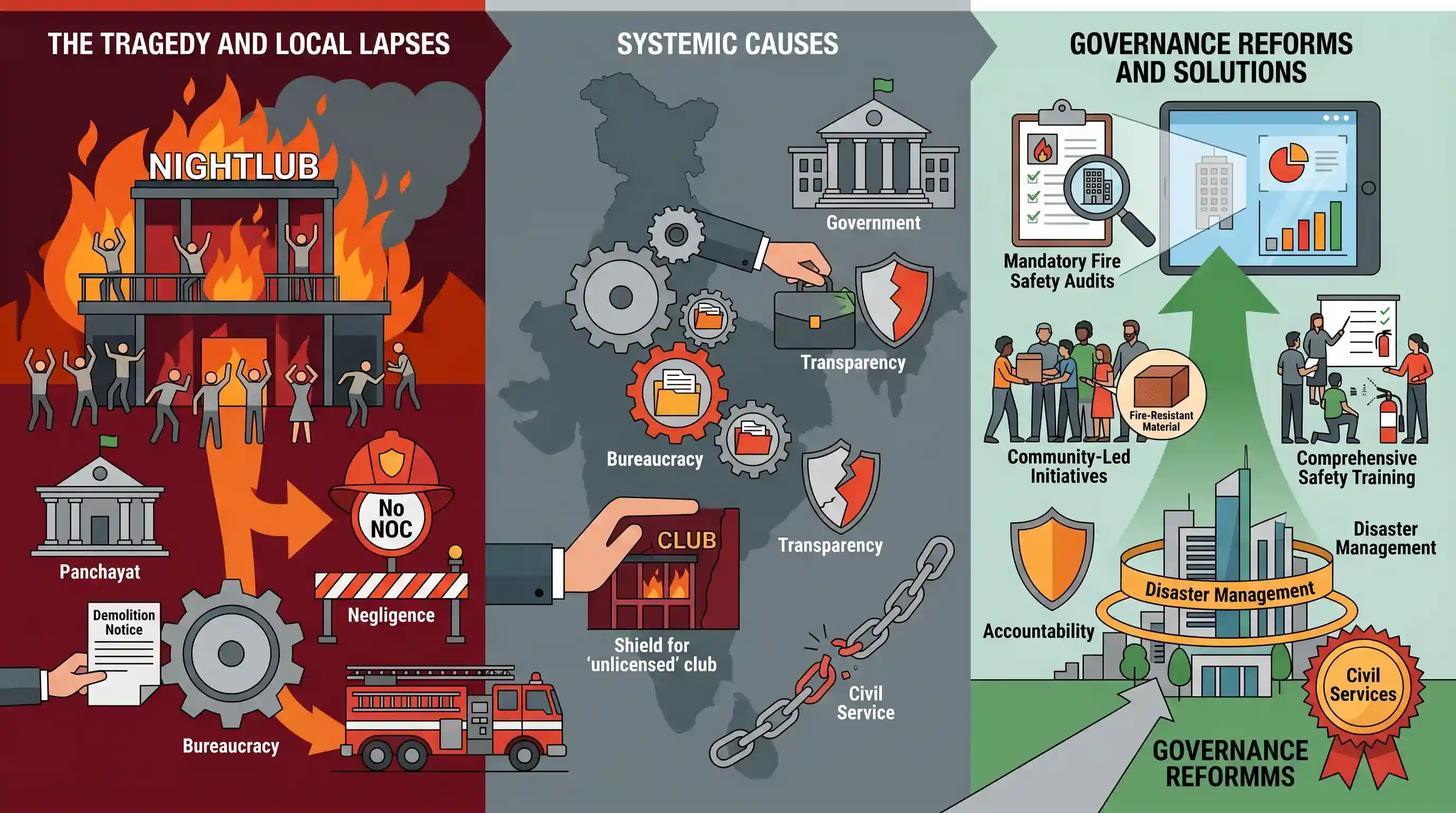
The fatal fire at a North Goa nightclub, which claimed 25 lives, highlights the grave consequences of systemic regulatory negligence and poor enforcement of safety norms. Despite lacking a fire department NOC and facing a panchayat demolition notice, the unlicensed establishment continued to operate with hazardous materials and inadequate ventilation. The tragedy underscores a broader nationwide pattern of bureaucratic inertia, corruption, and political patronage compromising public safety. The editorial calls for urgent governance reforms, including mandatory fire safety audits linked to transparent e-governance portals, community-led initiatives to incentivize fire-resistant building materials, and comprehensive safety training to ensure accountability and prevent future urban disasters.
Key Points
- The "Birch by Romeo Lane" nightclub fire in North Goa claimed 25 lives, exposing severe systemic failures in regulatory enforcement and safety compliance.
- The structure operated illegally without a fire No-Objection Certificate (NOC) and successfully evaded a demolition notice issued by the local panchayat.
- Casualties were compounded by the use of hazardous wooden panels, a lack of basic safety infrastructure, and poor ventilation leading to asphyxiation.
- Bureaucratic inertia, political patronage, and corruption routinely undermine existing building codes and fire safety norms across India, as seen in past incidents in Virudhunagar, Kolkata, and Kurnool.
- Proposed reforms include integrating mandatory fire safety audits with e-governance portals, community-driven promotion of fire-resistant materials, and safety training for establishment staff.
Important Terms
Panchayati Raj Institutions (PRIs)

Constitutional bodies (73rd Amendment) managing rural local affairs. In fire tragedies, they are responsible for enforcing building bylaws and issuing demolition notices to unauthorized structures.
UPSC context
GS Paper II (Polity/Governance): Tests decentralization, local governance accountability, and the 73rd Constitutional Amendment Act.
Fire No-Objection Certificate (NOC)
A mandatory clearance issued by fire services certifying that a building complies with safety norms. Absence of this document indicates a critical failure in regulatory oversight.
UPSC context
GS Paper III (Disaster Management): Relevant for safety regulations, industrial/commercial hazards, and administrative compliance.
National Building Code (NBC)
A comprehensive instrument by the Bureau of Indian Standards (BIS) providing guidelines for regulating building construction activities, including fire safety requirements and evacuation norms.
UPSC context
GS Paper III (Internal Security/Disaster Management): Tests knowledge of safety frameworks and urban planning standards.
E-governance
The application of ICT to deliver government services. Transparent e-portals for fire audits are proposed to reduce corruption and ensure real-time tracking of safety compliance.
UPSC context
GS Paper II (Governance): Essential for topics on transparency, accountability, and the role of technology in administration.
Disaster Management
The organization and management of resources and responsibilities for dealing with emergencies. Urban fire management involves prevention, mitigation, preparedness, and response to minimize casualties.
UPSC context
GS Paper III: A dedicated pillar testing strategies for hazard mitigation and man-made disaster response.
Urban Local Bodies (ULBs)
Elected local government bodies (74th Amendment) for urban areas. They are primary stakeholders in managing urban fire hazards through town planning and building regulation enforcement.
UPSC context
GS Paper II: Tests democratic decentralization and the functional effectiveness of municipalities.
Prelims Trap
"The National Building Code is a legally binding central legislation mandatory for all states."
The NBC, published by BIS, is recommendatory. Because 'Fire Services' falls under the State's domain, States must explicitly adopt the NBC into local building bye-laws for legal enforcement.
Static Concepts Connected
Where do 'Fire Services' fall under India's constitutional framework?
- 12th Schedule: It is listed as a functional item under Article 243W for Municipalities, introduced by the 74th Constitutional Amendment Act.
- State Subject: Fire services are fundamentally a State subject. State governments must enact legislation to devolve these powers and corresponding funds to local bodies.
What is the National Building Code (NBC) of India?
- Guiding Agency: Published by the Bureau of Indian Standards (BIS) to serve as a model code for building construction and safety guidelines.
- Recommendatory Nature: It is an advisory document. States and urban local bodies must formally adopt it into local municipal bye-laws to make it legally enforceable.
- Part 4 Focus: Part 4 of the NBC specifically addresses Fire and Life Safety, outlining mandatory protocols for fire prevention, evacuation, and protection equipment.
Cross-Topic Patterns
ULB Devolution + Urban Disasters
The lack of functional and financial devolution to Urban Local Bodies directly compromises municipal enforcement of safety codes, heavily compounding urban disaster risks.
E-Governance + Ethics in Administration
Automating NOC approvals via transparent portals demonstrates how reducing the bureaucratic human interface curtails rent-seeking, bridging e-governance and administrative probity.

Expect a 2026 Prelims statement testing the recommendatory nature of the National Building Code against the 12th Schedule (Fire Services).
Linked PYQs · 3
Linked PYQs · 3
- 2024MainsGS2
Analyse the role of local bodies in providing good governance at local level and bring out the pros and cons merging the rural local bodies with the urban local bodies.
- 2024MainsGS3
What is disaster resilience? How is it determined? Describe various elements of a resilience framework. Also mention the global targets of Sendai Framework for Disaster Risk Reduction (2015–2030).
- 2023MainsGS4
Corruption is the manifestation of the failure of core values in the society." In your opinion, what measures can be adopted to uplift the core values in the society ?
