Bilateral dispute resolution paradigms between India and China
Source:Indian Express ↗
Why It Matters
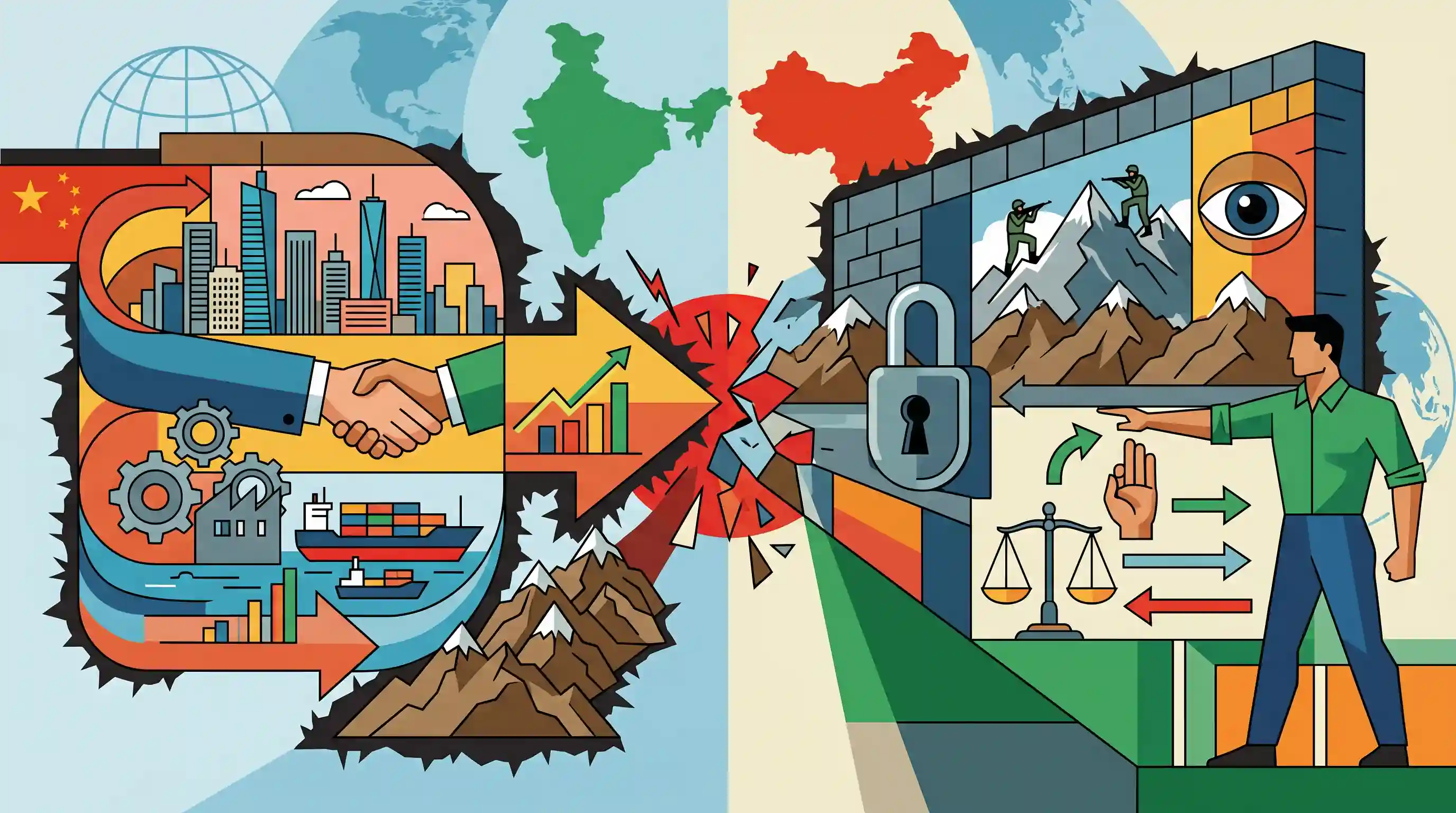
The India-China dynamic is a cornerstone of India's foreign policy and national security. Understanding their contrasting approaches to conflict resolution is vital for grasping the geopolitical complexities of the Indo-Pacific, analyzing diplomatic stalemates, and evaluating border management strategies.
Summary
Chinese Foreign Minister Wang Yi's visit to New Delhi underscores the fundamentally divergent paradigms India and China hold regarding their bilateral relationship. While China pushes for normalizing overall economic and diplomatic ties by putting the unresolved Line of Actual Control (LAC) border dispute in its 'proper place', India remains resolute that peace and tranquility at the border are essential prerequisites for restoring normal relations. This diplomatic standoff reflects profound strategic mistrust, as India refuses to delink the military friction from the broader geopolitical relationship, demanding complete disengagement and a return to the status quo.
Key Points
- China's Diplomatic Strategy: Beijing advocates for separating the border dispute from broader bilateral relations, seeking to normalize trade and diplomatic ties while keeping the LAC issue on the back burner.
- India's Firm Prerequisite: New Delhi maintains that the state of the border determines the overall relationship, making complete disengagement and peace at the LAC an absolute precondition for normalizing ties.
- Strategic Impasse: The contrasting approaches highlight deep structural mistrust, as India views the Chinese strategy as an attempt to legitimize its unilateral military maneuvers at the border without paying diplomatic or economic costs.
- Need for Resolution: High-level visits serve to communicate these rigid red lines, emphasizing that sustained diplomatic and military dialogues are required to break the deadlock and achieve de-escalation.
Important Terms
Line of Actual Control (LAC)

The non-demarcated de facto boundary separating Indian-controlled territory from Chinese-controlled territory, spanning roughly 3,488 km across the Western, Middle, and Eastern sectors.
UPSC context
GS Paper III (Border Management) and GS Paper II. Fundamental to territorial disputes and military standoffs with China.
Status Quo Ante
A Latin term meaning 'the state of affairs that existed previously.' In bilateral talks, it refers to restoring troop positions to their pre-April 2020 locations.
UPSC context
GS Paper II (International Relations). A primary Indian diplomatic demand for resolving border tensions.
Disengagement
The physical withdrawal of military forces from a face-off or friction point to their respective permanent bases or mutually agreed rear positions.
UPSC context
GS Paper III (Security). Tests understanding of tactical conflict resolution phases in border management.
De-escalation
The phase following disengagement involving the reduction of troop concentrations, heavy weaponry, and overall military build-up in the broader border hinterland.
UPSC context
GS Paper II & III. Distinguishes between temporary tactical withdrawal and comprehensive peace-building.
People's Liberation Army (PLA)
The unified military organization of the People's Republic of China and the armed wing of the Chinese Communist Party, overseeing ground, sea, air, and rocket forces.
UPSC context
GS Paper III (Security). Crucial for analyzing external threats and military modernization along northern borders.
Ministry of External Affairs (MEA)
The Indian government agency responsible for formulating and executing foreign policy, managing diplomatic relations, and representing the nation in international forums.
UPSC context
GS Paper II (International Relations). Essential for understanding the institutional framework of India’s diplomacy.
Prelims Trap
"The Line of Actual Control (LAC) is formally delineated on maps agreed upon by India and China."
Aspirants often assume the LAC is formally mapped. The core friction remains because the LAC is based on varying territorial perceptions, not mutually agreed military maps.
Static Concepts Connected
What are the key historical Confidence Building Measures (CBMs) along the India-China border?
- 1993 BPTA: First legal agreement aimed at maintaining the status quo and reducing troop levels along the LAC.
- 1996 Agreement: Banned the use of firearms, explosives, and combat aircraft flights within 10 km of the LAC.
- 2005 Guiding Principles: Set political parameters and guiding principles for the settlement of the India-China boundary question.
- 2013 BDCA: Established border personnel meeting points and communication protocols to avoid tactical-level military escalations.
What was the 1988 Rajiv-Deng "delinkage" consensus?
- Core Principle: The diplomatic strategy to keep the complex border dispute on the back burner.
- Economic Focus: Both nations agreed to simultaneously develop and normalize cooperation in trade, culture, and diplomacy.
- Current Status: India discarded this post-2020 (Galwan), insisting that peace at the border is a prerequisite for normal ties.
Cross-Topic Patterns
FDI scrutiny + Border Standoffs
Press Note 3 (2020) requiring prior government approval for FDI from nations sharing land borders with India is the direct economic lever enforcing India's diplomatic stance on the LAC.
LAC hostility driving Quad alignment
The breakdown of Sino-Indian land border CBMs has structurally accelerated India's maritime posture, pushing New Delhi toward deeper Indo-Pacific security cooperation and Quad institutionalization.

Expect a GS-2 Mains question analyzing the failure of 1993/1996 CBMs and India's shift from the 1988 'delinkage' model to post-Galwan realism.
Linked PYQs · 3
Linked PYQs · 3
- 2012MainsGS2
Do you think that China's emergence as one of the largest trading partners of India has adversely affected the settlement of the outstanding border problem?
- 2014MainsGS2
With respect to the South China sea, maritime territorial disputes and rising tension affirm the need for safeguarding maritime security to ensure freedom of navigation and over flight throughout the region. In this context, discuss the bilateral issues between India and China.
- 2024MainsGS3
India has a long and troubled border with China and Pakistan fraught with contentious issues. Examine the conflicting issues and security challenges along the border. Also give out the development being undertaken in these areas under the Border Area Development Programme (BADP) and Border Infrastructure and Management (BIM) Scheme.
